
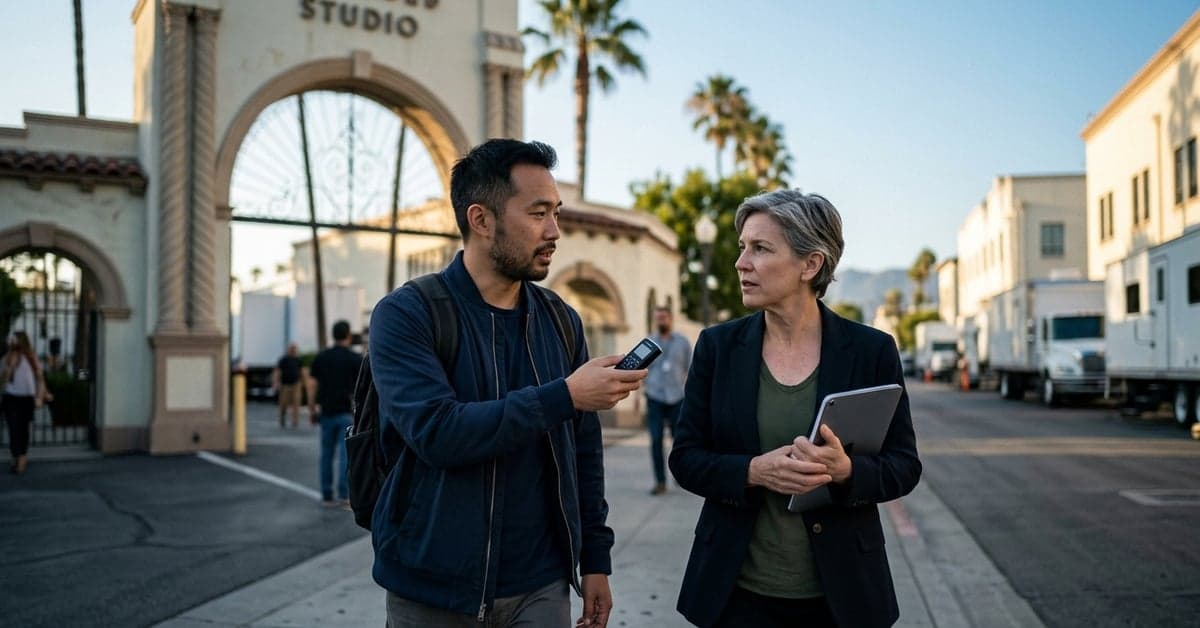
On July 5, 2026, TechCrunch reported that Midjourney wants Hollywood studios to reveal the details of their AI usage. The request, flagged by TechCrunch’s Anthony Ha, reframes a messy fight over generative tools into a straightforward demand: show your work.
Midjourney AI disclosure demand hits Hollywood headlines
By asking studios to spell out where and how AI shows up in production, the company is moving the spotlight from toolmakers to content buyers. According to TechCrunch, Midjourney’s position is that studios should be transparent about their own practices, not just call for guardrails on vendors. That simple shift matters, because the pressure point in Hollywood is now contracts, credits, and compliance, not just creative ethics.
The Midjourney AI disclosure push also aligns with how other parts of the media stack are evolving. Content provenance efforts such as the Coalition for Content Provenance and Authenticity (C2PA) aim to attach verifiable metadata to media files. If studios must disclose AI use anyway, provenance tech becomes less of a nice-to-have and more like an audit trail that can survive distribution. The incentive to adopt it grows once public and partner scrutiny turns from theory to paperwork.
Why transparency in AI use could reshape studio deals
Labor agreements already set some lines, and disclosures would give them teeth. The Writers Guild of America’s latest contract spells out how AI-generated material is treated and what writers can be asked to do. The union’s rules don’t ban AI outright, but they do create boundaries that depend on clarity about inputs and outputs. Readers can find baseline terms on the WGA’s contracts page.
Actors pushed for consent and compensation around likeness and voice. SAG-AFTRA’s materials explain how studios must secure permission before using digital doubles or training against a performer’s work. That again hinges on documentation—who did what, with which tools, under what terms. See the union’s TV/Theatrical resources at SAG-AFTRA for context.
The practical effect is clear: if disclosures become expected, studios will need a clean chain of custody for AI decisions. That spans everything from concept art prompts and dataset sources to how a background performer was replicated for a crowd scene. The Midjourney AI disclosure call accelerates that shift by placing responsibility where legal and reputational risk already lives—the studio ledger.
What disclosure might include, and what it won’t
TechCrunch’s headline doesn’t spell out the exact format of the requested disclosure. Taken at face value, though, it suggests a few reasonable buckets:
- Creative: where generative tools informed storyboards, design, or temp tracks.
- Production: how AI altered footage, faces, voices, or sets.
- Post and marketing: which assets were synthetically created or heavily edited.
- Rights and consent: whose data, likeness, or prior work trained or informed the result, and with what permission.
This isn’t a demand to expose trade secrets. Studios already share deep technical detail in awards campaigns and VFX breakdowns when it serves them. A disclosure standard would formalize that habit for AI, without forcing a studio to publish proprietary prompts or model configs. The key is scope: enough information for audiences, partners, unions, and regulators to understand the role AI played, and for disputes to be resolved faster.
There’s a ceiling, too. No disclosure requirement solves every concern about training data, market power, or creative credit. Those conflicts live in contracts, law, and bargaining. But a common disclosure layer would at least create a shared record, which tends to lower the temperature when arguments start.
How provenance tech could turn policy into practice
Provenance standards have matured while Hollywood argued over principles. The C2PA framework, adopted by major tech and media firms, lets creators attach cryptographically signed “content credentials” to images, audio, and video. A viewer can then inspect who created or edited a file and which tools were involved. Adobe’s coalition explains the concept well at Content Credentials.
If studios respond to the Midjourney AI disclosure push with policy alone, they’ll drown in spreadsheets. If they pair policy with provenance, they can embed machine-readable facts into the media itself. That makes audits faster, reduces finger-pointing across vendors, and gives streamers a way to apply consistent labeling without guessing.
The studio playbook here looks familiar: set a brief, insist on logs, mandate signed outputs, and reserve the right to sample raw material under NDA. VFX and post houses already live with similar requirements. Disclosure doesn’t reinvent the process. It extends existing quality control to a new class of tools.
What to watch next as the disclosure debate heats up
The next move will show whether this becomes industry practice or a week-long headline. Three signals to watch:
- RFP language: Do major studios and streamers start adding explicit AI disclosure clauses in vendor bids this quarter?
- Credit lines: Do awards campaigns and end-credit crawls adopt simple badges or lines flagging AI-assisted work?
- Platform policies: Do distributors require provenance metadata on delivery, the way they require caption files and QC reports?
If even one major buyer pushes for standard wording, the rest follow fast. Vendors won’t want a bespoke disclosure format per client. That could trigger a short, messy period while trade groups and unions converge on a shared template.
There’s risk for Midjourney, too. Calling for transparency invites scrutiny of its own policies and training data. But the gambit makes sense. The people with the most to lose from bad disclosure aren’t toolmakers. They’re the brands and studios shipping work to millions of viewers.
That’s why this story matters beyond a single headline on TechCrunch. Disclosures are how creative industries absorb new tech without breaking trust. The Midjourney AI disclosure push doesn’t settle every fight, but it points to a workable center: label what you did, prove it when asked, and keep receipts long enough to matter.
If Hollywood embraces that center, arguments over “AI or not” give way to clear expectations. And the next wave of deals will read a lot simpler: use what you want, but document it. That’s the test the Midjourney AI disclosure moment has put on the table. For more on this, see bloomberg.com and nytimes.com.
Related reading: AI Hardware • ChatGPT • AI Startups & Companies