
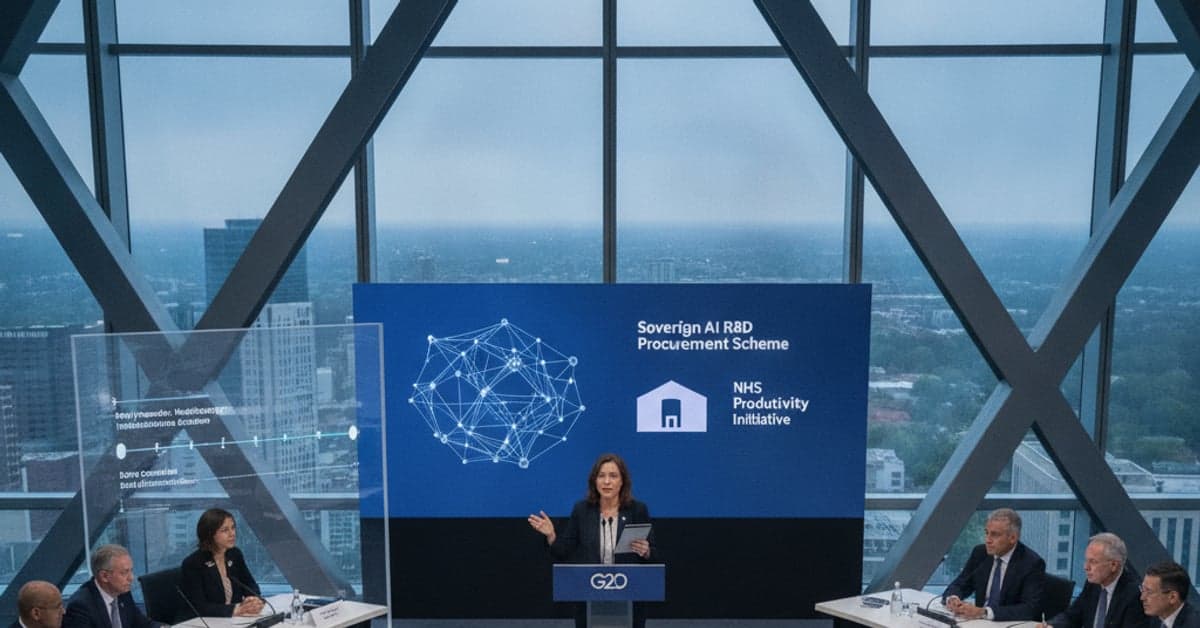
On August 31, 2026, the UK government launched a £100 million competition to buy AI prototypes for public services, shifting support from grants to demand-driven contracts. Announced at the G20 Finance Ministers meeting in North Carolina, the official release says the scheme targets NHS productivity, cyber and national security, and the computing infrastructure needed to power growth. Ministers also signalled plans to open the AI Economics Institute to cooperation with G7 countries.
How the Sovereign AI fund will work
The competition sits under the Sovereign AI R&D Procurement Scheme. In plain terms, departments will issue problem statements and place contracts for working prototypes, rather than hand out open-ended grants. According to the UK government’s announcement, the goal is to help British startups build solutions that slot into real services and scale faster.
R&D procurement is a known policy lever in the UK. Through the Small Business Research Initiative (SBRI), departments have run similar challenge-led buys for more than a decade, awarding phased contracts that de-risk early builds and move winners toward deployment. The SBRI model is documented by the government’s own guidance on challenge-based public procurement. The Sovereign AI fund leans on that playbook, but trains it squarely on artificial intelligence and compute.
Why this matters for founders: procurement creates a paying customer from day one. A contract beats a grant for market signal, because it comes with a buyer, a deadline, and a path into live systems. That is the core change embedded in this programme.
Where early contracts could land first
The release highlights three pressure points. First, cutting NHS waiting lists and improving care. NHS England’s performance pages show a sustained backlog and ongoing pressure on urgent and emergency services; the service publishes monthly trend data and operational metrics england.nhs.uk. Expect challenges around triage tools, scheduling, diagnostics support, and operational forecasting—areas where small gains can free staff time.
Second, strengthening national security and cyber resilience. The National Cyber Security Centre has issued guidance for building secure AI systems, including threat modelling, data handling, and model monitoring. Any supplier bidding into the scheme will need to show they can meet that bar; the NCSC’s secure AI development guidelines are the starting point. Projects that harden identity, detect anomalies, or reduce response times in security operations are likely candidates.
Third, investing in the compute layer that future services will rely on. The government frames this as a way to let strategically important British AI companies “start here, scale here, and win globally,” according to the announcement. That suggests contracts for software that improves utilisation, orchestration, or energy efficiency on domestic infrastructure—practical levers that free scarce capacity.
What R&D procurement buys that grants rarely do
Two practical differences stand out. Procurement contracts are tied to a defined use case and usually require in-situ testing with a public service team. That pushes suppliers to design for the realities of data access, legacy systems, and safety controls. It also anchors milestones to operational value, not just technical novelty.
The second is momentum. A phase 1 feasibility contract can move to a phase 2 prototype and then to a department-level rollout, without resetting commercial terms or governance each time. SBRI’s history shows that this path lowers adoption friction for smaller suppliers because procurement frameworks are already in place. If the Sovereign AI fund mirrors that cadence, successful pilots can graduate faster into real deployments.
There are risks. Poorly scoped challenges produce demos that don’t fit live services. Procurement cycles can drag if departments lack technical reviewers. Supplier payment terms matter for startups’ cashflow. The Cabinet Office has policies to speed payments down supply chains, such as prompt payment notes for public contracts; buyers running AI challenges should align with those rules to avoid avoidable strain.
International ties and standards
The Chancellor also said the UK plans to open the AI Economics Institute to international cooperation with G7 partners. While the release offers few details, this meshes with the G7’s ongoing Hiroshima AI Process on safety and governance, which aims to create shared expectations for testing and transparency. Background on that effort is summarised by the European Commission’s page on the G7 Hiroshima AI Process. If the Institute coordinates metrics or evaluation methods across governments, it could lower barriers for British companies selling abroad by aligning how results are measured.
Cross-border cooperation also matters for compute. Shared benchmarks for energy use, reliability, and model performance could inform public buyers in several countries. If the Sovereign AI fund outputs tools that meet those benchmarks, export wins become easier.
What to watch in the first wave of awards
Three signals will show whether the scheme is working. The first is specificity: clear, measurable challenge statements from departments. Vague briefs yield vague prototypes. Look for metrics like reduced appointment no-shows, faster threat triage, or higher cluster utilisation, expressed with baselines and targets.
The second is integration support. Even the best model will stall without data access, user testing time, and a route through security review. Departments that pre-book these steps will award stronger projects and hit service improvements sooner.
The third is continuity. If phase 1 winners can book follow-on contracts on predictable timelines, the market will view this as real demand, not a headline. That continuity is what will separate a photo-op from durable AI capability in the state.
According to the UK government, people “in every postcode” should feel the benefits as projects roll out. The promise is bold. The test is whether the first procurements under the Sovereign AI fund pick tight problems, fund usable prototypes, and clear the path to go live. If those pieces line up, startups get a faster route to revenue and citizens get services that work better. For more on this, see bloomberg.com and nytimes.com.