
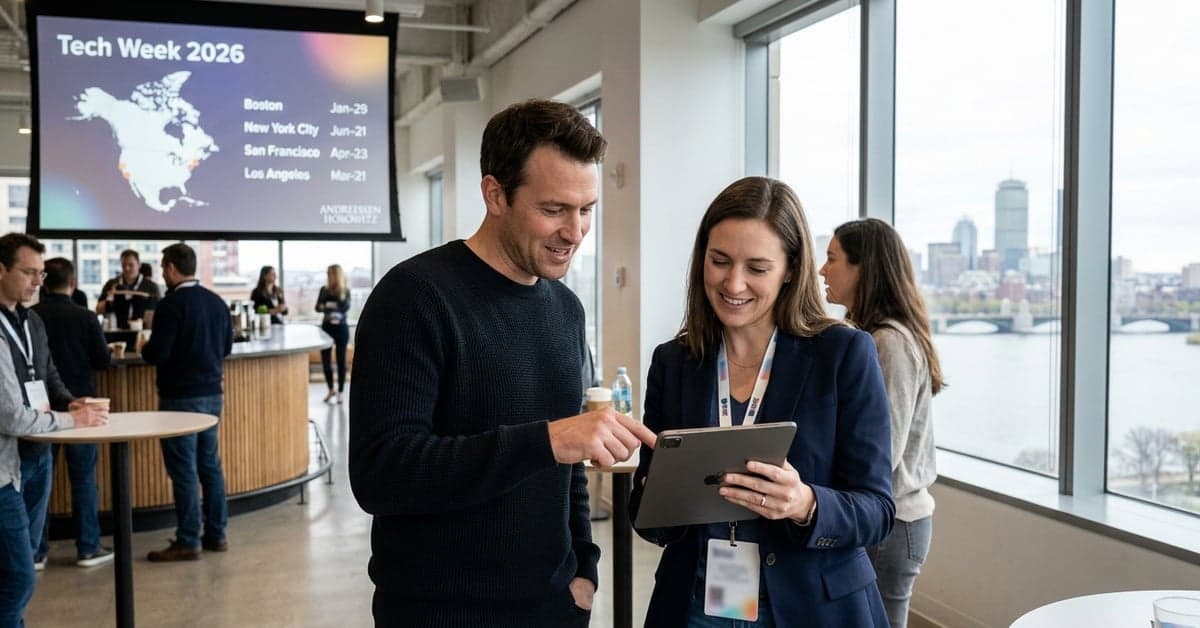
San Francisco will host Tech Week 2026 from October 5-11, with Los Angeles following on October 12-18. Boston joins the circuit on May 26-31, and New York City runs June 1-7, according to Tech Week’s official site. The decentralized series, presented by Andreessen Horowitz (a16z), is keeping its citywide, many-hosts format and has opened submissions for SF and LA events.
The dates and cities for Tech Week 2026
Tech Week 2026 stretches across four hubs: Boston (May 26-31), New York City (June 1-7), San Francisco (October 5-11), and Los Angeles (October 12-18). As the organizer explains, the series isn’t a single venue conference. It’s hundreds of individually run gatherings across each city, from hackathons to panels to meetups, all curated under one umbrella by a16z. Last year, the site says the Bay Area and Los Angeles combined for more than 1,000 events.
The lineup of featured speakers on the Tech Week site signals a mix of big-company operators and startup builders: IBM CEO Arvind Krishna, HubSpot co-founder Brian Halligan, WHOOP founder Will Ahmed, and Twitter co-founder Biz Stone. It also lists founders and investors tied to the firm and its network, including Deel’s Shuo Wang, Runway’s Cristóbal Valenzuela, Toast co-founder Steve Fredette, and a16z partners such as David Haber, Anish Acharya, Jorge Conde, Seema Amble, Bryan Kim, and Jonathan Lai. The names help set expectations for the kinds of conversations likely to headline throughout Tech Week 2026.
Why a16z’s Tech Week bets on decentralization
Tech Week pitches itself as a “decentralized tech conference,” which matters because it flips the usual conference equation. Instead of one expo hall with a stage and a badge, the programming fans out across neighborhoods and hosts. The official FAQ stresses that each event is organized by a startup, company, or VC, while the central team vets submissions and helps with discovery. The format lowers the barrier to host, and it can create tighter networking loops for specific sub-sectors.
Contrast that with mega-shows that concentrate attention under one roof. Paris-based VivaTech reports 200,000 attendees, 4,500 exhibitors, and more than 15,000 startups. That scale produces international visibility and heavyweight keynotes. But it also favors companies with the budget to exhibit, and it can be harder for niche communities to find momentum inside a sprawling floor plan. Tech Week 2026 is staking the opposite bet: lots of smaller rooms, faster serendipity, and a denser graph of investor-founder meetings city by city.
The roots of this approach echo the community-driven movement popularized by Techstars through Startup Week and Startup Weekend, where local organizers energize a city with dozens of sessions rather than one centralized show. a16z adds something different—its deal flow, partners, and institutional reach—to pull more investors and late-stage operators into the mix. That combination is the part to watch as Tech Week 2026 rolls through Boston, NYC, SF, and LA.
What the model means for founders and investors
For founders, the decentralized format changes how to win time with the right people. Calendars matter more than booths. The best outcomes tend to come from a string of targeted gatherings—product breakfasts, seed-stage roundtables, evening showcases—rather than a single keynote. Since Tech Week 2026 is accepting event submissions, the leverage point sits with those who craft sharp, invitation-worthy sessions with specific attendee profiles.
Investors gain another kind of filter. A dense week of concentrated, topic-led meetups makes it easier to spot signal within a theme and to see how a team engages outside a pitch deck. That was visible in prior years’ city weeks, according to Tech Week’s own framing of the series as a place to “meet new investors” and “get seen.” The SF and LA October dates extend that thesis into the fall funding cycle, after the Boston and New York weeks test audience appetite in late spring and early summer.
The trade-off is fragmentation. Without a single anchor venue, attendees need to work harder on discovery and logistics. The Tech Week site functions as a directory, but quality will vary across hundreds of rooms. That variability is the point and the risk. Great small events can punch above their weight. Weak ones vanish without much cost. The model rewards specificity and curation more than spectacle.
How Tech Week 2026 stacks up against mega-shows
On reach, centralized conferences still win. VivaTech’s published numbers dwarf any single-city week. Global brands and governments plan their year around those stages, which is why the biggest product reveals tend to land there. On depth, a distributed week like Tech Week 2026 can excel. It allows multiple micro-markets to convene in parallel—fintech in SoMa, bio in Mission Bay, game tools on the Peninsula—while LA hosts creator economy meetups closer to studios a week later.
The economics differ too. Expo floors monetize square footage, sponsorship tiers, and mass foot traffic. A decentralized format shifts spend into smaller venues, content-led sponsorships, and curated attendee lists. For startups, that can make participating cheaper and more targeted. For bigger brands, it creates dozens of chances to be relevant in context, though it lacks the spectacle of a 10,000-person keynote.
What to watch before October
Two things will determine the shape of Tech Week 2026. First, the event pipeline. Submissions for San Francisco (October 5-11, 2026) and Los Angeles (October 12-18, 2026) are open on the official site, and the balance of public versus invite-only sessions will set the week’s character. Second, the caliber and diversity of hosts. If more operators and customers step up alongside VCs, the weeks will feel less like a tour of investor lounges and more like a citywide lab.
There’s room here for both models—mega-shows that aggregate the world and city weeks that compress a network into a neighborhood. The Tech Week 2026 approach signals that founders and investors want more shots on goal, closer to where they work, with less time lost to expo sprawl. October in SF and LA will test how far that thesis can scale. For more on this, see bloomberg.com and nytimes.com.