
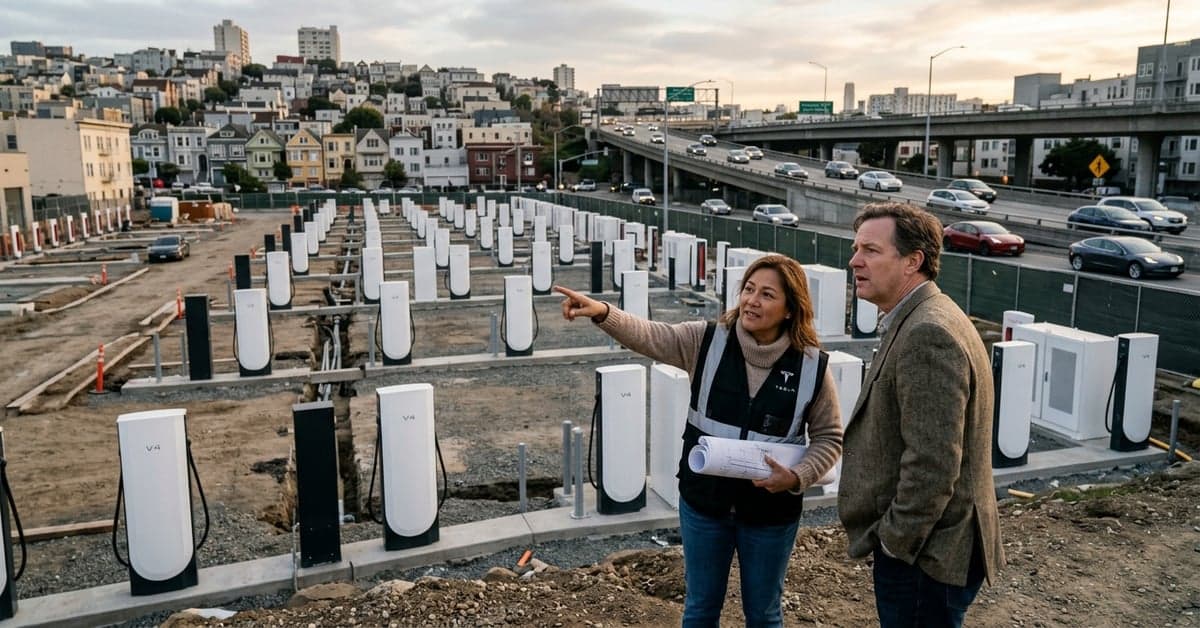
Tesla has filed plans for a 124-stall V4 Supercharger hub at 75 Waterloo Street in San Francisco, a site along Highway 101 near Alemany and Bayshore. According to Business Insider on August 14, 2026, the proposal would rank among Tesla’s largest globally and is unusual for a dense, high-cost urban core. The company also has a separate application for a 35-stall site at 25 Mason Street downtown, per the same report.
Why the Tesla 124-stall Supercharger lands in SF
This footprint signals a shift in where charging capacity is going: closer to drivers who can’t plug in at home. San Francisco has high apartment density, scarce garages, and heavy ride-hail activity. A megasite near a freeway on-ramp serves all three. It also offers a hedge against reliability complaints that surface when a handful of bays fill and queues form. By building big, Tesla raises the odds that a driver can pull in, charge, and leave without a wait.
There’s a strategic backstory too. On April 30, 2024, Reuters reported Tesla laid off much of its Supercharger team, prompting questions about its buildout. Weeks later, the company recommitted to expansion. A sprawling hub in the city center is a concrete expression of that pivot, aimed at visible, high-throughput use rather than incremental adds at the margins.
How a V4 Supercharger site changes who plugs in
The Waterloo Street plan is for V4 hardware, Tesla’s latest Supercharger generation. Bigger cabinets and longer cables are designed to better accommodate different vehicle inlets and parking layouts. That matters because the network is no longer just for Teslas. In 2024 and 2025, most major automakers committed to the North American Charging Standard, later formalized as SAE J3400, paving the way for broad cross-compatibility. SAE detailed the standard’s publication on its site, strengthening the case for a single connector in North America (SAE International).
For a city station, that mix is the point. A large, centrally located hub can capture Tesla drivers, NACS-equipped newcomers, and adapters in the interim. The more brands that can plug in, the more revenue-hours a site can support—critical in a city with premium land and construction costs.
Throughput, grid, and the users who stand to gain
Scale changes the math. If an average fast-charge session runs 30 to 40 minutes, a 124-bay site could realistically turn over each stall 1.5 to 2 times per hour during peaks. That’s on the order of 180 to nearly 250 vehicles per hour in a stretch, assuming clean handoffs. Even at conservative utilization, that’s thousands of sessions per day—enough to materially reshape where and when San Franciscans charge.
The first beneficiaries are drivers without home charging. Apartment dwellers can plan a weekly top-up on a reliable schedule, rather than threading short hops at scattered curbside plugs. Ride-hail drivers—already under time pressure—gain a near-101 stop with a high chance of an open stall. Uber has said it aims for 100% zero-emission rides in the United States and Canada by 2030, which places a premium on dependable public DC fast charging in cities (Uber sustainability).
Large urban hubs also raise practical questions: transformer placement, nighttime traffic patterns, and local noise. The build will depend on timely utility interconnection and smart load management to prevent neighborhood bottlenecks. California’s policy push for more public fast charging suggests the grid-side coordination is doable but must be sequenced carefully with utility upgrades and on-site energy management (California Energy Commission).
What Business Insider’s reporting tells us about the bet
Business Insider’s permit review puts the Tesla 124-stall Supercharger at a triangular vehicle storage lot, near the Alemany and Bayshore merge. That’s a logistics-friendly parcel with freeway visibility and fast in-and-out turns. The comparison to a 35-stall site planned for 25 Mason Street underscores a two-pronged approach: one mega-hub to mop up regional demand and a smaller downtown node to relieve localized pressure and give tourists and hotel guests an option in the core.
It’s also a shot across the bow for rival networks. Concentrating 100-plus fast-charging points in one urban location sets a new bar for uptime and availability. Competing providers will either cluster capacity in similar hubs or risk ceding city-center volume to Tesla’s network, especially as more non-Tesla models carry NACS from the factory.
What a mega-hub means for SF drivers next
If built as proposed, the Tesla 124-stall Supercharger would become a keystone site for the city’s EV ecosystem. Expect shorter wait times during peak weekend hours, stronger support for airport runs and late-night shifts, and a clearer path for buyers without garage access. The location also gives visitors a reliable fast-charge option close to major arteries, which reduces detours through residential streets.
The larger signal: a return to scale. After a turbulent 2024 for the Supercharger program (Reuters, April 30, 2024), a city-center build of this magnitude shows where Tesla thinks public charging earns its keep—dense, predictable demand with plenty of cross-network traffic under SAE J3400. If the Waterloo Street hub hits high utilization, expect more urban sites to follow the template, in San Francisco and beyond.
That’s the takeaway for drivers: plan on a faster, more reliable public fast-charge option inside city limits. For networks, the message is starker. Big-city fast charging is moving from scarcity to scale, and the projects that win will look a lot like Waterloo Street. For more on this, see reuters.com.