
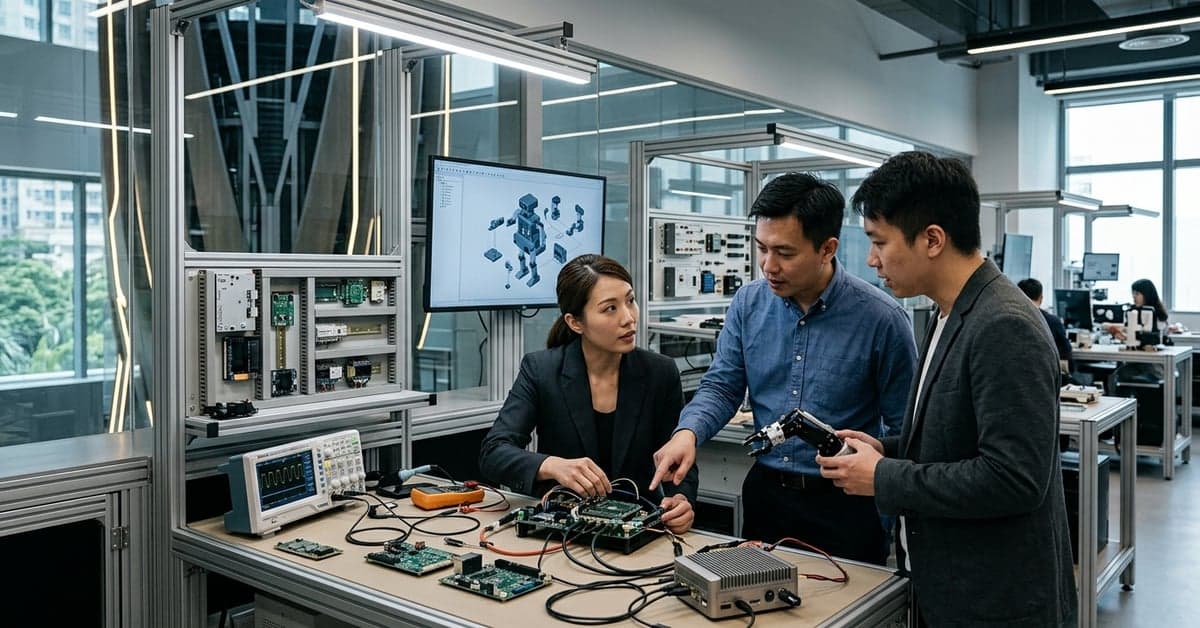
On September 17, 2026, Avnet and The University of Hong Kong (HKU) opened the Emerging Microelectronics and Ubiquitous Systems (EMUS) Lab at the Data Technology Hub in Tseung Kwan O InnoPark. The goal is blunt and practical: turn lab‑grade edge AI and robotics concepts into production‑ready devices. According to Avnet’s press release, the center pairs research with engineering support and a global supply chain, a mix that could make EMUS Lab Hong Kong stand out where most AI hubs still focus on software alone.
What opened and where
EMUS sits inside the Data Technology Hub (DTH) at InnoPark, part of the Hong Kong Science and Technology Parks (HKSTP) network. The press statement says the lab targets edge AI, physical AI, robotics, high‑performance computing, and emerging microelectronics. The location matters. DTH concentrates digital and data‑heavy businesses and offers space designed for R&D and light‑scale production, aligning with Hong Kong’s push to grow advanced manufacturing. HKSTP describes the hub as a link between research and industry in the city’s east side technology corridor, giving teams closer access to facilities and partners needed for hardware scale‑up. Readers can see how DTH fits into HKSTP’s broader plan on its official page.
Avnet brings its distribution network and engineering bench to the table, while HKU anchors the academic research side. The lab also plugs into element14—Avnet’s proof‑of‑concept arm known for prototyping resources—which widens access for early builds and evaluations. That mix aims to shave weeks off the cycle between a working demo and a manufacturable product.
How EMUS Lab Hong Kong tackles hardware roadblocks
The press release outlines support that hits the pain points founders face after a successful demo: design reviews, GPU access, prototyping, and supply chain planning. In one place, the lab offers:
- Engineering consultation and manufacturability assessments
- GPU computing resources for training and validation
- Prototyping and design‑for‑manufacture reviews
- Supply chain expertise spanning sourcing, alternates, and compliance
That list signals a focus on the last mile of commercialization. Many AI centers prioritize data, models, and cloud. This one targets the messy middle where hardware projects stall: component selection, certification, pilot production, and sustaining supply for the second and third build lots. Pairing those steps inside the same workflow is the real experiment here.
Edge AI—running inference on devices—raises the stakes. Compute footprints, power budgets, thermal limits, and latency targets collide with enclosure design and bill‑of‑materials choices. IEEE Spectrum’s overview of edge AI underscores why pushing intelligence into devices is hard but necessary for privacy, latency, and bandwidth reasons. The EMUS playbook, as presented by Avnet, goes where those constraints live: at the board, firmware, and component‑lifecycle levels.
Why Avnet’s supply chain matters for edge AI
Avnet sits inside the flow of parts and partners, which is where risk accumulates for AI hardware. Lead times slip. A sensor gets end‑of‑lifed. The only available memory part runs hotter than expected. According to the company’s announcement, EMUS responds with early manufacturability reviews, production‑grade prototyping support, and design chain services intended to prevent rework later.
There’s a second lever: element14. Early‑stage teams can tap its community and prototyping tools to shake out integration issues before money and time lock in. The element14 portal details how it backs proofs of concept and evaluations for engineers; see its community site for the kinds of builds and parts it surfaces. If EMUS routes those early wins directly into Avnet’s sourcing and compliance channels, founders avoid the common trap of redesigning around unavailable components just as pilots begin.
Locating the facility at DTH also lines up with Hong Kong’s stated ambition to lift advanced manufacturing and re‑industrialization. The city’s 2022 Innovation and Technology Development Blueprint set that direction and emphasized closer industry‑academia ties and tech transfer. The government’s overview of that strategy is available via the Innovation, Technology and Industry Bureau’s official site. For a hardware‑first AI lab, that policy context isn’t background—it’s the demand signal.
What startups should watch next at the HKU–Avnet EMUS hub
The near‑term test is simple: how many prototypes exit the lab as pilot runs within a quarter, and how many of those clear certification and sustain parts supply across revisions. Time‑to‑first‑build and time‑to‑first‑sale are the two numbers that show whether this model works. The press release mentions access to GPU compute and prototyping support; the impact shows up when a robotics controller ships from a small run to a paid deployment without a board respin.
Founders should also watch where the lab draws boundaries. Will EMUS support radio certifications and safety testing coordination, or hand teams off after DFM review? Will it maintain alternate component trees for critical parts and help with lifecycle planning as products scale? Avnet runs those services globally; the value in Hong Kong rises if they’re integrated and local.
Another point to track is how the lab handles mixed hardware‑software cycles. Edge AI products often require model updates and firmware tweaks after customer pilots. A tight loop between the lab’s compute resources and its prototyping benches could shorten that cycle—say, a model retrained on new data, quantized, and redeployed to an updated board image within days, not weeks. If EMUS achieves that, it strengthens its claim as a commercialization engine rather than a showcase space.
For researchers, the upside is different. A lab attached to a distributor can turn a paper’s reference design into a manufacturable kit and a sample BOM with validated alternates. That invites industry partners who won’t commit to pilots without a clear path to parts and compliance. For startups, it’s the difference between a demo that draws applause and a unit that ships.
It’s also worth noting the fit between the lab’s remit and the city’s infrastructure plans at InnoPark. HKSTP positions the Data Technology Hub as a base for data‑centric and advanced tech businesses with space tailored for production‑adjacent R&D. If EMUS pipes successful projects into nearby facilities for pilot manufacturing and test, the geography compounds the benefit. The DTH overview gives a sense of the facilities on offer.
None of this guarantees success. It does set up a cleaner path from a lab bench to a shipping device. The differentiator isn’t a single shiny feature; it’s the choreography between design reviews, compute, prototyping, and parts availability. If those steps line up, EMUS Lab Hong Kong could become the place where edge AI and robotics teams in the city go from idea to build without losing months to supply snags.
Avnet’s announcement frames the opening as a shared effort across academia and industry, with HKU and the lab’s partners present at the ribbon‑cutting. The full details are in the company’s press release. The next update that matters: evidence of shipped pilots and faster cycles for edge devices. If those arrive, expect more teams to route their first builds through this HKU–Avnet pipeline—and for EMUS Lab Hong Kong to become a fixture in the city’s AI hardware story. For more on this, see bloomberg.com and nytimes.com.