
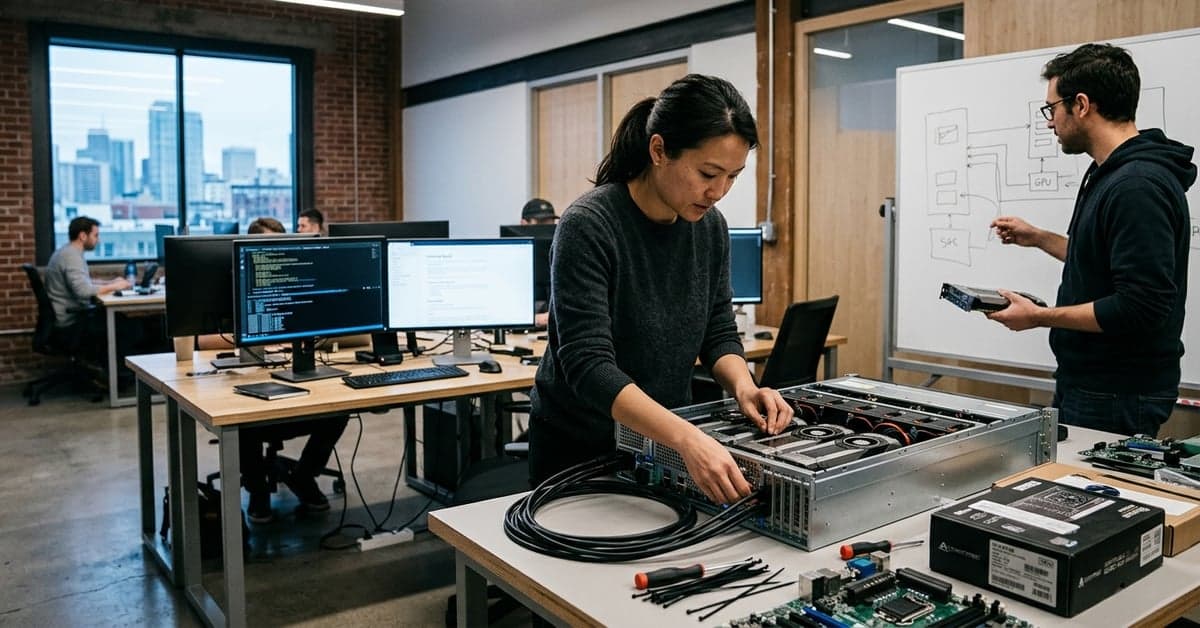
8,300 GitHub stars for a16z’s open-source AI Town project say one thing clearly: founders want to build more in-house. On its AI hub, Andreessen Horowitz lays out how to assemble and run your own GPU box and claims it means “no API calls to external services, no data leakage, and no usage throttles.” Harvard Business Review, by contrast, warns that AI rollouts are crushing middle managers. Put together, these signals point to a new fault line for AI startups: moving fast on infrastructure without breaking the organization.
Why startup GPU servers are back on the table
a16z’s AI page highlights a walk-through for “Building an Efficient GPU Server,” and a hands-on workstation build using NVIDIA GeForce RTX 4090s and 5090s. The pitch is simple: own your compute, cut uncertainty, tighten data control. The repository slate linked from that page — from AI Town to a companion-app stack — gives founders working examples for running agents and apps on local hardware. For teams chafing at variable cloud queues and rate limits, the appeal is obvious.
The hardware side is also easier to grasp now. Consumer-class GPUs like the GeForce RTX 4090 can shoulder many inference workloads, and even modest fine-tuning with the right tricks. When cloud costs spike without warning, a rack under your control looks safer. Cloud remains vital for bursty training runs, of course; providers sell purpose-built instances such as AWS’s P5. But the investor conversation is shifting toward a blend: keep long jobs in the cloud, bring steady inference and sensitive data in-house. That blend is where startup GPU servers enter the plan.
Owning GPUs changes the operating plan
HBR’s editors have been blunt about the organizational load from AI. One headline puts it plainly: “AI Adoption Overloads Your Middle Managers,” describing how managers get squeezed between executive ambition and the day-to-day reality of new tools (Harvard Business Review). Another piece dissects what happens “When Employees Are Held Accountable for AI-Generated Decisions.” These aren’t abstract worries. Once a team runs models on-prem, responsibility concentrates. There’s no vendor to lean on for throttles, privacy defaults, or uptime guarantees. The runbook, the patches, the rollback — all land inside the startup.
That shift is operational, financial, and cultural. Operational, because GPUs demand power, cooling, monitoring, and incident response. Financial, because a capital purchase looks cheap until you count staff time, spares, and the cost of downtime. Cultural, because a model’s outputs feel less like a service and more like a decision the team owns. With startup GPU servers in the mix, these tensions rise, not fall.
What investors should now vet about founder-owned compute
Investors will keep funding teams that control their fate. But the diligence bar moves from model demos to operating discipline. Based on a16z’s DIY stance and HBR’s caution on organizational strain, the most telling questions now cut across engineering and management:
- Cost model accuracy: Does the team compare all-in local capex and opex against steady-state cloud costs, including spares and staff time?
- Uptime and safety nets: Are there redundant power, cooling, and failover plans? Who owns incident response at 2 a.m., and what’s the target recovery time?
- Security and data control: How are secrets, weights, and customer data stored and audited on-prem? What process handles access and key rotation?
- Model governance: Who approves model updates, and how are rollbacks tested? How are hallucinations, bias, and safety filters monitored on local stacks?
- Team load and training: Which managers take on the new work? How are they resourced, and what gets deprioritized to make room?
- Cloud interop: Can the team burst to cloud cleanly for big jobs, then pull artifacts back without drift or dependency lock-in?
On the upside, investors gain clarity. A team that answers these questions crisply is likely to ship. A team that waves them away will burn time in hidden operations work, the very “invisible” load HBR describes. In short, startup GPU servers don’t just change unit economics; they expose whether a company can run systems, not just build models.
How the DIY ethos meets accountability risk
The DIY posture that a16z champions has real benefits. Local inference can cut latency and shield data from vendor pipelines. It also makes experiments cheaper and faster. But HBR’s throughline on accountability looms: when an AI output hurts a customer, who signs for it? With a homegrown stack, the answer is seldom “our provider.” It’s the product lead, the engineering manager, and, sometimes, the CEO.
That’s why policies and logs matter as much as FLOPS. If a model decision drives a financial or medical recommendation, the company must trace the version, the prompt, the weights, and the guardrails used. Teams that run on-prem need the same auditability they’d demand from a vendor. a16z’s open projects — from the companion app stack to starter kits — help teams learn by doing. To stand up in diligence, they also need to show process: documented change control, routine red-teaming, and a way to pause or degrade gracefully when things go wrong. Those practices keep DIY speed from turning into DIY liability, both for founders and for backers.
The near-term test for founder-owned compute
For the next wave of AI startups, the question isn’t cloud or on-prem. It’s whether the company can match its technical ambition with operating maturity. a16z is right that control over compute can reduce reliance on external gates. HBR is right that the burden will land on managers unless leaders redesign work and expectations. Investors who synthesize both views will spot stronger teams sooner, and avoid the costly mirages.
Expect term sheets to ask for more than throughput graphs. Expect heat maps of datacenter closets, call trees for incidents, and proof that a product team can say no to one more model without blowing a release. Those are healthy asks. They shift the conversation to repeatable delivery, responsible decision-making, and clear ownership — the ingredients that turn startup GPU servers from a shiny box into a lasting edge. For more on this, see developer.nvidia.com and reuters.com.