
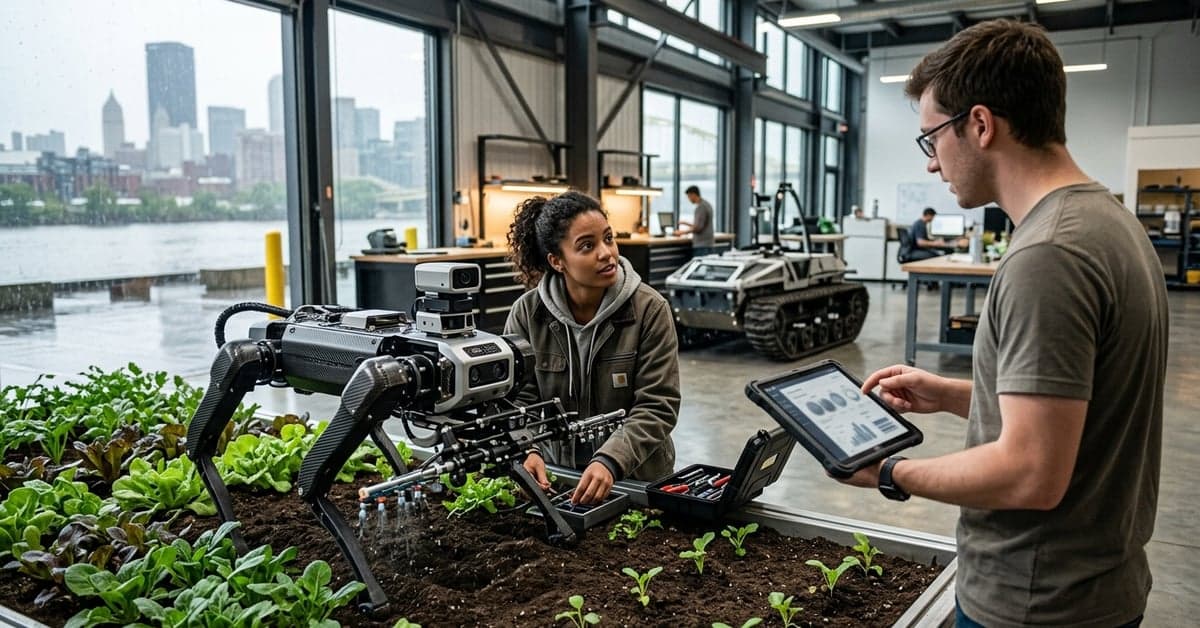
Summer 2026: YC Requests for Startups spotlights AI pushed into the physical world and a specific call for low‑pesticide agriculture. That brief lines up with Pittsburgh’s strengths in field robotics, computer vision, and applied engineering. The region has the talent, the test beds, and nearby growers who need practical tools now.
What YC Requests for Startups is pushing now
Y Combinator’s Summer 2026 list says AI is no longer a feature but “the foundation,” and it highlights ideas that pair perception with action. The entry on “AI for Low‑Pesticide Agriculture” argues that computer vision can identify individual weeds and pests in real time, while robotics makes precision treatment possible. It’s a shift from blanket spraying to plant‑level decisions. The same page warns that overreliance on chemicals is hitting limits and costs are rising for farmers.
Those points matter because they define solutions with clear, measurable outcomes: fewer liters sprayed, healthier soil, and higher yields per input. YC’s call prizes speed to working prototypes, then fast iteration in the field. That’s the playbook many Pittsburgh teams already know from autonomous systems work.
Why Pittsburgh’s robotics bench fits the Y Combinator RFS
Pittsburgh’s edge begins with deep technical training and decades of field deployments. The Carnegie Mellon Robotics Institute and the National Robotics Engineering Center built and shipped robots that survive rain, dust, and uneven ground. That know‑how—sensing, actuation, ruggedization—maps cleanly to the weeding, scouting, and targeted spraying concepts YC is promoting.
The city also has a dense network of engineers who have tuned vision systems outside the lab. Orchard aisles, vineyard rows, greenhouses, and dairy operations are less forgiving than benches or warehouses. Teams here learned to stabilize cameras, train models on messy data, and design serviceable hardware. Those are the same constraints an agtech startup will hit on day one.
YC Requests for Startups adds urgency by tying vision and robotics to an outcome farmers can value right away: reduced chemical inputs with the same or better yields. That concrete metric gives founders a crisp sales story and a simple pilot success criterion. Pittsburgh founders know how to turn that kind of constraint into a test plan.
Where early wins could land for the YC brief
Three practical entry points stand out. First, row‑crop spot spraying platforms that retrofit onto common rigs. Vision models ride alongside existing booms, firing valves only when a weed is present. That path avoids selling a whole new tractor. Second, orchard and vineyard scouts that score disease pressure leaf by leaf. Carts or small rovers could scan rows and push maps to growers overnight. Third, greenhouse tools that track plant stress and growth, turning daily rounds into structured data that improves recipes.
The Greater Pittsburgh region sits near working farms, orchards, and greenhouses across Pennsylvania and Ohio. Extension services such as Penn State Extension can help connect pilots to real operations. For teams building orchard or greenhouse tools, a few hours’ drive can translate into weekly field time and faster iteration. That’s a crucial edge when data quality and user feedback make or break a model.
On the financing side, the U.S. Department of Agriculture’s National Institute of Food and Agriculture funds research and commercialization programs that can complement seed capital. Blending non‑dilutive grants with venture funding helps cover sensor, rig, and field trial costs—often the most painful spend for hardware‑heavy startups.
YC Requests for Startups also implicitly rewards go‑to‑market creativity. Selling software subscriptions tied to acres scanned, liters saved, or disease events flagged gives growers a way to benchmark ROI. Hardware can be offered as install kits or field‑service plans instead of big one‑time purchases. That mix matches how many growers buy today and reduces sticker shock.
How Pittsburgh teams can move fast without overspending
Borrow what works from autonomy playbooks. Build a tight perception stack first, then automate actuation after data proves value. Use existing implements as the host platform. Keep the bill of materials simple. Those choices keep iteration cycles short and capital needs lower while you validate the core model.
Tap mentors with field‑hardened robotics experience around campus labs and alumni networks. Early design reviews from engineers who have shipped outdoors will save months. On the hiring side, cross‑train software and hardware generalists rather than stacking siloed roles too early. That blend keeps the team nimble when a sensor mount or lighting tweak unlocks a model gain.
The pilot plan should be explicit about failure modes: false positives, spray latency, occlusions, night operation, and maintenance needs. Tie each to a metric that improves week to week. Record every miss in a simple taxonomy so the dataset grows with real edge cases. That discipline is dull, but it’s how field robots stop surprising customers.
Partnerships can lower risk, too. Local growers get early discounts and responsive support; founders get labeled data and brutal feedback. Regional manufacturers can fabricate mounts and enclosures fast. Universities can support controlled trials that isolate variables and speed model tuning.
What success looks like if founders answer the call
A strong Pittsburgh response would produce a few visible proofs within months: a retrofit kit that halves herbicide use on a test plot, a scout that flags disease hot spots before they spread, and a dashboard growers can trust. Each win becomes a reference account and a data flywheel.
The timing helps. The YC framing centers on practical, shippable systems. That rewards the kind of gritty engineering the city is known for. With pilots close to home, a steady stream of labeled data, and a subscription priced to match savings, a team can cross the chasm from demo to dependable tool.
If founders here take the YC Requests for Startups brief seriously—and build for the row, not the slide—Pittsburgh can turn its robotics talent into durable agtech companies. The opportunity is specific, measurable, and within driving distance. For more on this, see bloomberg.com and nytimes.com.