
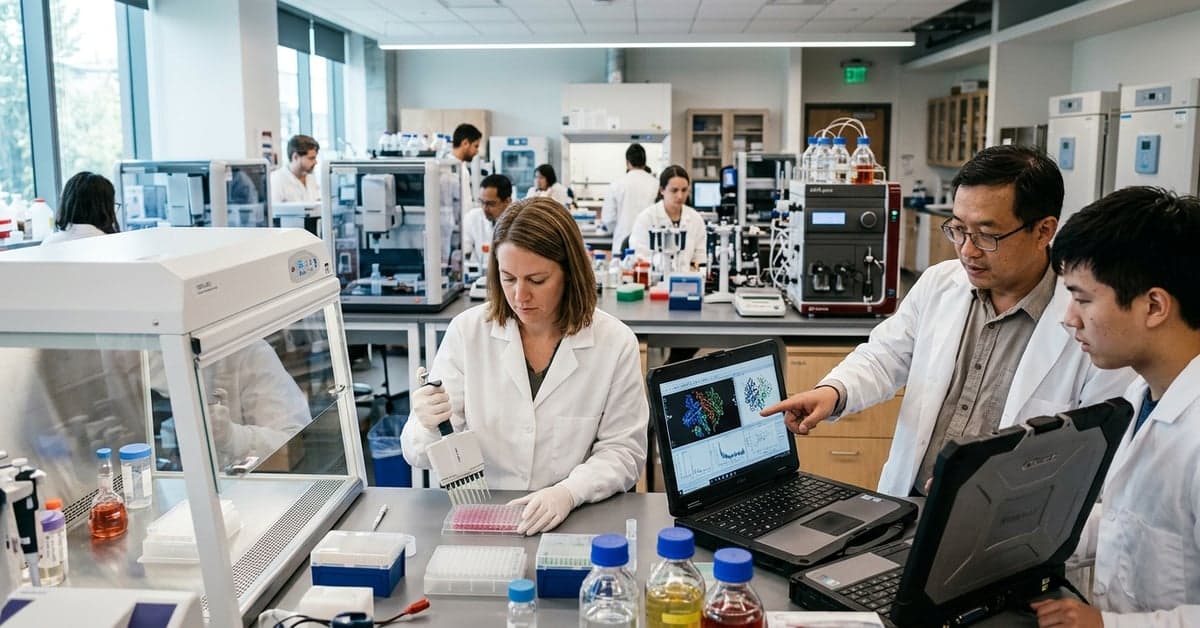
On September 3, 2026, the University of Washington announced the AI BioDesign project, a $95 million effort to model nature’s design rules and turn them into usable biological tools. According to the UW newsroom release, the collaboration brings together the Allen Institute, UW, and Fred Hutch Cancer Center, with funding from FFST. The team plans to release open models, datasets, assays, and lab methods to help others build new enzymes, therapeutics, and even low-power biological computers.
Inside the AI BioDesign project’s open-science bet
The partners say they will couple AI training with large, repeatable wet-lab experiments, then share the resulting models and assays. The Allen Institute’s track record in open science, which spans large-scale brain and cell atlases, suggests the new program will push for public releases across the stack. Readers can explore the institute’s approach to tool sharing on the Allen Institute site. Fred Hutch, a co-lead on the project, brings oncology and immunology depth that could shape early disease-focused tests; its translational focus is outlined on the Fred Hutch home page.
Open releases matter for more than credit. They reduce duplication, let smaller labs check claims, and create a shared testbed for faster iteration. That approach also aligns with the NIH Data Management and Sharing Policy, which has nudged U.S. life sciences toward wider access to datasets and methods since 2023. If the AI BioDesign project posts its assays and trained models as promised, it could turn boutique techniques into common lab work.
“For the first time, the speed of AI is beginning to match the experimental power of synthetic biology,” said David Baker, who leads the effort, in the UW announcement. That pairing is the key. AI can search a vast design space; high-throughput assays can verify hits and fix failure modes the models miss.
Why modeling nature’s rules could reset biodesign
The pitch is simple but ambitious: learn the rules biology uses to build life, then apply them. The UW release frames today’s biology as one slice of what’s possible, compared with the trillions of DNA sequences that could exist. That gap is an invitation to design, not just to catalog.
Predictive systems changed the field once already. DeepMind’s AlphaFold, hosted with EMBL-EBI, put more than 200 million predicted structures into the public AlphaFold Database. Those resources helped scientists understand proteins they could not resolve in the lab. But prediction is only half the game. Designing new molecules that fold, function, and survive in cells requires rules, constraints, and feedback loops that a static predictor cannot supply alone.
This program targets that design gap. If models can learn which sequence motifs drive binding, stability, or catalysis, then assays can stress-test those ideas across thousands of candidates. Iterating between the two could turn vague principles into working parts.
What past efforts teach: from AlphaFold to protein design labs
AlphaFold and related tools showed that opening core resources shifts the whole field. Labs worldwide tapped public predictions instead of building their own from scratch. The AI BioDesign project extends that logic to the act of invention itself: not only seeing what exists, but proposing what should be built next and sharing the playbook.
There is precedent at smaller scale. University of Washington teams have published methods for de novo protein design, which seeded community tools and inspired startups. The difference here is scope and tempo. Large, standardized assays can produce training data fast, help models learn causal patterns, and reject glitzy failures early. If that cycle runs in the open, other groups can contribute their own measurements, add corner cases, and fork the models for new targets.
That approach could also check a quiet trend in pharma AI: breakthroughs trapped behind closed consortia. A shared baseline lowers the barrier for academic labs and small biotechs. It also makes it easier to spot errors, because many eyes can test the same code and protocols.
What success would change for researchers and startups
If the AI BioDesign project delivers, three changes follow. First, standard assays become common currency. Labs could compare results across sites because the protocols and evaluation code match. Second, model updates tie to real-world benchmarks, not demo picks, which should raise confidence among industry partners and regulators. Third, an open ecosystem might shift where value accrues: from owning black-box models to mastering problem selection, clinical translation, and manufacturing.
- Drug programs might move earlier from target ideas to validated leads, because assays flag dead ends fast.
- Environmental tools, like enzymes for plastic breakdown, could be screened against realistic substrates and contaminants, not only neat lab surrogates.
- Biological computing parts could be judged on power, noise, and longevity in living systems, rather than only in vitro logic tests.
None of this removes the need for safety review. Open assays and models raise real governance questions about dual use, even as they speed good work. But broad access also distributes oversight. When more groups can reproduce a result, weak claims fail faster, and strong ones gain support.
The collaboration’s partners give it reach. The Allen Institute brings experience building shared platforms. Fred Hutch can steer disease-relevant tests and clinical logic. UW can knit the engineering with the biology. If those strengths align with open releases and steady assay cadence, the program could become the field’s reference set.
What to watch next if AI BioDesign delivers on pace
Two signals will show whether the idea is working. Look for frequent public model snapshots tied to new assay batches, and for outside labs building on them within months. Watch also for negative results posted with the same energy as wins, because they sharpen the rules and save others time.
The promise reads big because it is. But the outcome will hinge on rhythms: regular data drops, frank error reports, and design challenges that track real needs, not only glamour goals. If the AI BioDesign project keeps those beats, open biodesign could go from pledge to practice. For more on this, see reuters.com and bloomberg.com and nytimes.com.