
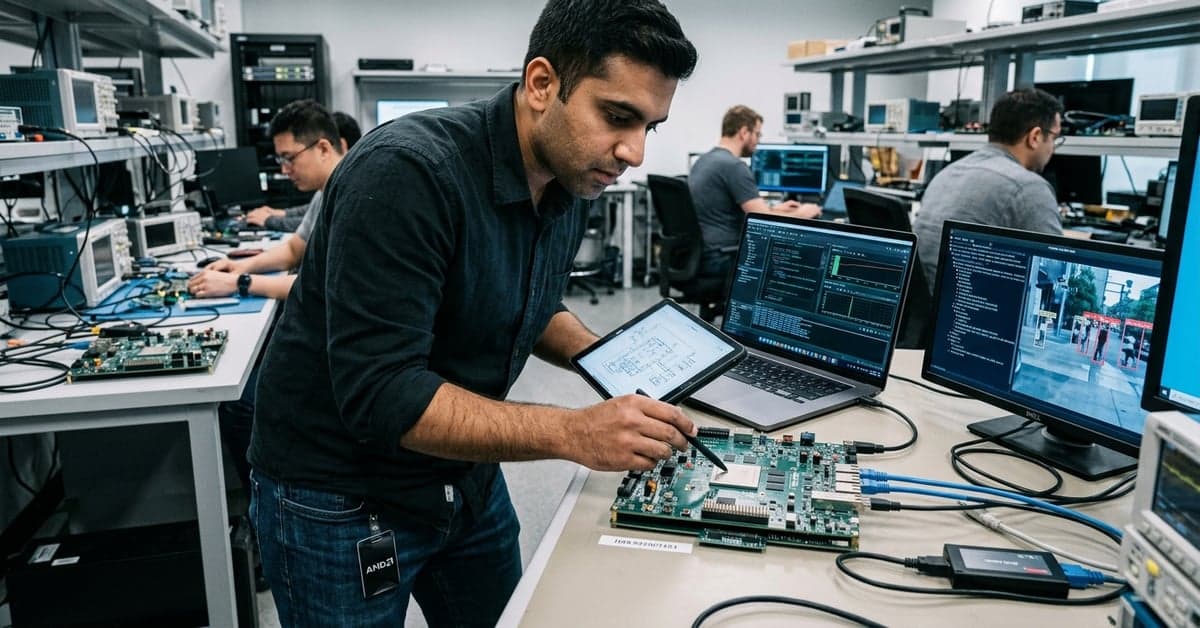
AMD is pitching its Vitis AI software as a single toolchain for embedded inference on its adaptive SoCs, bundling NPU IP, a compiler, a runtime, and developer tools. The promise: higher throughput and lower power on the device, without stitching together separate flows for CPUs, accelerators, and programmable logic. That’s a bold swing at the hidden tax in edge AI.
Inside the Vitis AI software stack
According to AMD’s product page, the stack supports “mainstream deep learning frameworks” and targets purpose-built NPU IP on AMD adaptive SoCs. The toolchain covers the model compile step, the runtime that schedules execution, and the knobs developers need to hit latency and power targets on a fixed budget. AMD also says the development flow integrates NPU inference with CPUs and programmable logic for embedded system design, a nod to the FPGA fabric that has long been a differentiator in its portfolio.
The company highlights a familiar developer journey: prepare the model, compile for the NPU, and deploy on the SoC alongside application code. For those standing up projects or evaluating fit, AMD points to a Vitis AI Developer Hub with docs, install steps, and tutorials. The pitch mirrors the portability play popularized by ONNX and vendor compilers, but tuned to AMD’s heterogeneous silicon.
Why a unified NPU–FPGA flow matters at the edge
Edge systems carry a different set of constraints than cloud endpoints. Power is tight. Thermal headroom is tighter. Deadlines are hard, because the sensor and actuator loop doesn’t wait. When the compiler, runtime, and hardware are tuned together for one SoC, developers can keep data on-chip, cut memory traffic, and keep worst-case latency predictable. That’s how you get meaningful safety margins in a vehicle or a factory cell.
Most teams today juggle separate tools for model conversion, accelerator kernels, and system glue. That friction often shows up in integration bugs and missed frame rates. A single flow that places work across an NPU, CPU, and programmable logic can reduce that risk. It also opens space for hardware specialization when a vision preprocessor or a sensor-fusion block needs to live in gates, not code.
Competing ecosystems exist. NVIDIA’s TensorRT has become the default on Jetson, and Intel’s OpenVINO spans CPUs, iGPUs, and VPUs. AMD’s read on differentiation is the tight coupling between an NPU and FPGA-class programmable logic in the same deployment flow. If that coupling feels smooth in practice, it’s a real edge.
Where AMD is aiming wins
AMD’s page points to four big buckets: autonomous driving and ADAS, smart infrastructure, machine vision for industrial automation, and healthcare. The common thread is straightforward. These are places where a watt saved or a millisecond shaved changes the product envelope.
In ADAS, inference has to be consistent across temperature swings and traffic chaos. In factories, line speeds climb while defect tolerances fall. Smart buildings push analytics into cameras and gateways to cut backhaul and protect privacy. Healthcare devices in clinics or at home work under strict power and reliability limits. AMD frames AMD Vitis AI software as the glue that lets its NPU do the heavy lifting while CPUs and programmable logic handle pre- and post-processing close to the sensor.
The hardware context matters here. AMD’s adaptive SoCs place CPU cores next to reconfigurable logic and AI engines, so each stage can live where it fits best. That architecture—long associated with the former Xilinx line—has been pitched for years in vision and control. With a modern AI compiler and runtime on top, the company is trying to turn a flexible diagram into a repeatable recipe.
What to watch next for AMD Vitis AI software
Two questions will decide whether developers buy in. First, does the compile-and-run flow produce predictable gains on real models without hand tuning? Second, does the tooling slot into existing CI, test, and observability habits without surprises? Developer experience, more than raw TOPS, sorts winners from also-rans.
Model breadth also matters. Teams will expect smooth paths for common vision networks, small audio classifiers, and light-weight multimodal stacks. They’ll look for clear guidance on quantization, memory planning, and how to split workloads between the NPU, CPU, and logic fabric when the graph doesn’t fit in one place. AMD’s developer hub will be the first stop to judge that depth.
There’s a larger signal in AMD’s positioning. As edge AI budgets tighten and privacy rules steer inference on-device, the center of gravity moves from cloud orchestration to deterministic pipelines on silicon. If AMD Vitis AI software makes that pipeline repeatable on its adaptive SoCs, the company earns a seat at the design table in ADAS rigs, retail gateways, and inspection cells.
That’s the bet. If AMD Vitis AI software can make post-training deployment boring—and predictable—more decisions will happen on the sensor side of the network. For more on this, see bloomberg.com.