
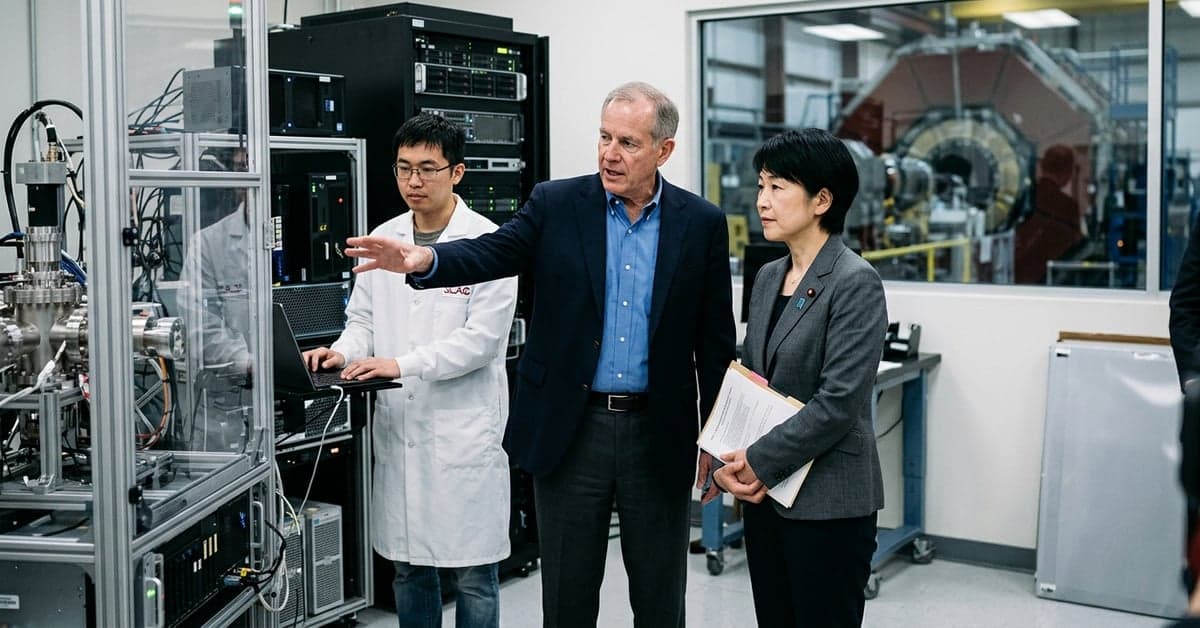
On June 4, 2026, the Department of Energy listed a $1 billion U.S.–Japan partnership under its Genesis Mission, signaling an allied push to tie AI to energy, science, and security. The DOE Genesis Mission also lays out 26 priority science and technology challenges and opens a funding track to move ideas off slides and into facilities.
What the DOE Genesis Mission aims to build
According to the Department of Energy’s program page, the Genesis Mission will create an integrated American Science and Security Platform that connects top-tier supercomputers, experimental facilities, AI systems, and unique datasets. In plain terms, the department wants a single fabric where compute, instruments, and data are wired together so researchers and engineers can push from model to measurement without weeks of handoffs. That is the heart of the DOE Genesis Mission vision.
This ambition leans on DOE’s long-running strengths in high performance computing. The agency already backs leadership-class machines—Frontier at Oak Ridge is a public example—built to crunch simulation-heavy science at scale. For context on that capability, Oak Ridge documents Frontier’s exascale system and its research roles. The Genesis plan would couple such compute with lab instruments and curated data, reducing the gap between a model’s prediction and a beamline or reactor test. That integration is non-trivial, but it is how time-to-answer drops from months to days.
The platform concept also implies new plumbing: data standards across labs, priority queues for cross-facility jobs, and shared tooling that can run on heterogeneous systems. The DOE’s Advanced Scientific Computing Research program already funds software and networking to stitch machines together; Genesis elevates that logic into a mission-level objective.
Why the $1 billion U.S.–Japan pact matters
The DOE page’s news feed cites a “historic $1 billion partnership” between the United States and Japan under the Genesis Mission on June 4, 2026. The number stands out. It hints at something bigger than a memo of understanding—funding that can underwrite shared datasets, compatible workflows, and possibly joint time on allied facilities. It also suggests the DOE Genesis Mission is meant to be outward-facing, not just a domestic modernization of lab IT.
Allied AI infrastructure has practical benefits. Shared hydrology data makes flood models better. Shared materials datasets accelerate battery discovery. Cross-border coordination also helps with resilience: if one facility is offline, another can pick up queued work with minimal retooling. The Genesis framing opens the door to that kind of redundancy, which matters when climate, grid reliability, and supply chains are all in play.
There is a policy signal too. Washington has backed an open, shared research fabric at home through the National AI Research Resource pilot. Genesis looks like the DOE’s sector-specific counterpart—focused on energy, climate, national security science, and discovery—but with the hardware, instruments, and data agreements to match its scope. The $1 billion figure implies the allied piece could move faster than typical interagency pilots, because the checkbook and use cases sit in the same program.
Twenty‑six challenges and Genesis Mission funding
The program page states that DOE has identified an initial 26 national science and technology challenges for Genesis to target. The list is designed to translate AI into measurable outcomes, from energy dominance to discovery science and national security. Framing the work as a finite set of problems is a small but important design choice. It creates a yardstick for progress and a filter for what gets compute time on the platform.
Money is starting to flow. In March 2026, the department announced a funding opportunity—titled “The Genesis Mission: Transforming Science and Energy with AI”—to back projects aligned with those challenges, per the DOE page. That means universities, national labs, and industry consortia can propose work tied to Genesis deliverables, with the promise of platform access and support. The application window, selection criteria, and award sizes were not detailed on the public overview, but the presence of an RFA shows the DOE Genesis Mission is moving from concept to contracts.
The timing matters. Getting awards out while the platform is being assembled lets project teams shape the tooling and data flows they will rely on later. It also avoids a common failure mode where a new platform ships and then waits a year for the first compelling use case. Here, the use cases are identified first, and the plumbing follows.
What to watch as the Genesis program scales
If the American Science and Security Platform is the backbone, governance will be the joints. Expect questions about how data from classified-adjacent projects is walled off while still powering unclassified models, how proprietary industry data is shared, and who decides which of the 26 challenges gets top priority in a given quarter. Those choices will control whether the DOE Genesis Mission speeds real work or sinks under meetings.
Another marker will be how well Genesis bridges simulation and experiment. DOE facilities are built for this loop: run a model, test it on a beamline or microscope, feed results back. The promise of the platform is to make that loop tight enough that a team can run many hypotheses in parallel. Watch for pilots that show reduced time-to-result on specific problems such as catalysis pathways or grid stability forecasting, with compute allocations and lab time coordinated rather than requested in isolation.
Hardware matters, but software will decide the pace. Portable workflows, clear APIs for experiment control, and reproducible pipelines will make or break adoption. The agency’s track record in scientific software, through programs like ASCR and the Exascale Computing Project, gives it a head start. The Genesis layer is where those pieces are expected to come together under common priorities.
Finally, the allied angle deserves attention. If the June 4 announcement evolves into shared governance or reciprocal facility access with Japan, that would set a template for other partners. It would also raise stakes on interoperability standards and export controls. The DOE Genesis Mission, by design, sits at the intersection of open science, industrial policy, and national security. That is a narrow path. Success will look like faster answers on a handful of hard problems—and a clear audit trail for how those answers were produced.
For researchers and policymakers, the signal is clear: the DOE Genesis Mission isn’t just a branding exercise. It’s an attempt to turn the United States’ scattered compute, instruments, and datasets into a working system, and to plug that system into allied capacity where it accelerates results. For more on this, see nytimes.com.
Related reading: Video Generation • AI Agents • AI Tools & Platforms