
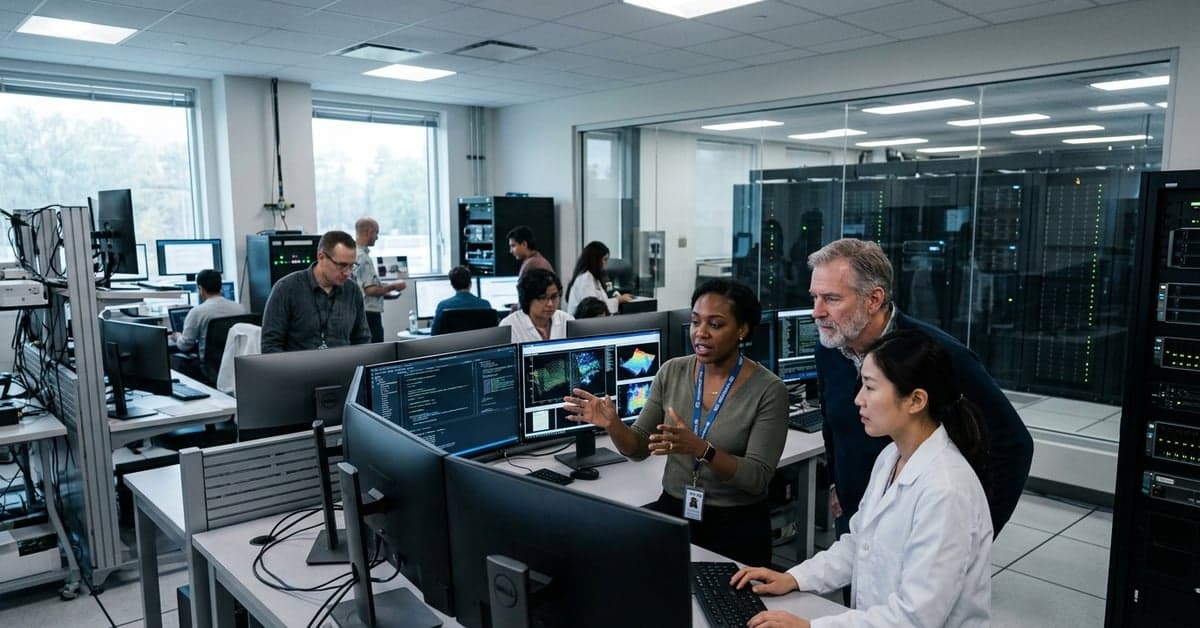
On July 22, 2026, the U.S. Department of Energy said partner commitments to its Genesis Mission exceeded $800 million and named the first projects to advance AI-driven science. The agency describes the effort as an integrated platform that will connect elite supercomputers, experimental facilities, AI systems, and unique datasets across the national labs network, industry, and academia (Department of Energy).
What the July 22 announcements say about Genesis Mission funding
The headline is simple: Genesis Mission funding has traction, and early work is underway. According to the Department of Energy’s program page, the agency secured more than $800 million in partner commitments and selected the first projects on July 22, 2026. The announcements build on a March 2026 call for applications aimed at tackling national science and technology challenges, from materials and climate to security and advanced manufacturing (DOE).
Two details stand out. First, the initiative is designed to fund projects that can use AI end to end: data collection at facilities, model training on high‑performance computers, and feedback into experiments. Second, the support is not just grants. The department points to shared access to compute, datasets, and software within a common platform, which matters in practice more than a single check.
How a shared platform could change applied science
The American Science and Security Platform at the heart of Genesis aims to knit together assets that usually sit apart. Consider the Frontier system at Oak Ridge, the first exascale supercomputer in the world. It can run enormous AI and simulation workloads, but its value multiplies when paired with live data from neutron sources, light sources, or national grid telemetry (Oak Ridge National Laboratory). The department’s plan is to reduce the friction between these pillars so that models learn faster and experiments adapt in near real time.
That approach acknowledges a real bottleneck. Many labs generate torrents of instrument data. Much of it remains underused because moving it, cleaning it, and aligning it with compute windows is hard. By promising a path that links facilities to compute and to teams across the U.S. national laboratories, the initiative could shorten cycles from months to days. If it works, AI will help scientists test more ideas with fewer experimental runs, which saves time and money.
Security is another thread woven into the platform. The department pitches Genesis as a way to strengthen American science and security. That implies attention to provenance, access controls, and evaluation. External frameworks such as the NIST AI Risk Management Framework give a blueprint for managing model risks; a federal platform can apply such guardrails at scale. Getting this right matters because the projects could touch critical infrastructure, from grid modeling to energy storage research.
Where the first projects are likely to land
The Department of Energy highlights “national challenges” as guideposts for selection, with energy dominance, discovery science, and national security among the targets (DOE). Expect early awards to cluster in areas where AI is already proving its worth:
- Grid operations and planning, where forecasting and control models can reduce outages and cut balancing costs.
- Materials discovery for batteries, catalysts, and carbon capture, where AI can prioritize candidates before expensive synthesis and testing.
- Fusion and high‑energy physics experiments, where real‑time inference can steer shots and filter events at the detector edge.
These are concrete use cases with measurable outcomes. Faster forecasts can be scored against real demand curves. Materials pipelines live and die by hit rates and time to synthesis. Experiments can count saved hours and better‑targeted runs. The common platform should make those metrics visible across teams, which creates pressure to improve or pivot.
Why this public build matters more than another AI model
Most AI headlines fixate on models. This one is about infrastructure and access. Genesis Mission funding sends a signal that public institutions are willing to pay for the unglamorous parts of AI adoption: data plumbing, compute scheduling, and software that plays nicely across organizations. That is where projects usually stall.
The other signal is strategic. By pooling compute and data inside a government‑backed platform, the department reduces dependence on any single vendor’s stack. That can steady costs and improve accountability. It also means methods developed in one domain, like a physics lab’s fast denoising algorithm, can be lifted into grid modeling or materials pipelines without re‑engineering everything from scratch.
There is a cultural shift here too. National labs are used to collaboration, but AI raises expectations for speed and reproducibility. A shared platform creates default practices for documentation, evaluation, and model sharing. It sets norms that private‑sector teams can also adopt, especially when they co‑fund or co‑staff projects.
What to watch next on Genesis Mission funding and delivery
Three tests will reveal whether the promises hold. First, can the platform make instrument data flow to compute with low latency and clear permissions? Second, do the first awards produce measurable gains, like reduced experiment time or higher materials hit rates, within a year? Third, does the initiative expand access to smaller teams at universities and startups, not just the largest labs?
Progress should be visible as the department publishes project lists and results. A sign of health would be reusable tools that survive beyond any single grant—data loaders for a beamline, training recipes for specific GPUs, or evaluation harnesses that become defaults across facilities. Those artifacts indicate the platform effect is real, not just a set of siloed awards.
The stakes are high, but the timing is good. Exascale systems are now online, and instruments are more instrumented than ever. If the Department of Energy delivers on the cross‑lab plumbing, the first cohort of projects could reset expectations for how quickly science can move with AI in the loop.
That is why this announcement matters. It is not another demo video. It is a public commitment to build common rails for scientific AI—and to fund the teams that will ride them. If the early results match the plan, Genesis Mission funding will look less like a headline and more like the backbone of the next decade of U.S. energy and science work. For more on this, see bloomberg.com.