
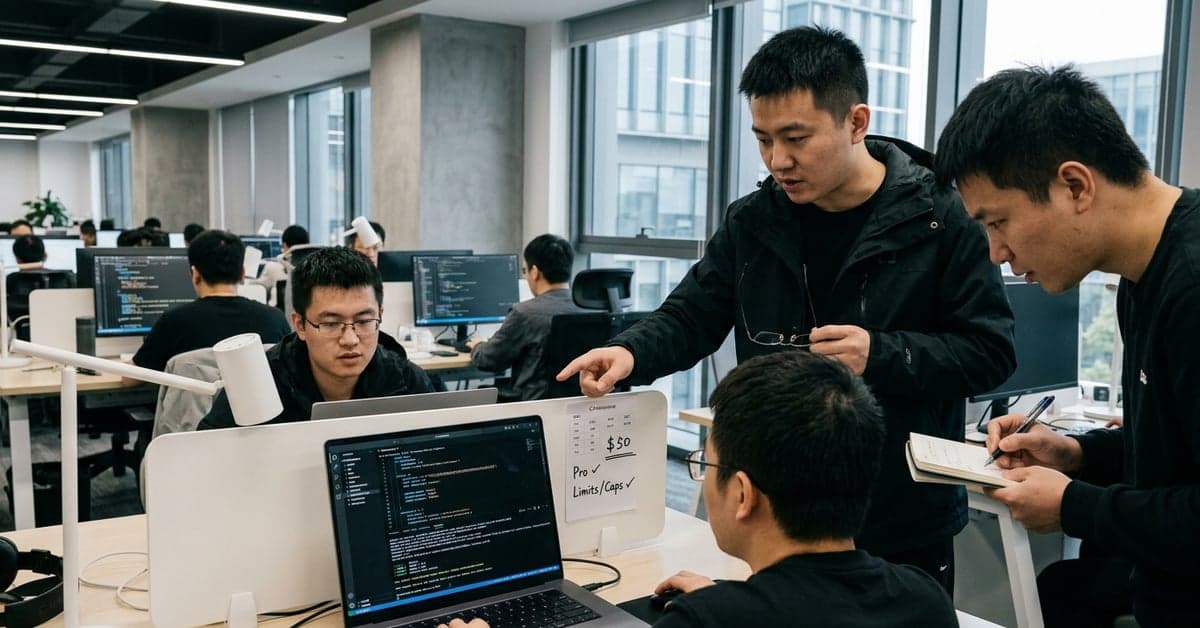
On April 13, 2026, Alibaba Cloud ended renewals and upgrades for its Lite tier after halting new sign-ups on March 20. The Model Studio Coding Plan now centers on a $50 per month Pro option that offers fixed-fee access to Qwen, GLM, Kimi, and MiniMax inside popular AI coding tools, according to Alibaba Cloud’s documentation (plan overview).
What changed with the Model Studio Coding Plan
Alibaba Cloud phased out the Lite plan for new customers as of March 20, 2026 at 00:00:00 (UTC+08:00) and closed Lite renewals and upgrades on April 13, 2026 at 18:00:00 (UTC+08:00). Before its deprecation, Lite carried the same model coverage as Pro—Qwen, GLM, Kimi, and MiniMax—so the feature gap between tiers wasn’t the issue, per the official page.
The Pro plan supports a specific set of model versions. Recommended options include qwen3.7-plus (vision), qwen3.6-plus (vision), kimi-k2.5 (vision), glm-5, and MiniMax-M2.5. Also listed are qwen3.5-plus (vision), qwen3-max-2026-01-23, qwen3-coder-next, qwen3-coder-plus, and glm-4.7. Models not named in the list aren’t supported. That version pinning matters for teams that want to standardize behavior across IDEs, and it sets clear expectations about which releases will work.
There’s a catch on availability: slots are limited and sold first-come, first-served, with new slots restocked daily at 00:00:00 (UTC+08:00). Anyone trying to subscribe from a distant time zone should note that window. The price is $50 per month.
How the rolling caps shape real-world use
The Pro plan has three simultaneous caps: up to 6,000 requests per five hours, 45,000 per week, and 90,000 per month. The limits operate together; the first one you hit pauses calls. Alibaba Cloud is direct about this: the caps aren’t cumulative allocations or guarantees spread evenly over time. They’re ceilings.
The five-hour quota rolls every minute. If you make 100 calls at 10:00, those 100 calls unlock again at 15:00. Use 50 calls at 10:30 and they re-open at 15:30. That rolling window favors steady usage over sharp spikes and can smooth out an IDE-heavy day.
Consumption depends on how your tools orchestrate calls. Alibaba Cloud says simple tasks typically take 5–10 calls, while complex tasks can use 10–30 or more. In practice, a quick bug fix may barely dent the quota, yet a long refactor with test generation can chew through it fast. Teams relying on agents or chain-of-thought tools will feel this most.
Here’s the part the documentation doesn’t spell out with numbers, but it’s implied by the caps. The five-hour gate allows short bursts, but the weekly 45,000 ceiling will clamp down long before you could sustain 6,000-call bursts around the clock. The monthly 90,000 limit then bounds the long-run average—roughly 3,000 calls per day if usage is spread across a 30-day month. The design nudges developers toward predictable, IDE-driven work rather than API-style batch jobs.
Pricing and models at a glance
The Pro tier is flat-rate at $50 per month. For that fee, the plan aggregates access to multiple families, including Alibaba’s own Qwen models, Zhipu AI’s GLM line, and entries from Kimi and MiniMax. Having these in one subscription simplifies procurement and avoids juggling per-vendor API billing. It also means developers can compare behavior across model families inside the same coding workflow without swapping credentials or rate limits.
Version pinning cuts both ways. It offers stability for reproducible results, but it can delay access to the very latest releases if they’re not on the supported list. For teams that care about repeatability in code suggestions or test generation, the current roster provides a known baseline. For teams chasing every new model drop, Pro’s curated list may feel slow.
Who the Model Studio Coding Plan fits—and who should skip it
This plan best fits solo developers and small teams living inside IDEs who want cost predictability. If your day is lots of short prompts—write a function, add unit tests, explain an error—the rolling five-hour cap is generous enough, while the weekly and monthly ceilings keep spend known. For managers, a single line item beats reconciling unpredictable pay-as-you-go bills.
There are two caution flags. First, the limited-availability model means you might need to time your purchase to the 00:00:00 (UTC+08:00) restock. Second, if your workflow needs big one-off surges—say, mass code migration or large repo audits—the weekly 45,000 and monthly 90,000 ceilings can block progress. Batch-heavy use is still better suited to metered APIs where you can burst and pay for it.
What to watch next for Alibaba’s coding plan
Keep an eye on the supported model roster and how quickly new versions land. Models not listed remain unsupported, so version coverage will determine how quickly developers can adopt new capabilities from Qwen, GLM, Kimi, and MiniMax. Alibaba Cloud’s broader Model Studio strategy suggests continued model breadth, yet the Coding Plan’s value hinges on timely updates.
Availability is the other variable. If demand keeps outpacing supply, the daily restock window becomes a bottleneck for teams trying to standardize on the Pro tier. If slots expand, the Model Studio Coding Plan becomes a cleaner alternative to per-call billing for day-to-day coding assistance.
For now, the shift to a single $50 Pro tier, capped by rolling per-window and calendar limits, sets clear trade-offs: stable, predictable coding help inside your tools, in exchange for hard ceilings on bursts. Teams that can plan around those ceilings will get the most from the Model Studio Coding Plan. For more on this, see bloomberg.com and nytimes.com.