
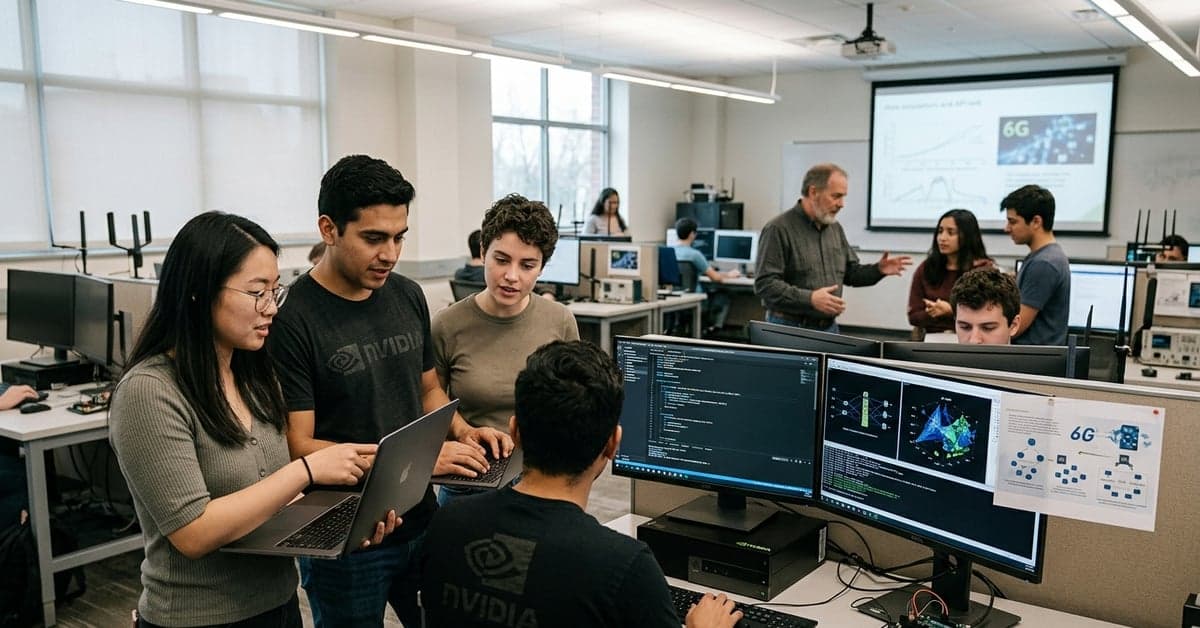
NVIDIA has bundled self-paced courses, mentor-led hackathons, NIM APIs, and a 6G Developer Program into a single Higher Education and Research hub. According to NVIDIA’s Higher Education and Research Developer Resources, the portal serves researchers, educators, and students with training, publications, and program access in one place. The signal: the company is weaving academic work more tightly into its production AI stack.
Inside the NVIDIA higher education resources hub
The hub splits content by role—researchers, educators, and students—and points each group to targeted offerings. NVIDIA lists hands-on workshops, certifications, teaching materials, webinars, and events, along with self-paced courses spanning AI, data science, and graphics. The “Learn With NVIDIA” entry centralizes education options, while Open Hackathons and Bootcamps promise mentor support for accelerating and optimizing research applications, per the company’s page.
For researchers, NVIDIA highlights access to publications and an entry point to broader company research. The site directs readers to NVIDIA Research, which showcases work that often feeds back into developer tooling. For students, the mix skews toward online courses and guided events that build practical skills with CUDA-era and AI-era tooling. Educators get curriculum-friendly teaching materials and training paths to keep classes current as model-serving and accelerated computing change quickly.
Why NIM APIs and 6G access matter in the lab
The inclusion of NIM—NVIDIA’s production-ready model-serving microservices—stands out. NVIDIA’s hub links to NIM APIs, which package popular inference tasks behind stable endpoints and deployment patterns. That nudges campus projects toward a runtime model industry teams already use, shrinking the gap between a paper prototype and something that survives a load test. For context on the approach, NVIDIA describes NIM as microservices for AI inference on its NIM overview.
The separate 6G Developer Program points at the telecom frontier. NVIDIA’s page says participants can join to access platforms, documentation, and software releases for advancing 6G research. That matters because 6G work blends radio innovations with heavy AI for optimization and control. Readers who want the broader research picture can see how the standards conversation is evolving via IEEE’s 6G coverage. Pulling model-serving APIs and next-gen wireless into the same academic hub encourages labs to prototype end-to-end systems—data capture, training, inference, and network integration—on tools that look like production.
NVIDIA academic resources in practice: who benefits and how
The hub’s design suggests three clear on-ramps.
- Researchers: Start with publications and the 6G Developer Program, then test ideas in Open Hackathons and Bootcamps where mentors can help tune kernels or workflows, as NVIDIA describes on its hub.
- Educators: Pull teaching materials and course modules from the training catalog to keep syllabi aligned with current toolchains. That includes self-paced content that can backstop labs or projects.
- Students: Use self-paced courses to build fundamentals, then apply those skills in hackathons. The page positions this path as a bridge from classwork to practical experience.
Because NIM APIs sit in the same portal, teams can go from a seminar on prompt engineering to a service that exposes a model behind a well-defined endpoint. That reduces context switching and the guesswork of stitching together ad hoc stacks during a semester crunch.
The bigger play: how NVIDIA higher education resources shape training
This consolidation looks like more than housekeeping. By placing training, events, research, and deploy-ready APIs together, NVIDIA is channeling academic users toward practices companies expect on day one. Cloud vendors have long used similar education programs—see AWS Educate—to align campus skills with their stacks. NVIDIA is applying that template to accelerated computing and model-serving.
The upside for universities is speed. A lab can adopt a standard serving layer and spend more time on experiments, less on glue code. The risk is familiar too: curricula may narrow around a vendor’s way of doing things. Whether that trade-off pays off will show up in student placement, lab throughput, and how often academic prototypes make it into real deployments.
There’s another tell. Tools for frontier telecom research usually live apart from AI deployment kits. By putting 6G experimentation and NIM in the same doorway, the company is betting the next wave of research will cut across both—AI shaping the network, and the network shaping what AI can do at the edge.
What to watch as the hub gains users
Track how many courses and capstone projects cite NIM in their deployment notes. Watch whether 6G labs begin publishing AI-in-the-loop results that rely on standard serving interfaces. And look for more mentor-led events tuned to specific research domains. If those signals pick up, the bet behind the NVIDIA higher education resources will be clear: teach the tools, shorten the path to impact, and make campus work feel like production from day one.