
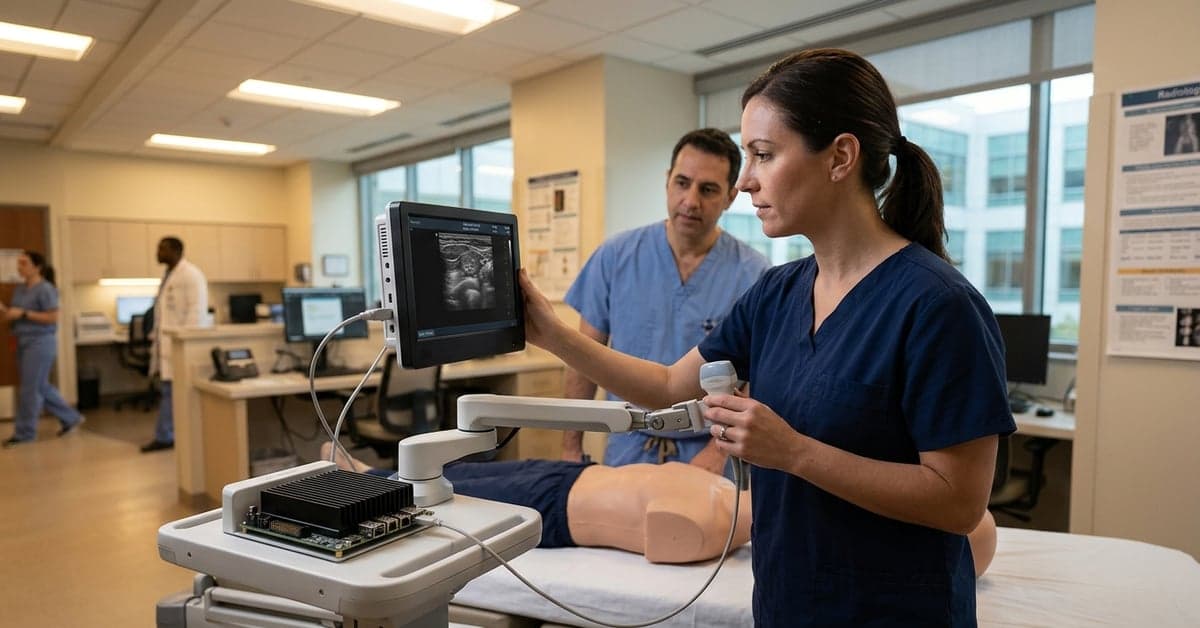
AMD’s Vitis AI bundles an NPU IP core, compiler, and runtime to deploy models on adaptive SoCs, and AMD names healthcare among its target sectors. That makes a fresh case for edge-first clinical AI—processing data where it’s captured, with fewer round‑trips to the cloud—at a time when policy momentum is building around safe, interoperable digital health. The question for buyers is whether the stack’s promised power‑efficient inference can carry real hospital workloads without adding integration debt. This piece looks at that gap, and what a serious Vitis AI healthcare pilot must prove.
What AMD is actually shipping at the edge
According to AMD’s product page for Vitis AI, the stack covers the full embedded pipeline: purpose‑built NPU IP for acceleration, a compiler to map models to that hardware, and a runtime that ties into CPUs and programmable logic on AMD adaptive SoCs. AMD pitches this for autonomous driving, machine vision, smart infrastructure—and healthcare—where power budgets and inference latency matter. The pitch is simple: keep models close to the sensor, keep data movement low, and squeeze the most results per watt.
That framing, while familiar to embedded engineers, matters in clinics. Many imaging carts, bedside monitors, and handheld scanners can’t tolerate heavy thermals or spotty connectivity. A stack designed for on‑device compilation and execution gives teams a way to scope work to the silicon they actually ship. If a team can show that Vitis AI healthcare builds hit frame‑rate targets inside those limits, doors open for pilots that never clear the network boundary.
Why Vitis AI healthcare bets favor the edge
The WHO’s digital health agenda puts steady pressure on interoperability, evidence, and scale. In its Global Strategy on Digital Health, adopted in 2020, the World Health Assembly linked innovation to real‑world use: make solutions that fit country needs, support data exchange standards, and move beyond pilot traps. Edge inference supports that in two practical ways. First, it reduces the volume of raw patient data shipped over networks, shrinking both exposure and bandwidth costs. Second, it cuts clinical latency—vital for triage, imaging overlays, or device alarms that need responses in seconds, not minutes.
For hospital IT, this aligns with an edge computing pattern they already manage: compute pushed to the device or closet, with a thinner data exhaust sent upstream. For engineering teams, an NPU‑centric flow that compiles models to fixed targets can make performance more predictable than variable cloud runtimes. That predictability is what clinical services want to validate: steady throughput, bounded latency, and power draw that won’t trip thermal throttling mid‑shift.
Interoperability and risk for medical edge AI
Policy alignment isn’t automatic. The WHO emphasizes standards for data exchange and a “needs‑based” approach to national deployments. Translating that into build plans means the AI device is only one piece. Even when inference stays on the device, results must still integrate cleanly into hospital systems. That usually means adopting standard interfaces—think orders, observations, or images routed via established clinical workflows—so the AI’s outputs don’t become a dead end. While AMD highlights a streamlined flow from NPU to CPUs and programmable logic, teams will still need to stitch results to interoperable systems upstream.
Risk management also shifts when models run on embedded silicon. You’ll validate model behavior under realistic noise, drifts from different wards, and harsh lighting or movement. You’ll document exactly what the compiler does to the model graph and how that changes accuracy, because that’s what reviewers will ask. Even though the Vitis flow is engineered for power and throughput, clinical buyers will press for evidence that optimizations don’t erase the signal they paid for. That’s where Vitis AI healthcare programs must invest: repeatable tests, versioned artifacts, and clear post‑deployment monitoring plans.
There’s one more integration wrinkle: portability. AMD describes support for “mainstream deep learning frameworks” without naming them on the public page. Teams should plan for export paths that preserve model intent across compilers and silicon generations. Open exchange formats like ONNX can help hold the line on model definitions, while still embracing target‑specific kernels for speed. That split—portable model spec, hardware‑tuned execution—is how medical device makers avoid long‑term lock‑in.
Regulators also expect a story for updates. Even at the edge, software bills of materials, reproducible builds, and auditable change logs matter. Those expectations aren’t theoretical; agencies have laid out approaches for AI/ML medical software, and buyers mirror them in RFPs. If the toolchain can make compiler versions, quantization choices, and runtime configurations machine‑readable, hospitals can assess risk faster and approve changes with fewer meetings.
So what makes the case for Vitis AI healthcare today? Clear power and latency gains at realistic batch sizes, paired with clean handoffs into hospital systems and a documented validation trail. AMD’s stack gives embedded teams a path to those targets. The rest—evidence, interoperability, and operational playbooks—decides which pilots move beyond demo day.
Before green‑lighting a pilot, teams should prove five things in a week‑long sprint on representative hardware: can the model hit clinical frame‑rates continuously on the NPU; does the device stay within its thermal and power budget; can results flow into existing workflows without custom clerical work; is the accuracy delta between training and compiled inference characterized and acceptable; and can you reproduce the build with the same outputs on fresh silicons. If those answers land well, the policy environment—and the WHO’s push for scalable, standards‑aligned digital health—will be an ally, not a blocker.
For hospital buyers weighing Vitis AI healthcare, the upside is tangible: faster answers where care happens, less data in flight, and hardware you can qualify once then run for years. The burden is equally clear: treat the toolchain as part of the medical product, with the same audit trail and integration discipline you’d expect from any clinical system. For more on this, see bloomberg.com and nytimes.com.
Related reading: Video Generation • AI Agents • AI Tools & Platforms