
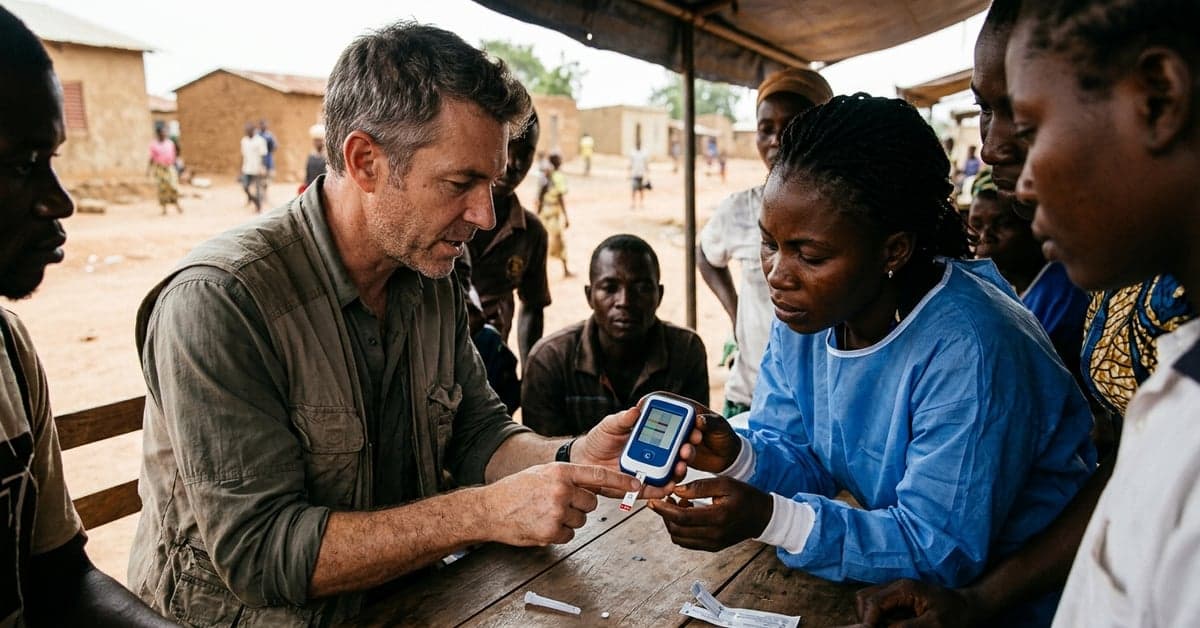
On September 21, 2026, Cornell University researchers unveiled a portable Ebola Lassa test that can tell the two viruses apart from a single finger-prick sample, a task that often stumps clinicians in low-resource settings where both circulate. The study, led by David Erickson with collaborators Saurabh Mehta and the U.S. Army’s Keersten Ricks, was published on August 31 in Analytical Chemistry, according to Cornell News.
What this portable Ebola Lassa test does differently
The team paired a dual antigen test strip with a compact optical reader called the Portable Rapid Onsite Versatile Image‑based Detection System, or PROVIDS. In Cornell’s description, the strip checks for proteins from both Ebola and Lassa using a tiny blood sample, while the reader snaps a photo and scores the lines in under five seconds. “Similar to a COVID antigen test,” Erickson said, the system outputs an objective, quantitative result rather than a subjective eyeball read, per Cornell News. That combination—duplex strip plus image scoring—is designed for field work, where electricity, refrigeration, and trained lab staff can be scarce.
Most rapid tests aimed at hemorrhagic fevers focus on a single pathogen. A two‑in‑one format matters because early signs overlap. Fever, weakness, and headache are common to both viruses, and gastrointestinal symptoms often follow. The non‑specific start is why many suspected cases must be isolated while waiting on a lab result. A duplex readout at the point of care could shorten that wait by delivering a likely answer minutes after a patient arrives.
Why a duplex test matters in co‑endemic regions
In parts of West Africa, clinicians face both diseases in the same season. The U.S. Centers for Disease Control and Prevention notes that Lassa fever is endemic in several countries and often begins with mild, non‑specific symptoms. The World Health Organization describes Ebola virus disease as highly transmissible in healthcare settings without strict infection control. When the first signs look similar, a wrong guess can be costly: a missed Ebola case risks spread to caregivers and other patients; a false Ebola suspicion can tie up isolation beds and personal protective equipment that are already limited. A portable assay that distinguishes between the two on the spot changes that calculus. It helps route patients into the right care pathway earlier and informs which protective steps a clinic must take now, not tomorrow.
Standard confirmation today leans on PCR platforms and centralized labs. Those tools are accurate, but they need stable power, cold chains, and trained staff, and they often require sample transport. Turnaround can stretch past a workday in remote areas. By contrast, a field diagnostic that delivers a camera‑verified answer in minutes brings the decision point to the bedside. It won’t replace confirmatory PCR for surveillance and case counting, but it can shape the first 30 minutes of care, when triage choices have outsized effects.
Camera scoring and data: faster decisions at the point of care
The PROVIDS imaging system does more than call a faint line. It standardizes how the line is interpreted, reducing reader bias across shifts and clinics. That matters in busy triage tents, where lighting varies and staff rotate. The ability to quantify line intensity also opens a door to trend tracking over repeat tests, even if those numbers remain proxies. For programs that report results upstream, an image‑scored read can be logged and shared with a supervisor or district office, supporting faster coordination during cluster investigations.
Another benefit is training. New staff can compare their visual calls with the device’s output and learn where borderline results land. In pilot deployments of other camera‑assisted rapid tests, that feedback loop has shortened onboarding. If the Cornell platform follows the same pattern, the portable Ebola Lassa test could help standardize triage decisions across facilities with varying experience levels.
Limits, open questions, and the road to deployment
Promising lab and early field data still leave gaps that only wider trials can fill. The Cornell team has not released head‑to‑head performance numbers here, and real‑world sensitivity and specificity for both analytes across disease stages will decide whether health ministries treat the assay as a triage aid or something closer to a rule‑in tool. Cross‑reactivity with other febrile illnesses common in the region—like malaria or typhoid—needs a hard look. So does test stability across heat and humidity cycles typical of rural clinics.
Supply and support also matter. Any new strip must be manufacturable at scale, priced for sustained use, and paired with a reader that survives field conditions. Batteries, charging, and dust‑proofing are as important as the optics. Countries that choose to adopt will likely seek independent evaluations and may look to WHO emergency use processes for guidance. Making the Analytical Chemistry methods public is a start; broad, multi‑site studies are the next test.
Policy fit is another piece. Some regions already run PCR confirmatory algorithms or use single‑pathogen rapid tests during flare‑ups. Integrating a two‑pathogen strip means updating workflows, training, and data systems. If adoption goes forward, expect ministries to set where the portable Ebola Lassa test sits in the pathway: first screen in fever clinics, backup when PCR is offline, or surge capacity during outbreaks.
What to watch next
Two signals will show whether this work moves from paper to practice. First, independent evaluations that publish performance across age groups, symptom days, and community versus facility samples. Second, pilot rollouts that test the reader in real clinics and track how the assay changes actual triage and isolation decisions. If those results line up, the portable Ebola Lassa test could become a new first step at the gate of many clinics—saving time, focusing scarce protective gear, and cutting risk for patients and staff. For more on this, see nytimes.com.