
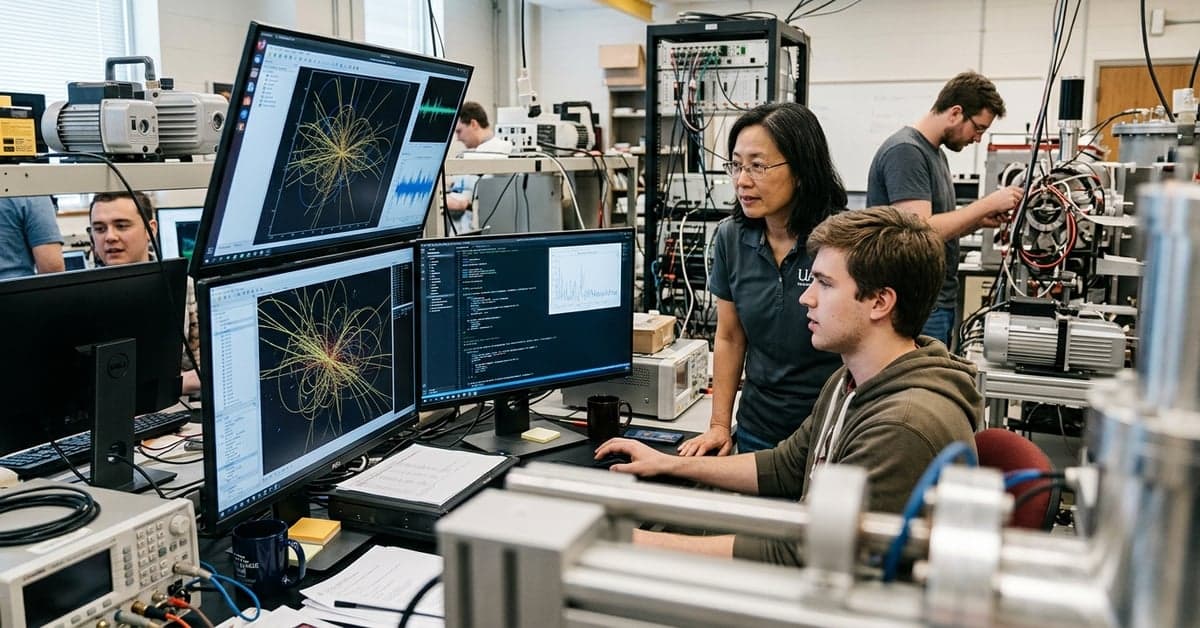
On August 17, 2026, the University of Alabama said a UA-led team will build an artificial intelligence system to sift vast physics datasets after winning Phase 1 support under the U.S. Department of Energy’s Genesis Mission. The UA AI physics tool was highlighted by the school as one of 278 projects selected from more than 5,000 proposals, a roughly five percent cut, according to the UA News Center.
What the UA AI physics tool sets out to fix
Modern experiments overwhelm humans and legacy software. Particle detectors, X‑ray beamlines, and plasma diagnostics can generate petabytes of raw signals, then spin off streams of derived data that outgrow local storage and staff time. At facilities like the Large Hadron Collider, for example, only a fraction of collisions can even be recorded because data arrives faster than it can be saved; machine learning already helps decide which events make the cut, as CERN explains.
UA’s project is aimed at that chokepoint. In plain terms: teach software to prioritize the right measurements, surface anomalies worth a closer look, and cut the blank time scientists spend waiting on scripts to finish. The university’s preview did not name specific instruments or subfields, but the goal is clear enough. Reduce the time between experiment and insight by leaning on trained models that can score, summarize, and route data as it lands.
For campus labs and collaborators, that kind of triage pays off twice. Less junk moves across networks or sits in queues. More candidate discoveries arrive on a scientist’s screen while the experiment is still running. The first win saves money; the second protects momentum.
Inside DOE’s Genesis Mission and why selection matters
The UA announcement frames the award within the Department of Energy’s Genesis Mission, described as a national push knitting together AI, supercomputing, quantum systems, and advanced instruments. While the program’s branding is new, the ingredients line up with DOE’s long-term arc toward AI‑assisted science on leadership‑class machines. Flagship systems like Frontier at Oak Ridge National Laboratory are already built to run both simulation and large‑scale machine learning in one place.
What stands out is the hit rate. Being one of 278 Phase 1 projects from a pool above 5,000 signals a tight competition. It also suggests DOE wants breadth at the outset: many seeds, then a smaller set of field‑ready tools after technical down‑selects. According to the UA News Center, the Genesis Mission unites government, industry, academia, and philanthropy. That mix points to a pipeline that runs from lab prototype to production deployments at user facilities—something Office of Science programs have delivered before, though usually with fewer AI pieces in the stack. Readers can find DOE’s broader science mission and funding focus at the Office of Science.
If UA’s team builds a compelling prototype, the next phases typically bring sharper milestones: datasets locked, metrics agreed, and integration plans with specific instruments and HPC centers. Those steps are where strong campus‑lab ties matter, because the fast path to adoption usually runs through a user facility with shared governance and a long queue of experiments.
How scientists could use UA’s AI for physics data
Tools in this class usually focus on three jobs. First, real‑time filtering and event scoring, where models learn to flag rare signatures before they are lost in the firehose. Second, anomaly detection to catch the “unknown unknowns” that traditional pipelines miss. Third, surrogate modeling that approximates an expensive simulation, shaving hours to minutes when exploring parameter space.
Each has precedent. Collider experiments rely on learned triggers to keep only the most promising collisions. Synchrotron beamlines apply neural networks to reconstruct images and analyze spectra on the fly, shrinking feedback loops for users at the station; the Advanced Photon Source at Argonne has chronicled those gains. Plasma physics teams blend HPC and ML to predict instabilities from sensor streams. The common thread is speed. The sooner a scientist sees a trustworthy result, the sooner they can pivot the apparatus and test the next hypothesis.
Expect the UA AI physics tool to target that outcome. Even simple wins—automatic metadata extraction, quality checks on incoming files, a ranked queue of “likely interesting” events—can compress a week of triage into a morning. When tied to exascale systems through well‑designed workflows, heavier inference jobs can move off the instrument without grinding progress to a halt. That is where DOE’s investment in HPC and networking matters as much as any model architecture.
What this means for Alabama researchers and partners
A UA‑led effort in a national AI‑for‑science program does more than add a line to a grant list. It gives campus groups a vehicle to formalize data practices—model registries, versioned pipelines, clear performance targets—that many labs have wanted but struggled to staff. It also sets up partnerships with national facilities that can outlast any single award, because a useful tool tends to spread by word of mouth among beamline scientists and program managers.
There is a talent story too. Students who help build or test the software will finish with experience across physics, machine learning, and high‑performance computing. Those are the skill sets user facilities and industry R&D teams hire for. If the team releases parts of the stack openly, as many science groups do, it also gives outside collaborators a head start on adoption and critique.
For regional partners—state agencies, nearby universities, and companies tied to sensors or materials—faster analysis can make joint projects feasible on tight timelines. A proof‑of‑concept pipeline that turns around results during a one‑week beamtime slot is more than a technical feat; it changes how partners plan experiments and budget for them.
What to watch next from the UA-led team
The UA preview did not provide timelines or datasets, so the next public markers will likely be a formal project page, a technical brief with evaluation metrics, and early demonstrations tied to a named instrument or facility. Watch for collaborations with national labs that operate user facilities, since that is often where AI‑assisted analysis proves its value under real constraints.
The selection itself is the signal. DOE wants AI closer to the instrument and connected to leadership‑class compute. UA’s pitch fit that brief well enough to make Phase 1. If the team can show sustained, measurable gains on real data—lower latency, higher precision at the same recall, fewer missed events—the UA AI physics tool will move from a campus preview item to something scientists plan around.
For now, the takeaway is simple: the university has a seat at a national table where AI, HPC, and physics meet. That can shorten the path from raw signals to publishable results—and give Alabama researchers a stronger hand when the next round of big science data arrives.
Related reading: What the Maju For The People rally could change in planning For more on this, see bloomberg.com and nytimes.com.