
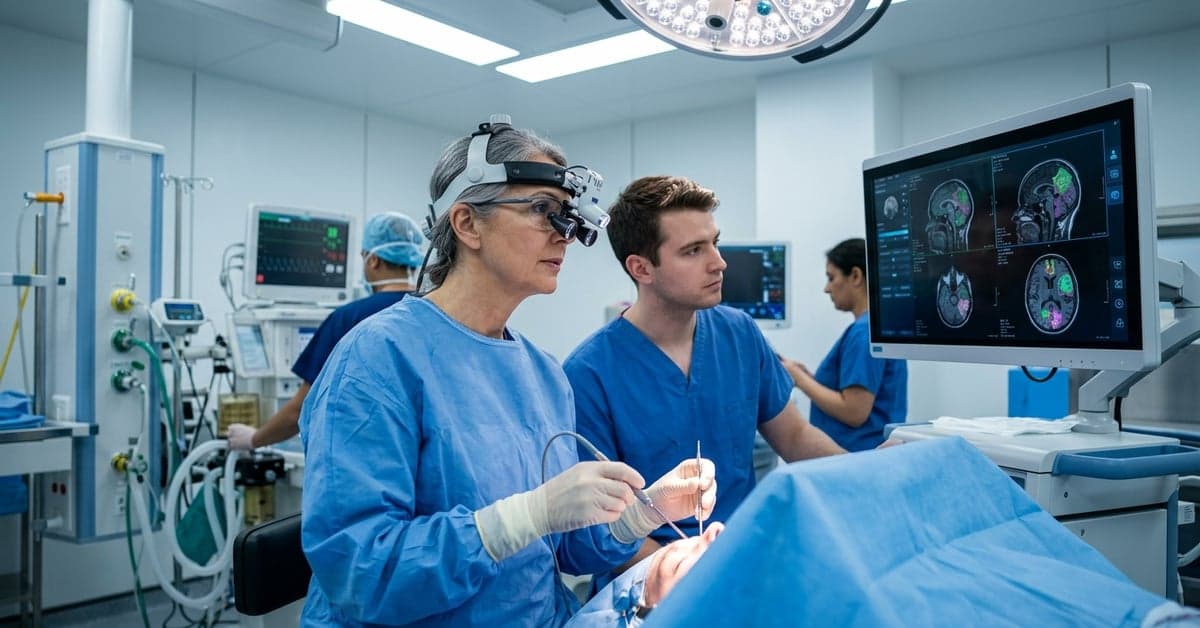
On August 27, 2026, The Guardian reported that London neurosurgeons performed the first successful AI-assisted operation to remove a brain tumour. The claim signals a new phase for AI in the operating room, where pilot projects are starting to touch life‑and‑death decisions. The real story is what happens next: how the NHS will decide when AI belongs in theatre, and who carries the risk if it goes wrong.
What happened in London’s AI-assisted brain surgery
According to The Guardian, a London team completed what they called the first successful AI-assisted brain tumour removal on August 27, 2026. The outlet did not publish full technical details on the system used or the hospital where it was deployed. That leaves open questions that matter for clinicians: was the AI guiding tumour margin detection, optimising a surgical path from pre‑operative scans, or flagging structures to avoid? Each workflow adds value in different places and carries different failure modes.
In neurosurgery, AI most often supports segmentation of tumours and critical anatomy on MRI or CT, then feeds those maps into navigation tools. Some systems also track tissue deformation during surgery to keep guidance aligned with reality. Others classify tissue at the tip of a probe, aiming to reduce residual tumour. Evidence for these approaches exists in research settings, including peer‑reviewed studies on automated brain tumour segmentation and intraoperative classification, but translation into routine NHS use requires more than a promising pilot.
Safety and evidence: how neurosurgery AI will be judged
Any leap from a headline to a standard of care runs through UK regulation and independent assessment. The Medicines and Healthcare products Regulatory Agency (MHRA) treats AI that informs diagnosis or treatment as software as a medical device. Its guidance sets expectations for clinical performance, post‑market monitoring, and change control for adaptive models. Readers can find the current approach in the MHRA’s Software and AI as a Medical Device change programme, which outlines how UKCA marking will apply to learning systems.
NICE then weighs clinical and economic value for NHS England. Its evidence standards framework details what data is needed at each risk tier, from analytical validity to real‑world impact. For AI-assisted brain surgery, that bar is high: prospective trials, clear definitions of “assistance” versus autonomy, and transparent human factors testing. A study that shows better contouring on scans is not the same as fewer complications or shorter operations. NICE will ask for the latter.
Professional bodies will also be central. The Royal College of Surgeons has cautioned that surgical AI must be evaluated like any device that can influence an operative plan, including human–machine interface risks and cognitive load in the theatre. Position papers, such as the College’s work on AI in surgery, push for structured evaluation and simulator training before live use. That message fits the London result into a longer pathway: one case shows feasibility; it does not prove general benefit.
Who pays and who benefits if AI enters the theatre
Even if evidence is strong, adoption rises or falls on budgets and workflow. The NHS has set aside targeted funds for digital innovation through the NHS AI Lab and regional transformation budgets. But hospitals still face upfront licensing fees, navigation hardware updates, and ongoing model monitoring. Trusts will ask whether a system saves theatre time, reduces length of stay, or lowers readmissions enough to offset costs within their current payment rules.
Equity matters as much as efficiency. High‑volume centres might afford early access and build datasets that turn into local advantages. Smaller hospitals risk lagging if procurement frameworks do not pool demand or if evidence does not reflect their case mix. For AI-assisted brain surgery, concentration of expertise is already a feature of care; commissioners will want to see that AI lifts outcomes across the network, not only at a flagship site.
Medico‑legal exposure is the other brake. If AI guidance contributes to an error, responsibility spans surgeon, hospital, and vendor. Contracts need explicit duty‑of‑care language, audit trails for model recommendations, and version control that shows exactly what the surgeon saw. Without that paper trail, even successful units will hesitate to scale beyond pilots.
Defining “assistance” in the operating room
“AI‑assisted” covers a wide arc, from pre‑operative planning to live classification under the microscope. The more an algorithm nudges an irreversible move, the tighter the guardrails should be. Three questions can sort hype from substance:
- What decision did the AI change? If it only reordered a checklist, impact is limited. If it moved a surgical margin, the risk profile rises.
- What is the counterfactual? Show cases where the plan would have differed without the tool, and link that to measured outcomes.
- Who overrode whom? Human‑in‑the‑loop is a design choice; logs should display every time a surgeon accepted or rejected a suggestion.
These questions do not slow progress; they focus it. They also map cleanly onto MHRA expectations for high‑risk SaMD and NICE’s demand for outcome‑level evidence.
What needs to change before this scales
The London case reported by The Guardian is a useful signal. It shows clinical teams are confident enough to invite AI into complex cranial work. To make that repeatable, two gaps need closing.
First, data governance in theatre must mature. Models often rely on pre‑op imaging linked to intraoperative video and device telemetry. Consent templates need to explain that loop in plain language. Hospitals also need secure ways to update models without breaking theatre integration or violating UKCA conditions.
Second, evaluation must move left in the lifecycle. Vendors should co‑design protocols with NHS sites and register prospective studies. Independent test sets, external validation across trusts, and public reporting of adverse events will build trust faster than marketing claims. The Royal College’s call for structured training on any new digital system belongs here, too. No AI should land in a theatre without a simulator pathway that proves the team can use it under stress.
For developers and hospital leaders, the next 12 months are a chance to turn a headline into a service line. Pick one pathway—such as tumour segmentation for navigation—and prove it end‑to‑end: uptime in theatre, calibration drift over months, impact on re‑operation rates, and cost per case. Publish the methods. Invite an external audit. If AI-assisted brain surgery can clear that bar, procurement will follow.
The story in London is a start, not a finish. Patients care less about “firsts” than about safer outcomes everywhere. That is the bar NHS England and its regulators will set for any neurosurgery AI—and the one vendors must clear to make AI-assisted brain surgery more than a milestone. For more on this, see reuters.com and bloomberg.com and nytimes.com.