
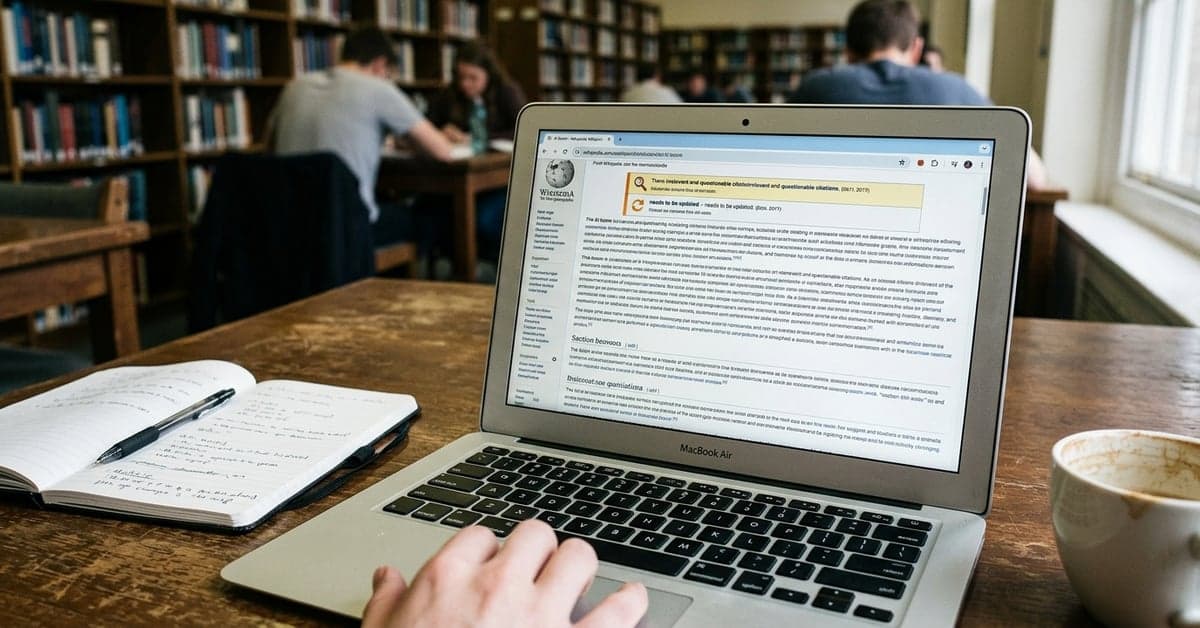
Two warning banners now sit atop Wikipedia’s AI boom entry. One flags “irrelevant and questionable citations” as of June 2026; another says the article “needs to be updated” as of August 2026, both visible on the AI boom page. That’s a clear signal to treat the summary of a fast-changing field with extra care.
What the AI boom Wikipedia notices say
Wikipedia doesn’t add issue templates lightly. On its AI boom article, an editor note states that “this article may have a number of irrelevant and questionable citations,” and invites review on the talk page. A second tag warns the entry needs updating. Both reflect pressure from a field that’s evolving faster than traditional sources can confirm.
The page also frames the topic within Wikipedia’s broader AI coverage, listing it as part of the encyclopaedia’s artificial intelligence series and featuring a Time magazine cover image described as a ChatGPT conversation with a Midjourney-generated dove. It even steers readers to a related topic: for market speculation, see the separate AI bubble article. Together, those cues show editors trying to bound the subject and separate hype from history.
These labels aren’t permanent verdicts. They’re public requests for help: fix sources, trim weak references, and add new, high-quality citations as they appear. In other words, the crowdsourced engine is running, but it’s asking for better fuel.
Why the flags matter for readers and students
The Wikipedia AI boom entry is a popular launch pad for homework, newsroom backgrounders, and investor briefings. When it carries reliability and update tags, readers should assume two things: first, some citations may not meet the site’s own bar for verifiability; second, the narrative may lag new developments until vetted sources exist. That’s by design. Wikipedia prioritizes secondary, reliable coverage over first-person claims, and it discourages overemphasis on fresh headlines under its guidance against recentism.
Fast-moving areas like AI stretch those rules. Corporate blogs, press releases, and conference talks arrive long before peer-reviewed studies or balanced reporting. If editors lean too heavily on promotional or incomplete sources, banners follow. When better coverage lands, those tags can be removed. The lag is a trade-off between speed and quality that readers should understand before citing the page.
How to read the Wikipedia AI boom page like a pro
You don’t have to abandon the Wikipedia AI boom page. Treat it like a map with a legend:
- Scan the maintenance notes first, then click to the talk page if linked. Disputes over sources or scope often explain what’s shaky.
- Open the page history to see recent edits, bursts of activity, and reversions. A flurry of changes can mean facts are still in flux.
- Spot-check a handful of citations. Do they point to independent reporting or to company posts and social media? Wikipedia’s reliable sources guideline sets the standard.
- Use related entries for context. The separate AI bubble page covers financial speculation, which the AI boom entry aims to keep distinct.
These habits turn a flagged page from a risk into a roadmap, showing where consensus is firm and where it’s still forming.
What this says about AI coverage beyond Wikipedia
The tensions on the AI boom Wikipedia article mirror a broader reporting problem. Labs and startups publish results on preprint servers or at events, then hype cascades through feeds before careful synthesis arrives. Encyclopedic summaries need that synthesis, so they trail the buzz. When the gap widens, weaker sources slip in, and editors call time-out with a banner.
That cycle has real costs. Students and general readers may anchor on an outdated description. Reporters scanning for a quick primer might pull a shaky claim into copy. Investors can misread yesterday’s breakthroughs as today’s baseline. The fix isn’t speed for its own sake; it’s disciplined sourcing and clear boundaries between economic froth and technical change—exactly the split Wikipedia signals by separating “AI boom” from “AI bubble.”
Readers can help close the gap responsibly. If you hold a credible secondary source that clarifies a contested point, consider contributing it through Wikipedia’s editing workflow. If you’re a company, resist the urge to treat the page as an extension of marketing. Reliable entries are built on independent coverage; pushing in-house claims only prolongs the maintenance tags.
Where the AI boom Wikipedia page goes next
Expect those warnings to linger until strong surveys, historical retrospectives, or policy analyses arrive that can anchor the narrative. That’s normal for a field that changes by the quarter. The best use of the page today is as a curated index—useful links, contested areas marked in the open, and a reminder to verify before you cite.
The upshot for readers is straightforward: keep using Wikipedia, but read the signs. On AI topics, the signage is part of the story. When the AI boom Wikipedia article drops its banners, it will likely mean the field’s core arcs have stabilized enough for an encyclopedia to summarize without caveats. Until then, treat it like live coverage, and keep one eye on the sources. For more on this, see bloomberg.com and nytimes.com.