
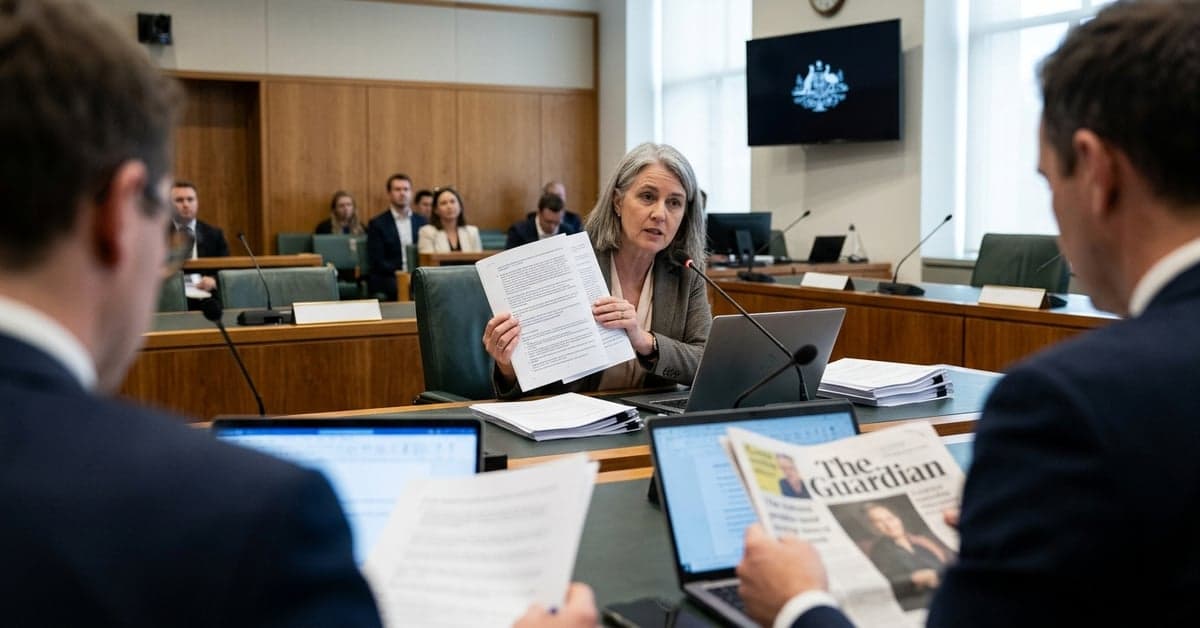
On August 17, 2026, The Guardian reported that a report used to support Australia’s proposed teen social media ban contained links to academic articles that do not exist, raising concerns of Australia AI hallucinations in the evidence base. The authors denied that any references were generated by AI, according to The Guardian’s account of the Senate hearing (The Guardian).
What The Guardian uncovered about Australia AI hallucinations
The Guardian’s analysis said one section of the report included phantom references, flagged during testimony before an Australian Senate committee on August 17, 2026. That detail matters for one reason: legislators were using the document to weigh a nationwide age-based restriction on social media. If even a slice of its citations are fabricated, the committee’s understanding of harms, benefits, and trade-offs could be skewed from the start (source: The Guardian).
The episode echoes a pattern seen in other fields. In 2023, a high-profile U.S. court case exposed how AI tools can produce realistic but nonexistent citations, leading to sanctions when lawyers relied on them. That incident showed how convincing fakes can pass first-glance reviews. The policy sphere is at similar risk, only with higher stakes: budget lines, enforcement powers, and civil liberties.
Why shaky citations can warp real-world policy
Parliamentary committees lean on expert submissions and commissioned research to shape law. If those inputs include fabricated sources, the distortion compounds. A single non-existent meta-analysis can be cited by multiple briefs, echoed in media, and repeated in floor speeches. Before long, the fact pattern hardens. That is how misinformation becomes institutional memory.
There is also a resource cost. Ministries and regulators pivot based on evidence summaries: staffing new compliance teams, drafting guidance, and reallocating grants. If a brief leans on illusions, taxpayers fund work aimed at shadows. For a teen social media ban, schools, platforms, and families would all be asked to change behavior. That’s a heavy lift to justify with clean data, let alone with questionable footnotes pointed out as Australia AI hallucinations.
How to stop hallucinated citations from shaping law
Fixing the problem is less about banning AI than about proof of provenance. Committees can require a short, auditable trail for every claim cited above a defined threshold of influence (for example, any statistic repeated in the executive summary). Four low-friction checks catch most phantom papers:
- Mandate live identifiers. Every cited academic source should include a working DOI or PubMed ID. If it lacks one, authors explain why.
- Spot-check with open tools. Staffers or independent reviewers run random samples through Crossref and publisher sites to confirm the paper exists and matches the quoted claim.
- Declare AI assistance. If generative tools helped draft or summarize, authors disclose which model, which prompts, and how outputs were verified. The U.S. NIST AI Risk Management Framework encourages this kind of process transparency.
- Keep a replication file. Host a simple spreadsheet linking each claim to its source and page number. If the link breaks, the claim is paused until verified.
These steps are not about punishing mistakes. They raise the cost of sloppiness and lower the chance that a sleek PDF, padded with references, sneaks unvetted ideas into law. They also create a paper trail that any journalist, advocate, or citizen can review on deadline.
What this means for platforms, schools, and parents
Platforms face exposure on two fronts. First, if a ban moves ahead on a weak record, enforcement can overreach, then face backlash or legal challenge. Second, if the evidence base is strengthened, firms lose the easy out of pointing to process errors. Either way, credible citations change the incentives, shifting the debate from headlines to hard numbers.
Schools and families need clarity about what will change and why. A ban affects identity checks, parental consent flows, and digital literacy curricula. If the foundation is rattled by Australia AI hallucinations, implementation timelines and budgets become moving targets. That uncertainty is expensive for districts and confusing for parents trying to plan.
Build better briefs: simple guardrails for research teams
Research shops can harden their workflow without slowing down. Treat every LLM output as a draft, never as a source. Use AI to surface candidate studies but verify with human-led database searches. Keep a separate log for anything the model generates—summaries, tables, or bibliographies—so reviewers know where closer scrutiny is required.
Where possible, cite systematic reviews and pre-registered studies. They are not perfect, but they are easier to audit than single, attention-grabbing findings. And if a submission references a yet-to-be-published manuscript, label it clearly and provide a contact for the corresponding author. When gray literature is unavoidable, describe the methods plainly so committees can weigh the quality.
Some governments are already pushing toward provenance. Audit-oriented frameworks, like NIST’s, spell out process controls that public bodies can adapt. Australia’s Senate committees can formalize similar expectations through updated guidance and transparent tender requirements for commissioned research (see the Senate’s committee portal at aph.gov.au).
What to watch next in Canberra
The Guardian’s reporting turns a spotlight on how evidence enters the legislative bloodstream. Expect committee members to seek independent verification of disputed citations and to press authors for their documentation trail. Watch for housekeeping moves—such as mandatory DOI fields in submissions and formal AI-use disclosures—that make fabricated sources easier to spot.
This story is not just about one report. It’s a stress test for how a modern parliament handles tools that write convincingly, fast, and wrong. If the Senate shores up its process now, it will set a template that outlasts this bill and reduces the odds that Australia AI hallucinations steer the next one. If it doesn’t, the price will be paid in misdirected budgets, shaky court defenses, and policies that can’t survive contact with real life. For more on this, see reuters.com and nytimes.com.