
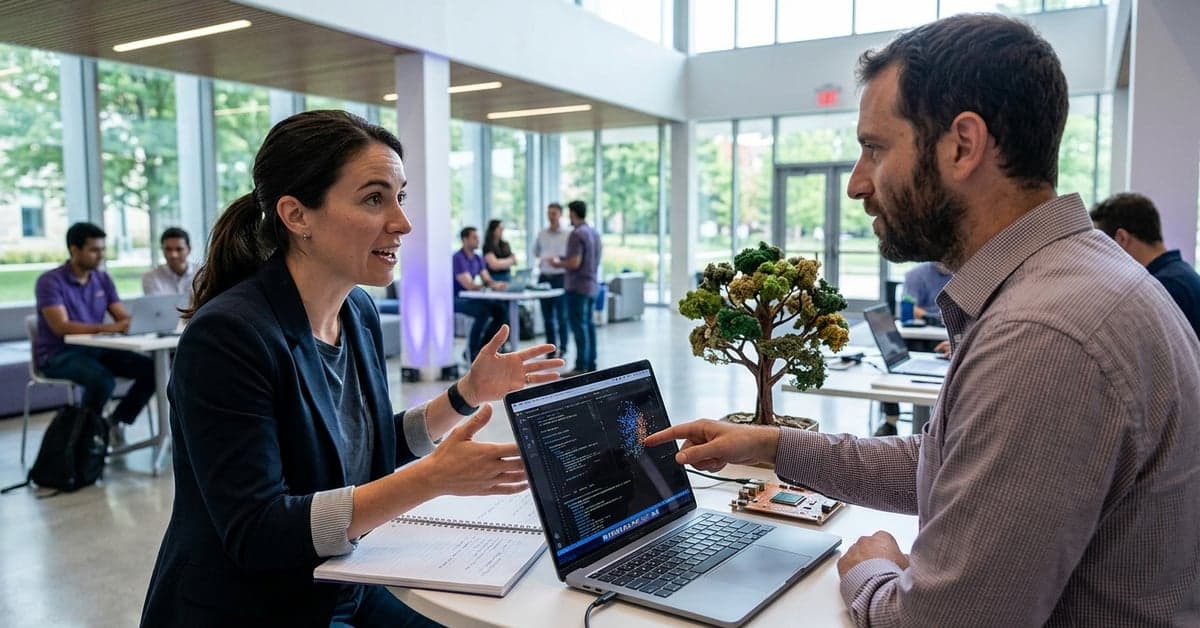
On August 19, 2026, Northwestern University’s Network for Collaborative Intelligence hosted a pair of talks spanning forest canopies to speech recognition. The event, featuring Meta’s Madeline Hinkamp and Technion’s Yossi Keshet, underscored how open-source models and methods are moving from labs into fieldwork and accessibility tools, according to the Network for Collaborative Intelligence (NNCI). That mix — real-world use cases plus open tools — is the thread the Network is pulling through Northwestern’s schools.
What the Network for Collaborative Intelligence is building
NNCI describes itself as a university-wide community for responsible, high-impact AI and data science that links top schools across campus and industry partners beyond it. In plain terms, it’s a coordination layer. The goal is to tie together methods, compute access, and people so a materials scientist can learn from a linguist’s model, or a policy scholar can test an algorithm shaped in engineering. The Network for Collaborative Intelligence positions these links as the fastest route from concept to classroom to deployment.
That coordination is already visible in the program’s public touchpoints. The Summer Speaker Series highlighted how open-source AI can cut costs and speed iteration for field researchers tracking forest structure and for teams improving speech systems. The talks spotlighted a practical stance: use community models when they work, adapt them where they don’t, and reserve proprietary tools for the narrow cases that truly demand them. It’s a signal about where Northwestern sees the balance of power in AI moving — toward shared code, transparent datasets, and reproducible results.
From forests to chips: where the NNCI model shows up
Cross-pollination is clearest when you can point to a result. On July 31, 2026, Northwestern highlighted work led by Professor Chris Wolverton that fuses machine learning, advanced structure searches, and quantum-mechanical calculations to reveal material interfaces that matter for electronics performance. The advance, reported by the McCormick School of Engineering and featured by NNCI, aims to improve the durability and efficiency of devices by finding stable, efficient junctions in complex materials stacks.
That’s not a flashy chatbot. It’s an applied pipeline that connects algorithms to manufacturing outcomes. The approach mirrors what the Network promotes: statistical learning for discovery, domain expertise for validation, and a path to translation. Pair that with open-source talks on environmental sensing and speech systems, and a picture forms of a university trying to standardize the handoff between disciplines. In one month of programming and news, the same playbook spans ecology measurements, human-computer interaction, and materials design.
The emphasis on responsibility is not just branding. It maps to wider guidance like the NIST AI Risk Management Framework, which many campuses use to shape safe development. Building a network rather than a siloed institute creates natural friction checks: a social scientist can stress-test a model a computer scientist built; a legal scholar can catch data rights issues early; an educator can flag where a tool misses students with disabilities. NNCI’s structure makes those collisions easier, and more routine.
Open-source as the working default
Across the August talks, NNCI leaned into open ecosystems. That aligns with industry’s turn toward transparent models and tooling for research and deployment. Meta’s AI group, for example, has promoted open releases and community development on core components, a stance detailed across Meta AI’s research pages. Technion’s speech research tradition offers another angle: rigorous modeling that’s meant to be inspected, replicated, and upgraded in the open. NNCI’s programming placed those values at center stage.
Why that matters for a campus network: open components lower switching costs. A lab can test a general model, fine-tune it on a small dataset, share the code, and let peers push back. That creates a living baseline other groups can improve without starting over. For students, it means they can walk into an internship having already worked on code their host company recognizes. For industry partners, it reduces audit headaches because the model history is clearer.
Responsible adoption also depends on visibility into data and model behavior. Open code and documented datasets aren’t a cure-all, but they shrink the gap between what a system does and what stakeholders think it does. That’s the core of NNCI’s pitch when it calls for “responsible, high-impact” work: make the assumptions legible, then let many hands test them.
Why this networked model matters to researchers and students
Universities have run AI labs for decades. The shift here is scale and connective tissue. The Network for Collaborative Intelligence acts as a rover, not a starship: it goes out to where the research lives, pulls in people and problems, then sets up new routes between them. For a materials group, that might mean an easy on-ramp to advanced structure search methods. For a linguistics lab, it could be a channel to deploy speech tools in clinical studies. The network makes those transactions normal.
Several payoffs follow:
- Faster translation: Common tooling and shared compute mean a dataset gathered in the field can be modeled in days, not months.
- Better scrutiny: When methods move across schools, blind spots show up earlier, and fixes arrive with fewer sunk costs.
- Talent velocity: Students build portfolios on public repos and papers, making hiring signals clearer for companies that value reproducibility.
There is a broader labor story here. AI hiring rewards breadth and shipping experience, yet many curricula still split those goals. A networked model encourages both: breadth across collaborators, shipping through open artifacts. If NNCI sticks to that, graduates will show up ready to contribute to multi-disciplinary teams on day one.
What to watch next from Northwestern’s AI network
According to the NNCI site, the network is inviting faculty, educators, students, and industry leaders to join projects that tie AI to societal needs. That open door matters as new funding and compliance pressures push universities to show real-world impact. Expect more programming that pairs domain problems — such as climate monitoring or health access — with model choices that can be audited and reproduced.
The next marker of progress will be whether the Network for Collaborative Intelligence publishes shared assets that travel: benchmark datasets from field studies, deployment checklists for applied labs, and starter kits for clinics or museums that want to pilot AI tools. Those artifacts would turn a campus network into a regional resource. If that happens, the Midwest gains a steadier supply of open, inspectable AI building blocks for companies and civic groups.
Northwestern is betting that a network beats a single center when the work spans forests, voices, and materials at once. The Network for Collaborative Intelligence has already used that approach to surface applied wins and shared methods across schools. If the pattern holds, more labs will ship code and datasets alongside papers, and more students will graduate with open, verifiable work in their portfolios.
That’s a directional change for how universities organize AI. And it’s one worth tracking, because it scales beyond one campus. A living network, fed by open tools and backed by cross-school teams, can move faster than any one lab. Northwestern’s NNCI is the test case in front of us. For more on this, see reuters.com and bloomberg.com.
Related reading: AI Update • Automation • Generative AI