
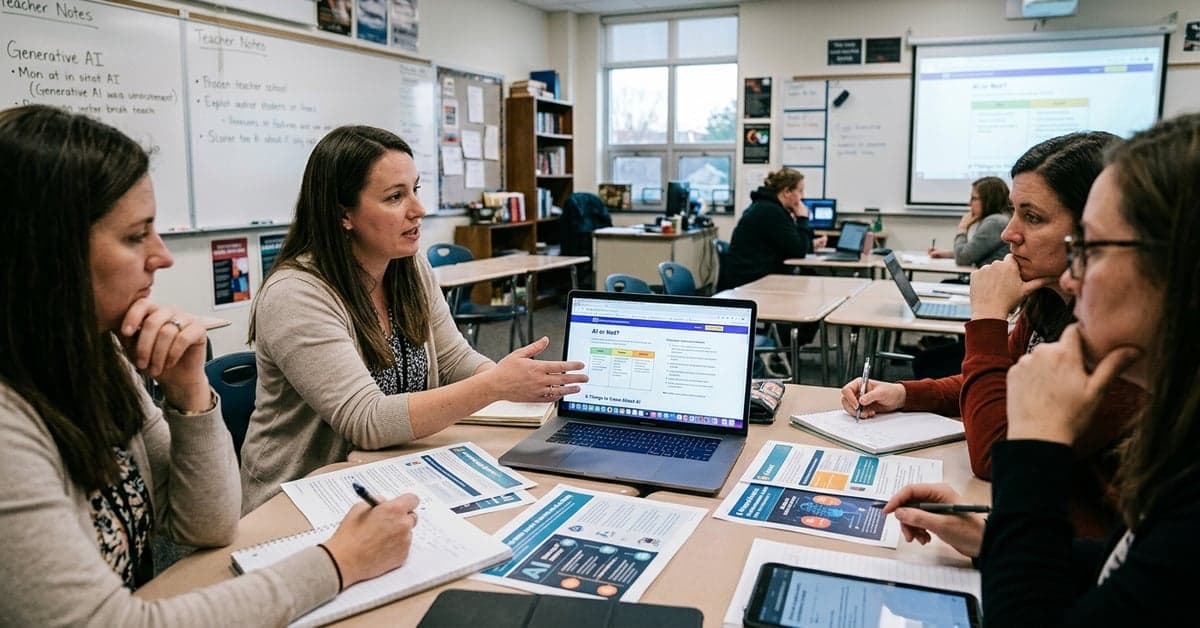
The News Literacy Project offers a one-stop hub of free classroom materials on artificial intelligence, from an “AI or not?” lesson plan to a “6 Things to Know About AI” infographic, built to help teachers handle the generative ai latest in real time. The resources are designed for social studies, English, media, and advisory periods, not just computer science.
Why schools need help with the generative ai latest
Teachers are being asked to teach with and about AI while misinformation spreads faster and looks sharper. According to the U.S. Department of Education’s Office of Educational Technology, schools should emphasize critical thinking, transparency, and human judgment when they adopt AI tools, as outlined in its guidance published on May 2023 (U.S. Department of Education). UNESCO also urges educators to build foundational AI literacy and clear disclosure practices, especially with generative models that can convincingly fabricate media, in guidance released on September 7, 2023 (UNESCO).
The News Literacy Project’s approach lands squarely in that gap. Rather than training students to write code, it gives them short, adaptable activities that teach verification moves and habits of mind. That makes it easier for any teacher to address the generative ai latest without new software, extra devices, or a semester-long rewrite of their syllabus.
Inside the toolkit: quick wins teachers can deploy
On its AI page, the organization curates materials that range from bell-ringers to full lessons (News Literacy Project). Two anchors stand out: an infographic titled “6 Things to Know About AI,” which distills core takeaways for students, and a lesson called “AI or not?” that includes activity slides plus extension ideas. The former helps classes set a common vocabulary. The latter turns AI detection into a structured inquiry, not a guessing game.
Beyond those entries, the group folds AI into its ongoing classroom stream, The Sift. Teachers can pull “Daily Do Now” slides focused on AI, assign Sift quizzes on artificial intelligence, or explore “Dig Deeper” explainers on chatbots and AI basics. Because these pieces are built for short sessions, they fit into tight schedules and cover more than jargon. They show how to read claims, ask better questions, and corroborate.
RumorGuard, the organization’s series that explains viral rumors and the evidence behind them, adds another track. Each post comes with slides so educators can model verification in front of students. That’s where the content meets real life: a class can analyze how an AI-generated claim spread, what specific signals were missed, and how to check them next time, all within a single period. The result is a pathway for teaching the generative ai latest through concrete cases rather than abstract warnings.
- “6 Things to Know About AI” infographic for quick framing
- “AI or not?” full lesson with slides and extensions
- Daily “Do Now” AI slides and Sift quizzes for practice
- RumorGuard posts and ready-to-teach slide decks
Every item is free and designed to be adapted, which matters for districts with uneven access to devices or paid platforms. A teacher can run an unplugged discussion, a slideshow-driven inquiry, or a short media-analysis task using links or screenshots captured in advance.
Teaching generative AI without a computer science degree
Many AI lessons on the web focus on prompts, productivity tips, or novelty. The News Literacy Project’s materials focus on epistemology: How do you know what you think you know? That framing mirrors the Department of Education’s emphasis on human oversight and evidence (U.S. Department of Education). It also lines up with UNESCO’s call for educator-ready, non-technical approaches that help students judge AI output and understand limitations (UNESCO).
The “AI or not?” lesson is a good example. The plan points teachers to activity slides and extension ideas, which let them scale difficulty from basic comparisons to deeper analysis of sources and claims (News Literacy Project). A class can interrogate a headline, examine an image for context clues, and then check an original source. Those are the same moves journalists and fact-checkers use daily.
There’s also a forward-looking thread running through these materials: provenance and labeling. As industry and publishers expand content credentials, understanding signals like provenance metadata becomes part of media literacy. Teachers who introduce verification workflows now will be ready to explain those signals as they reach students. The C2PA coalition’s work on content credentials shows where this is headed, and classroom practice can prepare students to read those labels with healthy skepticism.
How it fits policy guidance—and what’s still missing
Policy documents are clear on the “why,” less clear on the “how.” The Department of Education recommends human-in-the-loop decision-making and documentation for AI use, but it stops short of telling a ninth-grade civics teacher what to do on a Tuesday. UNESCO stresses transparency and equity, yet every school’s constraints differ. The News Literacy Project fills that practical gap with classroom-ready slides, quizzes, and explainers that a teacher can run tomorrow.
That makes the set valuable in districts without dedicated media literacy courses. English teachers can anchor a unit on argumentation with the AI infographic. Social studies classes can use RumorGuard slides to analyze a viral claim about an election. Advisory periods can use Daily Do Now prompts for ten-minute media workouts. It’s a menu designed for scarcity: scarce time, scarce PD, scarce tech.
The missing piece is system-level adoption. Resources like these scale when districts build them into pacing guides and assessments, when PD time is carved out, and when administrators align them with standards. The materials already track the generative ai latest through examples and flexible activities. Without scheduling and accountability, they risk staying optional extras.
What to watch as classrooms face the next wave
Generative models are iterating quickly, and so are the tactics that exploit them. That means more convincing audio fakes, faster image churn, and chat outputs that mix facts and fiction with ease. A nimble, free library that updates through a newsletter and rumor analysis is well suited to that pace. The News Literacy Project’s approach—short, verifiable, and cross-curricular—gives teachers a fighting chance to keep instruction aligned with the generative ai latest rather than a semester behind it.
Two signposts will show whether this sticks. First, do districts embed these lessons into core courses, not just electives? Second, do students start to narrate their verification steps unprompted, the way they cite sources or check a rubric? If the answer is yes, the next wave of AI will meet a student body trained to slow down, cross-check, and ask for evidence.
For now, the path is clear. Pick a class period, open the “AI or not?” slides, and let students test claims against proof. The tools are there—and they meet the moment. For more on this, see bloomberg.com and nytimes.com.