
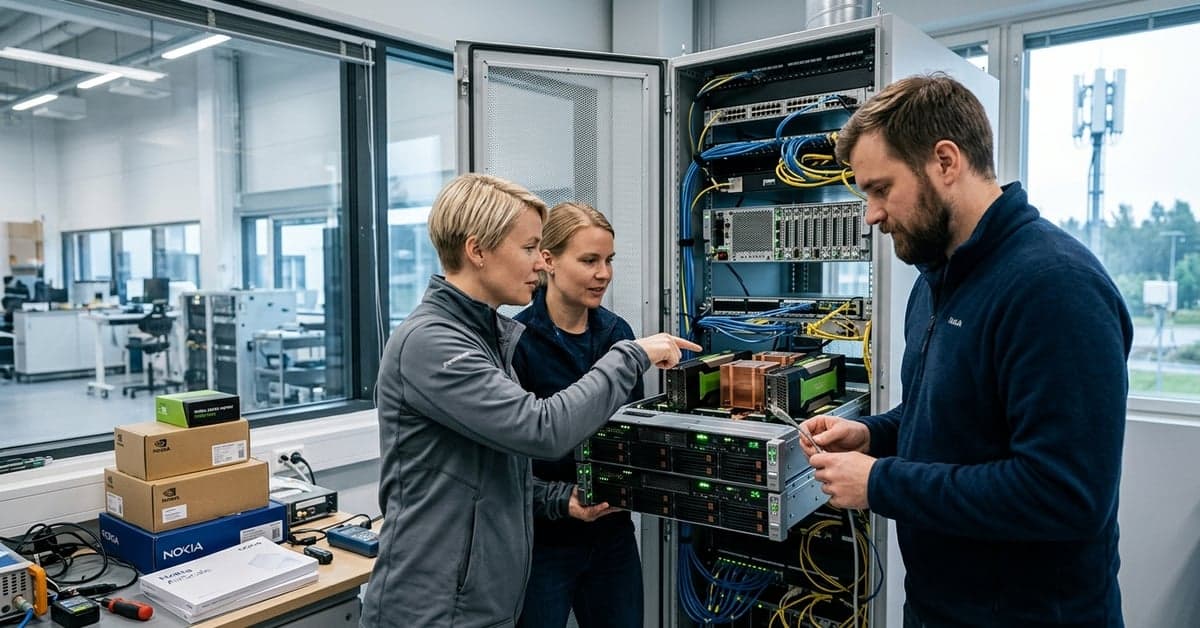
On July 15, 2026, Artificial Intelligence News reported a radio comeback at Nokia: an AI-RAN platform running on NVIDIA hardware. The headline signals more than a tech refresh. It points to a bid to repair operator margins while opening fresh enterprise sales.
That’s the story to watch. If Nokia can prove GPUs and AI control loops lower total cost per bit, telcos get breathing room. If it also shortens time to market for new enterprise offers, they get growth.
What the Nokia AI-RAN platform actually promises
Based on the reporting by Artificial Intelligence News, the Nokia AI-RAN platform centers on running radio workloads and AI inference on NVIDIA accelerators. In plain terms, the physical and MAC layers shift from fixed-function silicon toward general-purpose compute with GPU offload. That opens the door to tighter AI feedback loops for scheduling, beamforming, and interference mitigation.
NVIDIA has been courting this model for years with its Aerial software stack, which brings CUDA-accelerated libraries to RAN functions and edge AI apps. The pitch: one pool of accelerators hosts Layer 1, serves AI models near the cell, and scales like cloud. An operator that sees both capacity gains and fewer site visits gets a quick return. If enterprise apps can also sit on the same edge stack, sales teams get something new to sell.
That’s why a GPU-powered RAN isn’t just a speed play. It’s an opex and product velocity play. The Nokia AI-RAN platform will be judged on those two outcomes more than lab benchmarks.
Where the 5G business growth could come from
Operators have been searching for growth outside classic connectivity. Two areas align with AI-enabled RAN: private 5G for factories, hospitals, and campuses, and exposing network capabilities as APIs. The first is an enterprise sale with service-level demands. The second, pushed by industry efforts like GSMA Open Gateway, packages network features—quality on demand, location, security—as developer-facing products.
Running radios and AI inference on the same acceleration fabric could speed both tracks. For private 5G, an operator can drop a compact, software-defined footprint on site, then tune performance with AI models trained on local data. For APIs, a more programmable RAN and edge makes it easier to guarantee behavior, measure it, and bill for it. None of this requires hype. It requires repeatable deployment, stable latency, and clean observability across the stack.
That’s the angle many missed in the initial headlines. A GPU-assisted RAN is a means to an end: higher contract renewal rates, more share in verticals that want control, and a bundle that doesn’t look like commodity bandwidth.
Inside the NVIDIA-powered RAN shift
The industry context matters. Virtualized and cloud RAN designs have been maturing under 3GPP and open RAN efforts. 3GPP’s Release 18 brings more explicit AI/ML hooks into radio procedures. The O-RAN Alliance has defined near-real-time RIC and xApps to keep optimization loops close to the network. NVIDIA’s push stitches these pieces to a common accelerator layer. Nokia is now betting it can integrate, harden, and support that end to end.
The benefits are obvious on paper: elastic scaling as traffic ebbs and flows, software updates that deliver gains without truck rolls, and the chance to run inference where the data is born. The risks are equally clear. Power budgets at cell sites are tight. GPUs cost money. Tooling and skills for cloud-native RAN operations are still uneven across markets.
That’s why design choices matter. Use accelerators where they pay back. Keep interfaces open enough to avoid lock-in. Bring observability up to the same level operators expect in IT stacks. And be honest about what belongs at the far edge versus a regional zone.
What to watch as operators trial Nokia’s approach
Procurement and power. Those two words will shape early results. If the Nokia AI-RAN platform can hit energy-per-bit targets with realistic traffic loads, CFOs will listen. If it can bundle radio and AI capacity in a way that flattens site sprawl, CTOs will move faster.
Interoperability will be next. Open interfaces from O-RAN promise supplier flexibility, but real-world multivendor vRAN still tests patience. Buyers should insist on documented performance with third-party radios, DUs, and RIC apps. They should also push for clear migration steps from existing basebands to GPU-accelerated sites without long outages.
The enterprise angle deserves hard questions too. Can edge GPU capacity be partitioned safely between radio duties and AI apps? What are the guardrails when a hospital or factory wants to deploy its own model at the site? Standards bodies like ETSI ENI are shaping policy-driven management for these cases, but operators will own the service-level outcomes.
Talent is the final swing factor. Success needs radio engineers who think in containers and MLOps engineers who respect RF realities. Vendors can supply reference designs and playbooks. The operating model needs to live inside the carrier.
If those pieces line up over the next few quarters, the Nokia AI-RAN platform could do what the headline promised: bring radio back to the center of Nokia’s growth story and give operators a path to better margins. If not, it will be another well-aimed idea blocked by field constraints. Either way, the bet on NVIDIA puts a clock on results. For more on this, see developer.nvidia.com and reuters.com.