
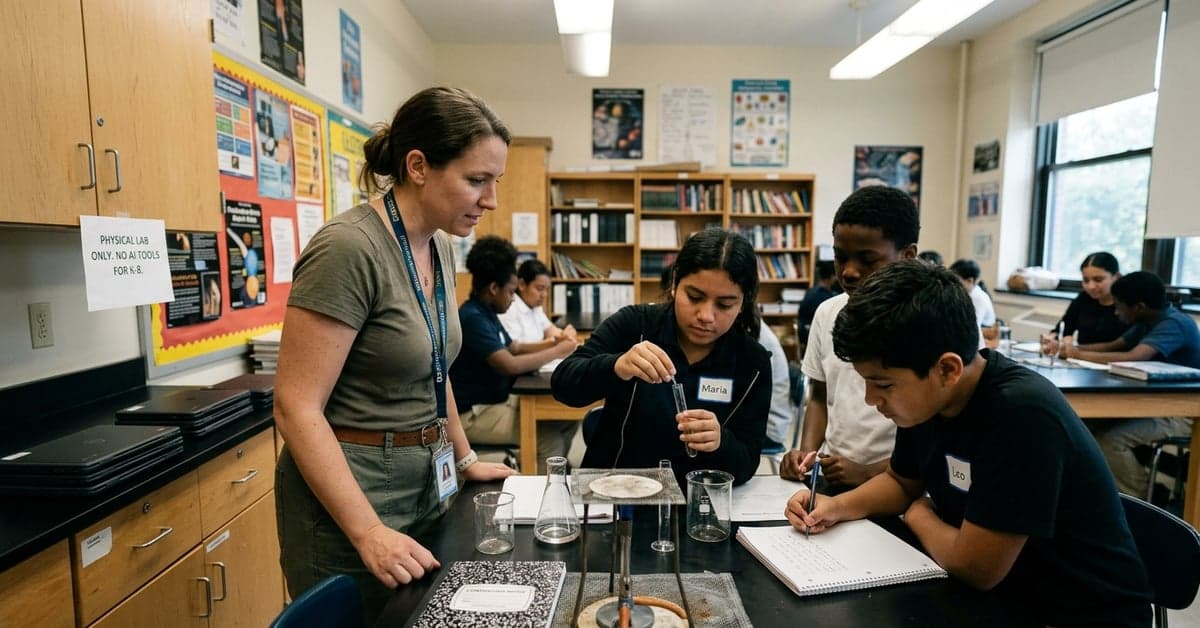
More than half a million New York City students will start the 2026–2027 school year under a ban on AI through eighth grade, according to ABC News on September 2, 2026. The NYC schools AI ban covers pre‑school/2‑K through grade 8, making it the most expansive moratorium in the country, the district told ABC.
In a statement to ABC, New York City Mayor Zohran Mamdani said the city would impose a yearlong pause to study the technology’s effects. “The tech industry wants us to believe that A.I.-powered early education is not only inevitable, but necessary,” he said, adding, “We do not see it that way.” High schools are excluded from the moratorium; those students will instead receive twice‑yearly AI literacy classes intended to build critical thinking before they “rely” on the tools, the district said. The move follows last year’s bell‑to‑bell cell phone restrictions during the instructional day, also cited by ABC.
What the NYC schools AI ban actually covers
New York City Public Schools told ABC it will remove software that includes student-facing AI software and will ban companion chatbots for K‑8. That sweeps in apps that embed generative text, image assistance, or conversational help directly into the student experience. The district framed the step as a pause to observe outcomes, not a permanent stance, and plans to spend the year “studying the impacts of this technology.”
Practically, that means classroom products used by younger grades will need AI features turned off or removed. The district characterized this as a child‑development choice as much as a technology call: leaders urged students and teachers to “develop connections” and strengthen relationships without algorithmic intermediaries. For grades 9–12, schools will keep access while inserting twice‑annual instruction on how AI works, where it fails, and how to question outputs—an approach that mirrors federal guidance to pair exposure with explicit skill‑building. The U.S. Department of Education’s Office of Educational Technology has pressed for careful, teacher‑led use with guardrails since May 2023, in its AI in teaching and learning brief.
Why the moratorium stops at grade 8
The district’s line at middle school reflects two ideas embedded in the announcement ABC reported: very young learners benefit from face‑to‑face practice with reading, writing, and discussion, and older students can weigh AI with skepticism when taught how. That’s why high schoolers get AI literacy classes rather than a ban. Twice‑yearly sessions are meant to seed habits around verification and citation, and to make clear where chatbots can misstate facts or copy style without attribution.
That split stance—pause for younger students, guided exposure for older ones—fits a broader pattern in education policy. Districts are trying to reconcile the promise of tutoring‑like support with risks to privacy, academic integrity, and developmental needs. New York’s approach doubles down on developmental pacing while reserving judgment about long‑term use.
What changes on day one for teachers and edtech
Because the district will “eliminate software that uses student‑facing AI” and bar chatbots, many default features will need to be shut off in K‑8 settings. Expect these operational shifts:
- Vendors will be asked to disable text‑suggestion, summarization, and chat modes for student accounts in grades K‑8. Large platforms already offer admin switches to turn off generative tools—Google and Microsoft document controls for education tenants (Google Workspace admin settings for Gemini; Microsoft Copilot for Education controls).
- Teachers relying on embedded hints or writing help in learning apps may see those modules disappear for K‑8 students. Lesson plans that counted on AI‑assisted drafting or quick feedback loops will need alternatives.
- Any “companion” bots built into learning management systems, reading apps, or math practice tools will be switched off for younger students, even if the rest of the product stays.
- Vendors handling student data will face heightened scrutiny under New York’s student privacy rules, including Education Law 2‑d requirements on data minimization and security (NYSED student data privacy).
For families, the visible change will be simpler: fewer “Ask the AI” buttons in elementary and middle school apps, and more emphasis on teacher‑led discussion. For high schools, access remains paired with instruction, so parents may see handouts or sessions tied to the new literacy courses that explain model limits, mistakes, and acceptable use.
How the NYC AI moratorium will be judged
ABC reported the city plans to spend the year studying the technology’s impact. That framing raises obvious benchmarks to watch:
- Student work quality in K‑8 without AI prompts: do writing fluency and math explanations improve, hold steady, or slip?
- Teacher workload: do grading and feedback times rise when AI‑assisted tools are disabled, and if so, how do schools compensate?
- Academic integrity incidents: do high schools see fewer AI‑related plagiarism cases after literacy sessions roll out midyear?
- Equity: does the split policy widen or narrow gaps between schools with different staffing and tutoring supports?
The NYC schools AI ban also interacts with last year’s bell‑to‑bell phone limits, cited by ABC, which curbed device use during instruction. Together, the two moves tilt the classroom toward human‑led talk and paper‑first drafting in the early grades. That shift could buy time for researchers to study AI’s value for young learners and for districts to build clearer rules around provenance and consent. It could also pressure vendors to offer clean “AI‑off” modes rather than burying settings in admin panels.
Parents and educators won’t need to guess how the city interprets “student‑facing AI software.” Expect updated vendor guidance and acceptable‑use policies from the district and school administrators. NYC DOE’s standing materials on digital citizenship already guide teachers on responsible tech use; the moratorium will likely sit alongside those principles as a temporary rule (NYC DOE digital citizenship).
What’s next as New York studies AI
As of September 2, 2026, ABC reports New York City has drawn the clearest K‑8 line of any major district, while keeping high school access paired with literacy. The city calls it a one‑year pause. What happens in June 2027 will turn on three forces the announcement only hints at: evidence from classrooms, clear privacy rules, and the maturity of admin controls in common apps. The federal guidance already favors educator‑in‑the‑loop uses; local data will show whether that’s workable at NYC scale.
For now, the NYC schools AI ban sets a clean, testable policy. It gives younger students a year of human‑only practice and gives high schoolers tools with guardrails. By June, the city will have real numbers—and far fewer hypotheticals—to decide what sticks. For more on this, see reuters.com and bloomberg.com.