
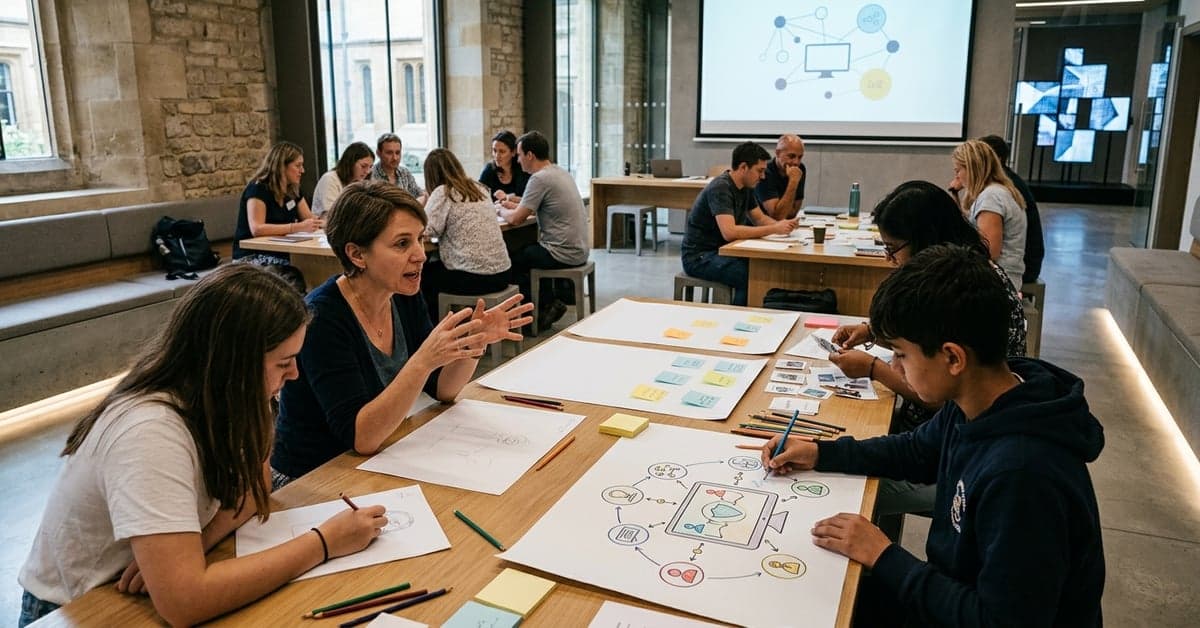
On September 16, 2026, the University of Oxford’s Department of Education announced a public call for visual submissions that will help illustrate generative AI product safety in UK schools. Working with the Department for Education (DfE), the team plans an online resource that turns policy into pictures—imagined classroom tools, screens, and prompts that show what safe and unsafe AI might look like in practice. The project is designed to support a forthcoming government consultation, according to Oxford’s announcement.
Oxford’s Principal Investigator Dr Sara Ratner said the work brings children, teachers, and caregivers into active policy-making. In her words, the resource “puts their voices and lived experiences front and centre” in shaping responsible AI use in schools, as quoted by the university’s Department of Education.
What the call says about generative AI product safety
Oxford and the DfE are seeking speculative designs—mockups of imagined products or user interactions—that explore a specific area of the DfE’s Generative AI Product Safety Standards. The brief asks contributors to show three kinds of scenarios: compliant examples, non-compliant examples, and edge cases that sit in the grey areas. It is not a review of real products but a design exercise that makes abstract rules visible in context, Oxford says.
Contributors are asked to pick a concrete use case in education—homework help, assessment feedback, lesson planning, safeguarding prompts, or parental dashboards—and create visual examples of how a system would behave. The goal is to show how a single requirement might appear on screen, which choices would be offered to users, and where a design could fall short. That framing aligns with the UK’s recent push to make AI guidance actionable for schools; the DfE’s guidance on AI in education focuses on practical adoption and risk management rather than blanket bans (Gov.uk guidance).
Why visual safety standards matter for schools and vendors
This call does more than collect pretty mockups. It uses scenario design to close a costly gap between policy text and classroom reality. Standards written in prose often leave room for reasonable but conflicting interpretations. A visual reference set—good, bad, and borderline—can act as a common language for governors, headteachers, and vendors. That makes procurement faster and audits clearer.
Consider a few recurring pressure points in school AI deployments. Age-appropriate defaults. Data minimisation and retention limits. Clear disclosure that a response is AI-generated. Assisted, not automated, high-stakes decisions. These are familiar themes in the UK’s broader children’s privacy regime, including the Information Commissioner’s Office Children’s code. Yet they are far easier to debate when pictured as on-screen settings, prompts, and flows rather than as abstract principles. Oxford’s brief is structured to produce exactly those pictures.
The timing also fits the national agenda. Since the government’s 2023 AI Safety Summit at Bletchley Park, the UK has encouraged sector-specific guidance and risk profiling over one-size-fits-all rules (AI Safety Summit collection). Education is a high-stakes domain where trust is built in classrooms, not conference rooms. This project signals that the next phase for schools is implementation detail—the kind that helps a multi-academy trust write a specification, or a small edtech team ship a compliant onboarding flow.
For vendors, these exemplars could become the de facto templates that buyers expect to see. A procurement pack with screenshots that mirror a public reference example will face fewer hurdles than an unfamiliar flow. For schools, the resource could underpin policy training: what a safe flagging system looks like, how appeals show up to a student, where staff oversight is required by default. In short, it translates generative AI product safety into day-to-day practice.
What to submit, and who should apply
Oxford’s call invites a wide mix of contributors—students, teachers, school leaders, caregivers, designers, and edtech builders. The common brief: pick a specific feature or interaction and show how it would work in the real world under the standard you want to illustrate. Submissions can be single screens, short sequences, or annotated storyboards.
- Show one requirement clearly. For instance, how consent is requested, or how a human review step is triggered before a grade is changed.
- Provide a compliant version, a non-compliant version, and an edge case. The contrast helps policymakers test the boundary lines.
- Annotate decisions. Labels and short notes should explain which requirement is addressed and why an element is necessary.
- Keep it educational. Scenarios should fit real school contexts—primary, secondary, SEND settings, and parental engagement.
The brief stresses this is a speculative design exercise. That matters. It lets the DfE examine sensitive failure modes without calling out a company by name. It also makes space for lived experience—how a year-eight class might react to a content warning, or how a teacher manages a false positive—without entangling anyone in a product endorsement or critique.
What this could mean next for the DfE standards
Oxford’s resource is being developed to support a government consultation on AI safety in education, per the university’s summary. That creates a straight line from public submission to policymaker reading list. If the strongest examples converge on common patterns—say, a standardised disclosure banner or a consistent parental notification flow—expect those motifs to surface in guidance, training materials, and procurement checklists.
The project also helps reconcile overlapping duties schools already face. Ofcom’s emerging Online Safety Act duties will shape expectations for content risks and reporting flows (Ofcom online safety). The ICO’s Children’s code influences defaults and data flows. DfE guidance addresses teaching practice and governance. Visual exemplars that thread all three will lower the cognitive load for busy leaders trying to stay compliant while adopting useful tools.
There is a pragmatic upside too. Visual references can surface trade-offs early—accuracy versus latency, privacy versus personalisation, or false positive rates versus safety nets—so the policy conversation can focus on thresholds, not hypotheticals. That feedback loop is vital if generative AI product safety is to become a working standard, not just a paper promise.
Oxford’s announcement leaves room for creativity and critique. By inviting compliant, non-compliant, and edge-case designs side by side, it encourages honest debate about where guardrails should sit. For classrooms deciding whether to switch on a new assistant, and for vendors choosing defaults, that is where generative AI product safety becomes real.
Submissions and project details are available via the University of Oxford’s Department of Education. The brief is open to people closest to the classroom, and to those shaping the tools they will use. If a good standard is a shared reference, a clear picture can go a long way toward safer AI in schools—and toward generative AI product safety that everyone can see. For more on this, see bloomberg.com and nytimes.com.
Related reading: AI Update • Automation • Generative AI