
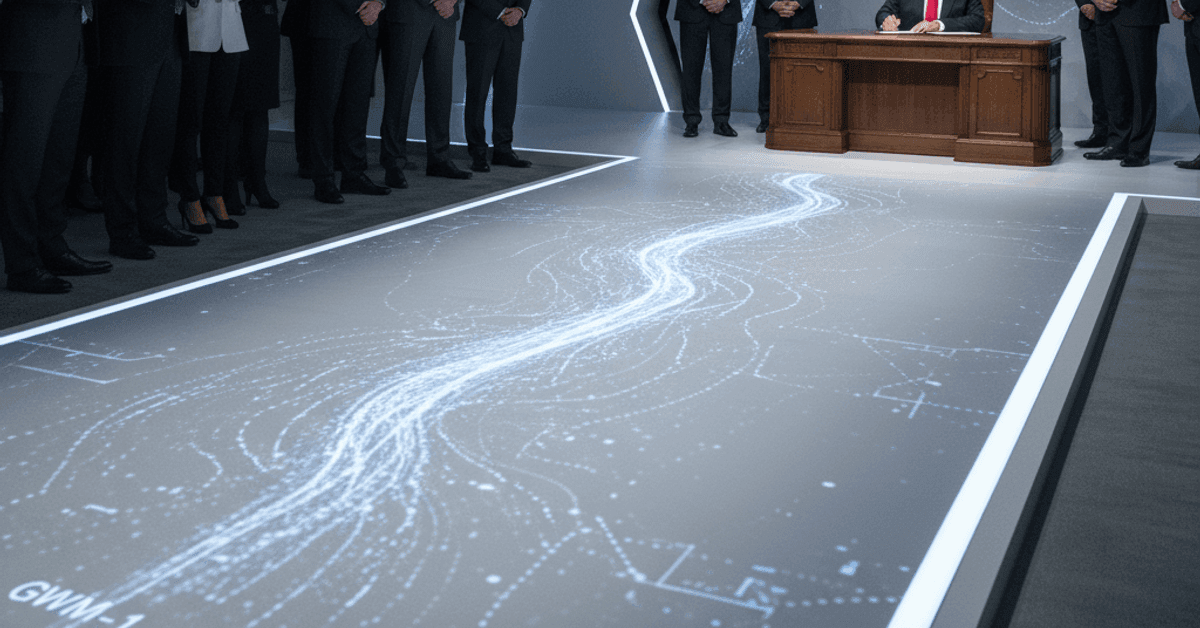
Runway launched Runway GWM-1, a family of “world models,” as President Donald Trump signed an AI executive order that pressures states on regulation. The pair of moves highlights fast product progress and a sharper policy turn. Together, they signal a new phase for generative AI.
Runway GWM-1 world model explained
Runway’s GWM-1 introduces an approach that extends beyond clip-length video generation. The company describes “world models” that maintain coherence across long sequences. According to Ars Technica, Runway claims GWM-1 can stay consistent for minutes in some scenarios.
GWM-1 is built on top of Runway’s Gen-4.5 text-to-video model. Furthermore, the system is post-trained with domain data for distinct use cases. Runway describes a trio of autoregressive models under the GWM-1 umbrella. One component, called GWM Worlds, lets users define environments, rules, and physics.
Users can issue real-time inputs like camera moves or scene edits. As a result, the system adjusts subsequent frames to match new instructions. The approach resembles advanced frame prediction rather than full simulation. Even so, Runway asserts useful stability across extended motion sequences.
Potential uses span pre-visualization, interactive concepting, and rapid prototyping. Additionally, long-horizon coherence could reduce costly manual stitching. That shift may change how teams plan, explore, and iterate visual ideas.
AI executive order targets state AI laws
On the policy front, the White House signed an order that seeks a national framework. The move takes aim at state AI rules seen as “onerous” by the administration. As Wired reports, the order creates an AI Litigation Task Force at the Justice Department.
The task force will challenge state AI laws that conflict with federal priorities. Moreover, the Department of Commerce will draft guidelines that link future broadband funds to state policy choices. States that advance strict AI measures could face eligibility risks for those funds.
The order cannot directly erase existing state statutes. However, it directs federal agencies to undercut such laws through litigation and incentives. It also discourages legislatures from passing rules that Washington may contest later. The push reflects pressure from some investors and trade groups.
During the signing, the administration and advisers emphasized national competitiveness. They argued that a patchwork of state policies could hinder innovation. Meanwhile, The Verge notes the order singled out Colorado’s new consumer law as overbroad. The text claims certain “algorithmic discrimination” bans could force false outputs.
Policy advocates will contest that framing. In contrast, civil society groups may argue that guardrails need local tailoring. Therefore, a legal clash over AI federalism now looks likely. The order also calls for legislative recommendations to cement this stance.
Why world models matter for generative AI
World models promise continuity across time and space, not just single shots. Consequently, they could bridge a key gap between static prompts and dynamic scenes. Stable environments enable interactions that feel less brittle and more useful.
Filmmaking pre-vis and game prototyping are obvious beneficiaries. Still, design, robotics teleoperation, and education could gain from responsive worlds. Notably, long-horizon planning requires consistent object identities and physics. That is where GWM-1 claims progress, though independent validation remains essential.
The method also fits a broader research trend. Google, Nvidia, and others have explored learned representations of environments. These efforts aim to compress dynamics into manageable state. As a result, systems can predict plausible futures from compact latent worlds.
Runway’s approach builds atop a strong text-to-video model. That foundation makes authoring fast and flexible for creators. However, solving stability remains a tall order across diverse scenes. Benchmarks and third-party evaluations will matter for credibility.
Regulation, funding, and the innovation lens
The executive order’s funding lever could reshape state priorities. Broadband dollars often carry substantial economic weight. Therefore, the linkage to AI policy will attract attention in capitols. Agencies will now define what qualifies as “onerous.”
Industry argues that predictable national rules reduce compliance costs. In practice, preemption disputes can take years to settle in court. During that period, companies still navigate overlapping rules. Clear federal guidance could ease that friction, if it arrives soon.
At the same time, safety advocates warn against lowering protections. They point to risks from synthetic media and automated decision systems. Additionally, they note that states often pilot protections before Congress acts. A strict federal stance could stall local experimentation.
The order arrives as agencies refine their AI frameworks. The NIST AI Risk Management Framework already guides many organizations. Alignment with that approach would ease adoption across sectors. Divergence could create confusion during implementation.
How GWM-1 compares to a text-to-video model
A text-to-video model generates shots directly from prompts. By contrast, a world model maintains a persistent scene and latent state. Consequently, agents and cameras can move through a coherent environment. That difference unlocks interactivity without constant re-prompting.
Runway’s stack pairs Gen-4.5 with world modeling layers. The company claims improved temporal consistency over standard generation. However, world models can still drift over long runs. Guardrails and corrective feedback remain critical for quality.
Evaluation will hinge on stability, controllability, and latency. Creators need predictable edits that propagate across frames. Furthermore, teams want clear failure modes and reproducibility. Reliable handoffs from pre-vis to production also matter.
Implications for teams and timelines
Studios and agencies may fold GWM-1 into early ideation. Faster loops can reduce cost and enable broader exploration. As a result, directors can test staging before committing resources.
Policy turbulence may influence deployment plans as well. Companies often adjust features based on compliance risk. If state rules weaken, firms might ship broader capabilities. Conversely, legal uncertainty could delay rollouts in some markets.
Procurement decisions will track risk frameworks and funding signals. Public-sector buyers watch federal guidance closely. Therefore, agency definitions could govern which tools qualify. That filter may shape demand for controllable world models.
What to watch next
Expect rapid iteration on world models in early 2026. Competitors will tout longer horizons and better controls. Independent benchmarks will test claims under strict protocols. Moreover, creators will share case studies that reveal practical limits.
On policy, the task force’s first challenges will set tone. States may revise bills to preserve funding eligibility. Courts will weigh preemption claims against local interests. Congress could receive proposals that codify parts of the order.
For now, GWM-1 expands what creative tools can do in real time. The executive order, in turn, seeks to narrow who sets the guardrails. Together, these moves illustrate AI’s dual-track moment. Innovation accelerates as governance hardens, and both tracks will shape outcomes.
Stakeholders should prepare for quick shifts on both fronts. Teams can pilot world models in constrained workflows first. Additionally, compliance leads can map state and federal requirements. With that, organizations can move fast while staying within evolving rules.
The next few months will test the durability of each claim. Runway’s promises face real-world productions and tight timelines. The White House order faces politics, courts, and state pushback. Consequently, results will depend on execution as much as ambition.
If the technology scales, longer, coherent sequences may become standard. If the policy holds, a single federal baseline may dominate. Either outcome will shape the tools and norms of generative AI. The stakes, and the tempo, continue to rise.