
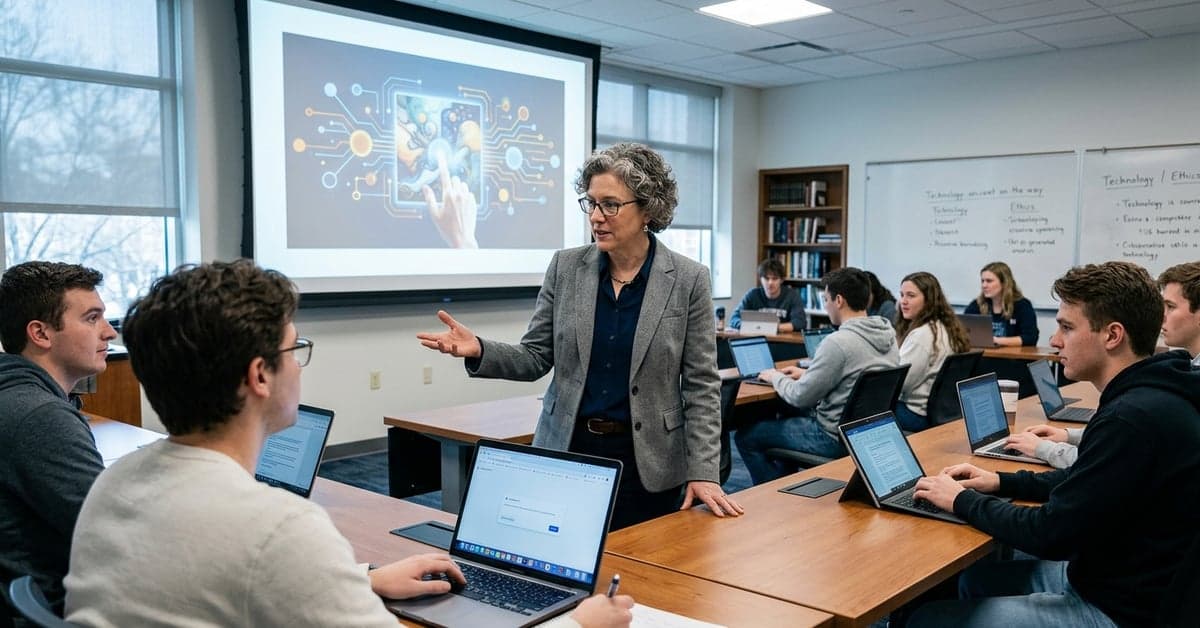
On July 20, 2026, The Conversation published an essay by Zakaria Lacheheb arguing universities should stop policing AI and start teaching it as a productivity tool grounded in ethics. That push, set against companion pieces on July 13 and July 10, signals a clear pivot: higher education is moving from bans to instruction, with The Conversation’s generative AI coverage capturing the turn.
In that July 13, 2026 analysis, Penn State’s Gerald K. LeTendre wrote that evidence doesn’t show AI tutors outpacing human teachers. Three days earlier, Brett DeJager highlighted that cheating fears mask a deeper challenge: measuring learning in courses where AI is everywhere. Step back, and a throughline emerges. Teach the tools, redesign the work, keep humans central.
What the July essays add up to
Lacheheb’s case on July 20, 2026—teach AI in class, with ethics built in—reads less like a hot take and more like a policy prompt. The July 13, 2026 piece by LeTendre undercuts the idea of swapping teachers for software, pointing to thin evidence for superior outcomes from AI tutors. DeJager’s July 10, 2026 survey work reframes the faculty worry list, suggesting assignment design and assessment are the real pressure points, not just misconduct.
A June 29, 2026 study summary by Amy Dawel and colleagues adds a practical kicker: people can learn to spot AI faces, even as the telltales get subtle. If visual literacy can be taught, so can prompt craft, verification tactics, and model limits. That bolsters the case for teaching generative AI inside the curriculum, not outside the door.
Across these pieces, the consensus is neither permissive nor punitive. It’s pragmatic. Treat models as tools that students will use, then build the skills and rules to use them well.
Why teaching generative AI beats blanket bans
Blanket bans create two problems at once. They fail to stop use that’s trivial to conceal, and they leave students unprepared for workplaces where AI is standard. Teaching generative AI, by contrast, turns hidden use into guided practice, where faculty can set boundaries, model citation, and require process evidence.
LeTendre’s review makes the human role sharper. If AI tutors aren’t clearly better, then the payoff comes when teachers shape how students engage with the tools: when to draft, when to fact-check, when to turn AI off. DeJager’s focus on learning outcomes points to a related fix—assess the act of reasoning, not just the final text. Portfolios, oral defenses, data logs, and version histories all make sense in a course that integrates AI.
Global guidance is moving the same way. UNESCO has urged systems to equip teachers and learners with AI competencies and to set guardrails on use, rather than rely on bans that don’t hold. That aligns with what these July essays argue in practice: instruction first, restrictions where they matter most, and evidence all along the way. Readers can explore UNESCO’s approach to policy and classroom practice on its guidance for generative AI in education page.
Assessment, integrity, and the skills that matter
Cheating is real, but DeJager’s July 10, 2026 survey suggests the heart of the issue is alignment between tasks and goals. If an assignment can be solved by a prompt, then the assignment is the problem. Lacheheb’s call to teach the tools pairs well with that position. When courses require process artifacts—prompt notebooks, model comparisons, source trails—students show their work, and the temptation to outsource thinking drops.
Dawel’s June 29, 2026 review of how people learn to spot AI faces supports this approach. Detection improves with training because learners look for the right cues, and those cues evolve. The same dynamic applies to text and code generation. Teach model behavior, likely failure modes, and verification steps, and students build durable habits. That’s the core of teaching generative AI inside a discipline, not as an add-on.
For institutions shaping policy, this shift lines up with broader advice from research networks and quality bodies. The OECD has cataloged how assessment design and teacher development drive real gains, which complements what these essays argue on the ground. See the OECD’s resources on AI in education for comparative policy work.
AI literacy, not automation, as the strategy
LeTendre’s July 13, 2026 argument that AI tutors don’t beat human teachers on outcomes isn’t a rejection of software. It’s a re-centering of the human role. Faculty decide what counts as original work, how to cite model help, and where to draw bright lines. Teaching generative AI then becomes a channel for core academic skills: framing questions, evaluating sources, and defending claims.
That’s also where institutional policy should land. Spell out approved uses per assignment. Require students to disclose when, how, and why they used a model. Provide faculty with example rubrics that reward method, not just output. And invest in workshops that help staff keep pace with fast-changing tools without chasing fads.
What universities should do before the next term
The Conversation’s July run offers a workable map. If leaders act now, they can move from whack-a-mole enforcement to guided practice before classes start.
- Adopt course-level AI statements that define permitted and prohibited use, with examples tied to learning goals.
- Redesign at least one major assessment per course to require process evidence: prompt logs, drafts, citations, and oral checks.
- Stand up short faculty workshops on prompt writing, model limits, and integrity policy, drawing on the July 20, 2026 and July 10, 2026 insights.
- Teach verification. Build units on fact-checking and source attribution, supported by studies on detection like the June 29, 2026 piece.
Readers can scan the linked topic page to find the essays discussed here, including Lacheheb on July 20, 2026, LeTendre on July 13, 2026, DeJager on July 10, 2026, and Dawel’s team on June 29, 2026, all under The Conversation’s generative AI topic. Together they make the same case in different keys. Universities should be teaching generative AI now, inside courses and assessments, so graduates can show how they think with the tools—and when they choose not to. For more on this, see bloomberg.com and nytimes.com.