
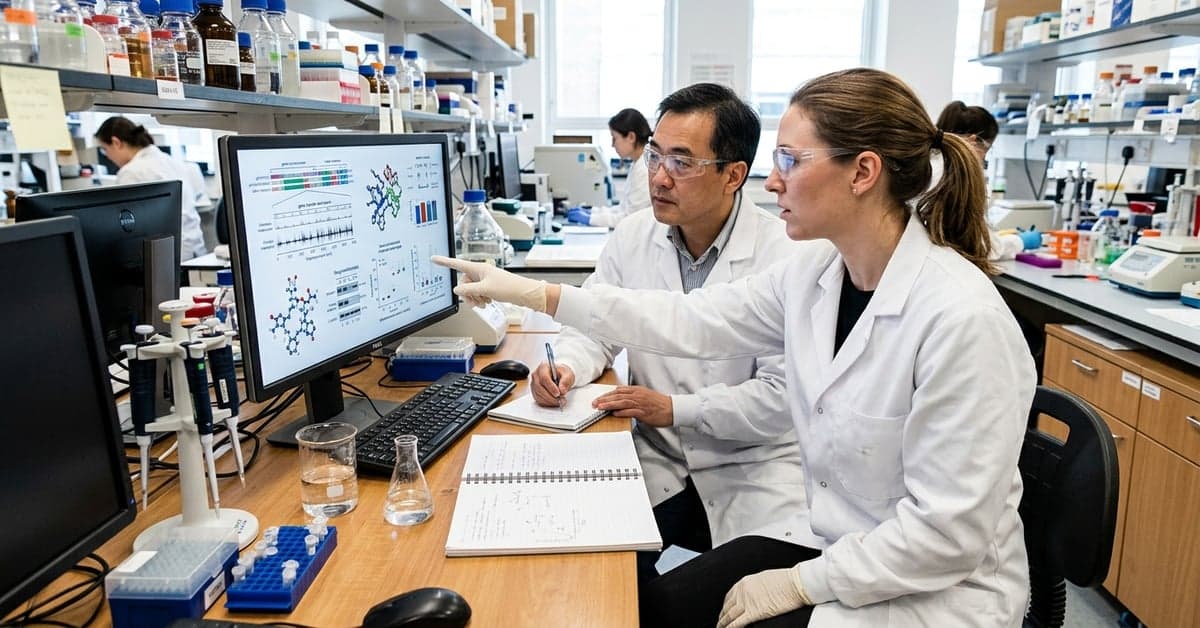
An AI “co-scientist” from Google, powered by Gemini 2.0, proposed a new gene transfer mechanism tied to antimicrobial resistance and flagged drug candidates for liver fibrosis, with both ideas later validated by academic labs. According to Drug Target Review, Imperial College London researchers confirmed the gene-transfer insight, while Stanford scientists tested the fibrosis leads in the lab. For pharma, the signal is clear: hypothesis generation is no longer bottlenecked by human reading speed.
What the Google AI co-scientist actually did
The system runs as a team of AI agents that generate hypotheses, design experiments, and analyze complex datasets. Drug Target Review reports the agents worked together to surface an unrecognized gene transfer mechanism relevant to antimicrobial resistance. Imperial College researchers then reproduced the finding independently. In a second case, the AI proposed compounds for liver fibrosis. Stanford investigators later validated several candidates in vitro.
Drug Target Review situates the work in Google DeepMind’s broader stack. It points to AlphaFold 3, which extends beyond structure prediction to modeling interactions among proteins, DNA, RNA, and small molecules. Isomorphic Labs, Alphabet’s drug-discovery unit, aims to bring its first AI-designed candidate into clinical trials by the end of 2025, supported by deals with Eli Lilly and Novartis, the outlet notes.
Even with the caveat that the examples are early, the Google AI co-scientist marks a shift. Models are not only ranking targets; they are proposing testable mechanisms and experiment plans that wet labs can verify on standard timelines.
Why an agent model could speed drug discovery
Drug R&D stalls when teams spend months scanning literature, reconciling noisy omics data, and agreeing on a single experiment to run first. A multi-agent system can split that work. One agent drafts a mechanism, another checks for confounders, a third enumerates assays, and a fourth scores feasibility against lab constraints. The goal is not a single “right” answer, but a prioritized slate of ideas, each with a tractable plan.
In that light, AlphaFold 3 serves as a substrate for the agents. It gives them a way to reason over molecular interactions before anyone orders reagents. If the path from in silico guess to bench validation shrinks, portfolio managers can test more ideas per quarter without ballooning headcount.
There is also a pipeline effect. As Drug Target Review highlights, Isomorphic Labs expects an AI-designed molecule to reach the clinic by late 2025. If that timeline holds, discovery teams will feel pressure to pair hypothesis engines with faster verification loops. The Google AI co-scientist is a natural front end to that loop, teeing up experiments rather than just cataloging patterns.
Verification is the hard part: who checks the AI’s work?
Speed without trust does not help patients. Wet-lab confirmation is mandatory, but labs also need machine-readable provenance: which model version generated the idea, what data it saw, and how prompts were structured. Without that, negative replications become punishing to debug.
Regulators will ask the same questions. The U.S. Food and Drug Administration has outlined how AI can support drug development while preserving traceability and scientific integrity. Its guidance emphasizes documentation and controls across the development lifecycle; see the FDA’s AI in drug development resource for the current framing. An agentic system will need audit trails by default, not as an afterthought.
Practically, that means preregistered hypotheses, logged decision trees, and standardized assay metadata. It also argues for adversarial review: a “red team” agent tasked with breaking the idea before the real team wastes a week at the bench. The Google AI co-scientist can help only if its claims are easy to interrogate and reproduce.
From lab to clinic: the wider shift is already visible
Bench progress matters because the clinic is moving too. On August 27, 2026, The Guardian’s technology desk reported that London neurosurgeons performed the first successful AI-assisted operation to remove a brain tumour. The item, listed on the paper’s AI section, signals how quickly surgical decision-support is gaining ground.
Taken together, drug discovery agents and operating-room copilots show AI filling both ends of the translational chain. Discovery engines propose mechanisms and molecules; clinical tools help apply them safely. The risk is a verification bottleneck in the middle, where preclinical models, toxicology, and trial design still consume time and cash.
What changes now for R&D leaders
First, budget for verification, not just licenses. If you adopt the Google AI co-scientist, you also need bench capacity, data management, and a playbook for fast follow-up experiments. Second, treat agents as peers in design meetings. Let them write the first draft of the methods section, then have scientists edit it down.
Third, align with partners early. Drug Target Review notes Alphabet’s Isomorphic Labs is working with Eli Lilly and Novartis. That is a signal: drugmakers will expect AI-originated ideas to arrive with assay plans, negative controls, and a clear readout path. Fourth, plan for governance. Keep an eye on emerging standards for synthetic data disclosure, assay reproducibility, and AI traceability, which will change how you document preclinical packages.
The direction of travel is set. If the Google AI co-scientist generalizes beyond a few case studies, discovery groups that marry agentic ideation with disciplined validation will ship more credible candidates, faster. Those that treat it as a dashboard will add cost without speed.
Related reading: AI Update • Automation • Generative AI