
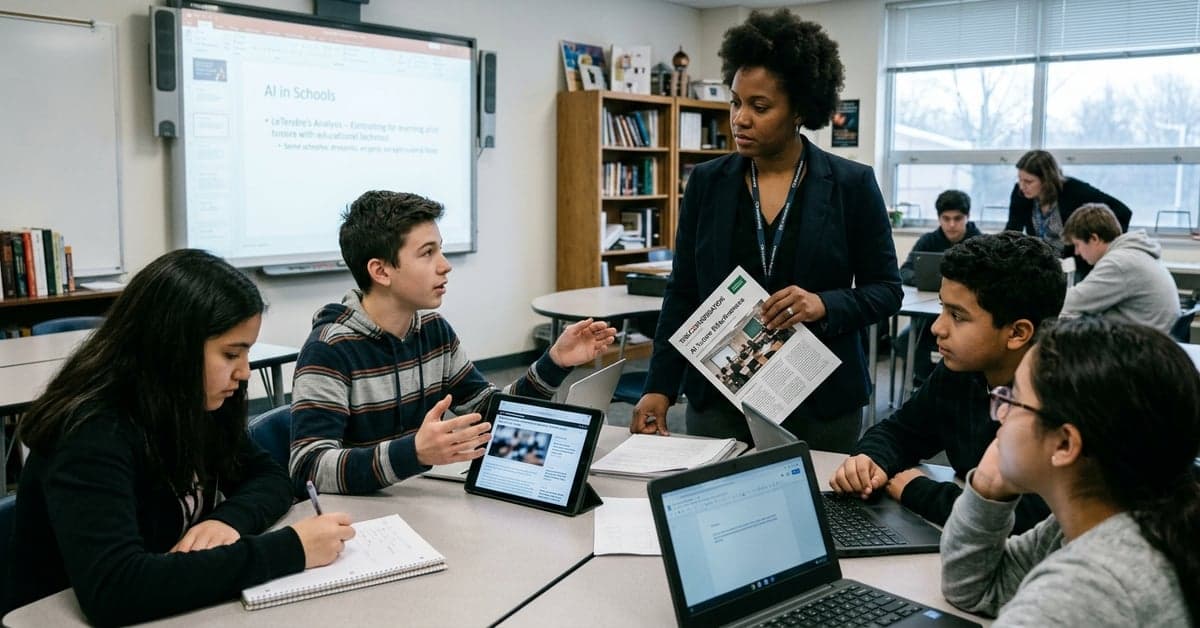
On July 13, 2026, The Conversation ran a piece by Gerald K. LeTendre of Penn State arguing that research doesn’t show AI tutors outperform human teachers. That sharp claim drops into a noisy market for classroom bots and study companions. It also reframes the debate over AI tutors effectiveness from hype to evidence.
What The Conversation’s educators are saying
LeTendre’s review, published by The Conversation on July 13, 2026, concludes that AI tutor systems have yet to beat experienced teachers on learning outcomes. A week later, on July 20, 2026, Zakaria Lacheheb of the International Islamic University Malaysia argued that universities should “stop policing AI in the classroom” and start teaching it, with ethics built in, per his essay for The Conversation. On July 10, 2026, Brett DeJager of the University of Wisconsin–Stout reported survey results showing that while cheating fears loom large, the deeper issue is whether students are learning anything meaningful when AI is present.
Read together, the three essays paint a clear throughline. AI is here and students are using it. The question isn’t if, but how. The authors urge institutions to move resources from detection and discipline toward instruction, assessment redesign, and teacher support.
What the evidence says on AI tutors effectiveness
LeTendre’s case is simple: the published evidence doesn’t yet show consistent gains from AI tutors that beat human-led instruction. That matches the broader caution expressed in the U.S. Department of Education’s 2023 report on AI in teaching and learning, which emphasizes human guidance and guardrails over automation (U.S. Department of Education). Lab demos often look impressive. Classroom trials, with real schedules, messy data, and varied student needs, tend to be less dramatic.
Vendors often promise personalized support at scale. The reality is mixed. Many tools are good at surface-level feedback and practice generation. Fewer show sustained gains when measured against well-run classes led by trained teachers. That gap matters because the bar isn’t perfection; it’s whether the tools improve the effectiveness of AI tutors enough to justify cost, training time, and classroom change.
There’s also a baseline to respect. One-to-one tutoring by humans is among the most effective interventions in education. Meta-analyses from the Education Endowment Foundation underscore its strong impact, especially when tightly linked to classroom teaching (EEF). Any claim that a chatbot can reliably match that should meet a high evidence standard, which LeTendre argues hasn’t been cleared.
That doesn’t make AI useless. It means schools should treat these tools like any new curriculum supplement: pilot them, share transparent results, and compare them to lower-cost alternatives. The burden of proof sits with those selling or mandating the software. Until then, policy should assume uneven gains and keep teachers in the loop.
Teaching the tool beats policing the class
Lacheheb’s July 20, 2026 essay argues for a pivot from bans to instruction. Students are already writing with AI, brainstorming with it, and using it as a study buddy. The practical response is to teach effective prompts, model verification, and set ethical boundaries, rather than fight a losing battle over detection. UNESCO’s guidance echoes that direction: build AI literacy, protect privacy, and keep human oversight at the center (UNESCO).
That shift doesn’t trivialize academic integrity. It reframes it. If a course expects students to use AI, then the rules must say how and when. If a course bans it, the policy must explain why and what support replaces it. Either way, instructors need time and training. Faculty development beats blanket rules.
Here’s the trade many institutions miss: every dollar spent chasing detection could fund practical training or small pilots that measure AI tutors effectiveness in context. Students benefit when the adults align on expectations and model good use. They flounder when rules change by class and semester.
Redesigning assessment for an AI-native semester
DeJager’s July 10, 2026 survey work, as summarized by The Conversation, suggests the bigger risk isn’t just cheating; it’s shallow learning when assignments are easy to outsource. The fix is assessment design. Instructors can require process evidence: drafts, planning notes, and reflections. They can shift some grading weight to oral defenses, in-class problem solving, or timed critiques of AI outputs.
Those moves don’t eliminate AI. They make dishonesty harder and learning visible. When students must explain choices, trace sources, and connect ideas, the tool becomes an aid, not a substitute. That’s also the premise behind many national recommendations urging “AI-resilient” assessment: measure thinking, not just final prose. Jisc’s practical principles for using generative AI in education lay out starting points for policies and course design (Jisc).
Program leaders should set a cadence: trial, measure, share. Start with low-stakes uses, publish the rubrics, and gather outcome data by course type. Over time, institutions can identify where the effectiveness of AI tutors is highest, where it’s neutral, and where it distracts from core goals.
Where schools should place their bets next
The three July essays from The Conversation point to the same playbook. Keep teachers at the center. Invest in AI literacy for students. Redesign assessments to surface thinking. Use limited pilots to test AI tutors effectiveness before scaling.
That path is slower than buying licenses districtwide. It’s steadier. It respects the fact that strong teaching already beats most software. It also leaves room for tools that truly help: targeted feedback systems, accessible study aids for students who need them, and planning assistants that save instructors time without hollowing out the craft.
The next procurement meeting should start with two questions. What learning outcome are we missing today? How will we know if this tool closes that gap for our students? If a vendor can’t answer both, the budget is better spent on teacher time and better assessments—and on testing whether claims about AI tutors effectiveness hold up in your classrooms. For more on this, see openai.com and reuters.com and bloomberg.com.