
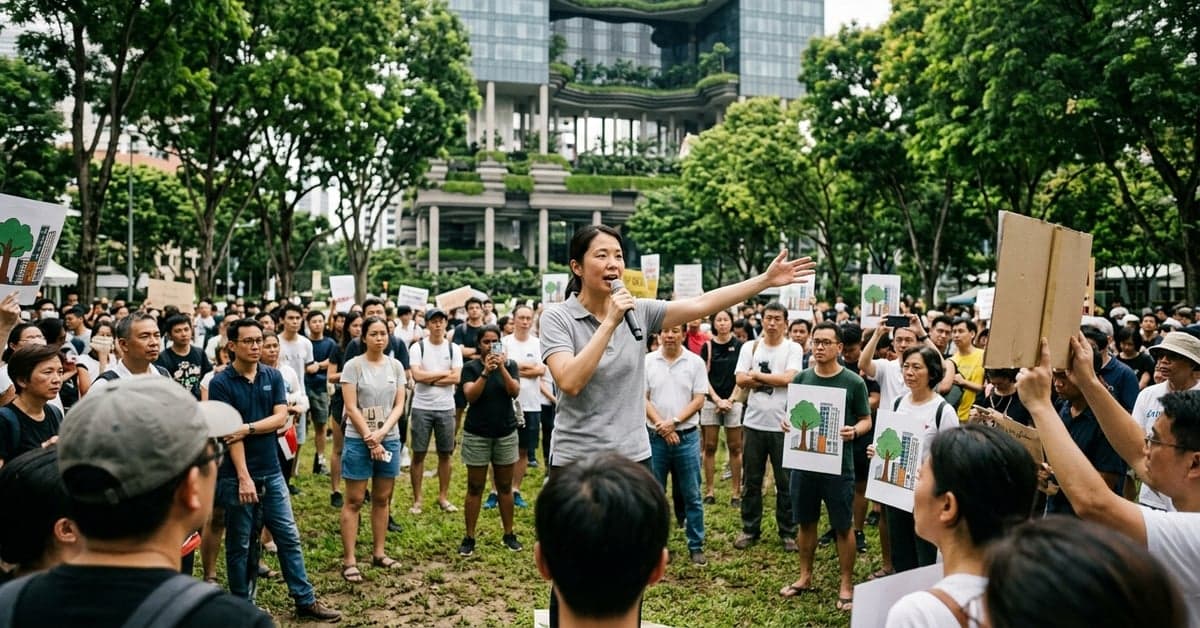
On August 15, 2026, a familiar Singapore debate lands in Hong Lim Park. The Maju For The People rally convenes days after officials said more greenery would be kept at Sunset Way and Gillman Barracks, with a warning that this means fewer homes. That framing — trade trees for flats — is fast becoming the crux of a bigger question: who gets to decide what Singapore preserves and what it builds?
The Maju For The People rally as a stress test
In a newsletter published on August 15, 2026, We, The Citizens highlighted the government’s message ahead of the rally: more green will stay at Sunset Way and Gillman Barracks after public feedback, but housing output will drop. Minister of State for National Development Alvin Tan delivered the trade-off logic, which the newsletter argued feels like a grudging concession rather than a shared plan. The Maju For The People rally is where that sentiment will be tested, in full view of a public that cares about homes and habitat.
Hong Lim Park — Speakers’ Corner — is not just geography. It’s a barometer. It shows whether public consultation is heard, and whether decisions change course when they need to. The park’s rules and history are easy to find, but the stakes of this weekend are specific: can collective pressure shift how choices are framed, not just the outcome in one or two sites?
Greenery versus housing: a false choice at Sunset Way and Gillman?
According to We, The Citizens, the official line is clear: keep more trees, build fewer homes. That framing compresses a complex set of options into a thumbs-up or thumbs-down. Urban planning rarely works in binaries. Sites differ in ecology, transport access, soil, flood risk, and cost. Budgets and timeframes vary. So do the levers the state can pull.
There are alternatives to explore before pitting this patch of green against that housing block. Infill on underused plots near MRT stations can raise supply without touching sensitive greenery. Adaptive reuse of low-intensity sites can add units while preserving mature trees. Plot ratio adjustments where infrastructure already runs strong can deliver more homes per hectare without pushing into forest edges. None of this is easy, and some options take longer. But the menu is wider than a single trade-off line suggests.
Gillman Barracks, for example, sits in a historic precinct connected to Alexandra and Telok Blangah. It blends arts spaces with green corridors. Treating it as a template for combining culture, light-touch housing, and biodiversity buffers could protect character while meeting demand. Sunset Way abuts Clementi’s established estates. Any move there should start with a clear map of what’s ecologically significant, what can be enhanced, and what can host mid-rise, transit-friendly homes without severing wildlife links.
Who gets a say in what Singapore keeps?
We, The Citizens posed the central question: who decides what to preserve and what to lose? Today, much of Singapore’s public input happens through feedback portals and consultations tied to long-term plans. The Urban Redevelopment Authority’s Long-Term Plan Review lays out national directions and invites comments. That’s useful, but often abstract. When decisions land at the site level, the room for influence can feel small and the timeline short.
Process design matters. If residents and civil society only see choices when drawings are almost final, the friction is baked in. If agencies share constraints early — biodiversity surveys, drainage needs, transport models, and cost — people can help shape the path rather than react to it. That means opening data, not just taking comments. It means showing trade-offs with numbers and maps, then iterating in public.
There are practical formats to make this concrete. Charrette-style workshops where community members, planners, and ecologists mark up the same maps. Citizen juries that study constraints for weeks and propose a preferred scheme. Transparent scoring of alternatives, published so any resident can see how “Option B” beat “Option A” and why. Singapore’s institutions already run effective public exercises in other domains. Bringing that same clarity to land use would raise trust.
What better consultation looks like after the rally
The Maju For The People rally will likely surface two things: a hunger for homes that remain affordable for families, and a desire to keep the green that makes estates liveable. The job after the speeches is to turn that energy into plans that balance both. Three steps can move the needle without waiting for the next master plan cycle.
- Publish site-specific baselines before options. Environmental, social, and transport baselines should be public for places like Sunset Way and Gillman Barracks. Where possible, include biodiversity surveys and connectivity maps. This is common in many cities’ planning workflows and helps everyone argue from the same facts.
- Run open option-testing with real numbers. Lay out at least three build-and-preserve mixes, each with unit counts, cost ranges, transit impacts, and canopy changes. Invite competing proposals from community groups and universities, then score them against shared criteria.
- Commit to a feedback loop that bites. Set milestones when plans must show what changed because of input, and why. Publish the “why not” alongside the “what’s next.”
Anchoring participation in specifics also protects the green that matters most. The National Parks Board already maps nature reserves and parks. Extending that clarity to ecologically sensitive secondary forests, riparian buffers, and wildlife corridors would reduce last-minute fights. It would also guide where higher-density housing can go with less ecological cost.
What to watch at Hong Lim Park
Two signals will show whether this moment has teeth. First, whether agencies move beyond the “more trees means fewer homes” script in follow-up briefings. Second, whether they put transparent options for Sunset Way and Gillman Barracks on the table, with numbers the public can stress-test. If those steps appear, the Maju For The People rally will have shifted more than a headline; it will have nudged process.
None of this replaces elected accountability. But it makes the trade-offs visible, shared, and harder to wave away. That’s the core ask embedded in We, The Citizens this week: a genuine say in what we keep. If the rally sparks that shift, Singapore will have proven there’s a better way to add homes while protecting the places people love.
For context on how long-range choices are typically framed, readers can review URA’s national process via the Long-Term Plan Review. To understand the civic space where these debates surface, see the public information for Hong Lim Park. For Gillman Barracks’ current role and heritage, the precinct’s site offers background on its arts programming and setting at gillmanbarracks.com. Each helps frame what the Maju For The People rally could change next. For more on this, see reuters.com and nytimes.com.
Related reading: AI Update • Automation • Generative AI