
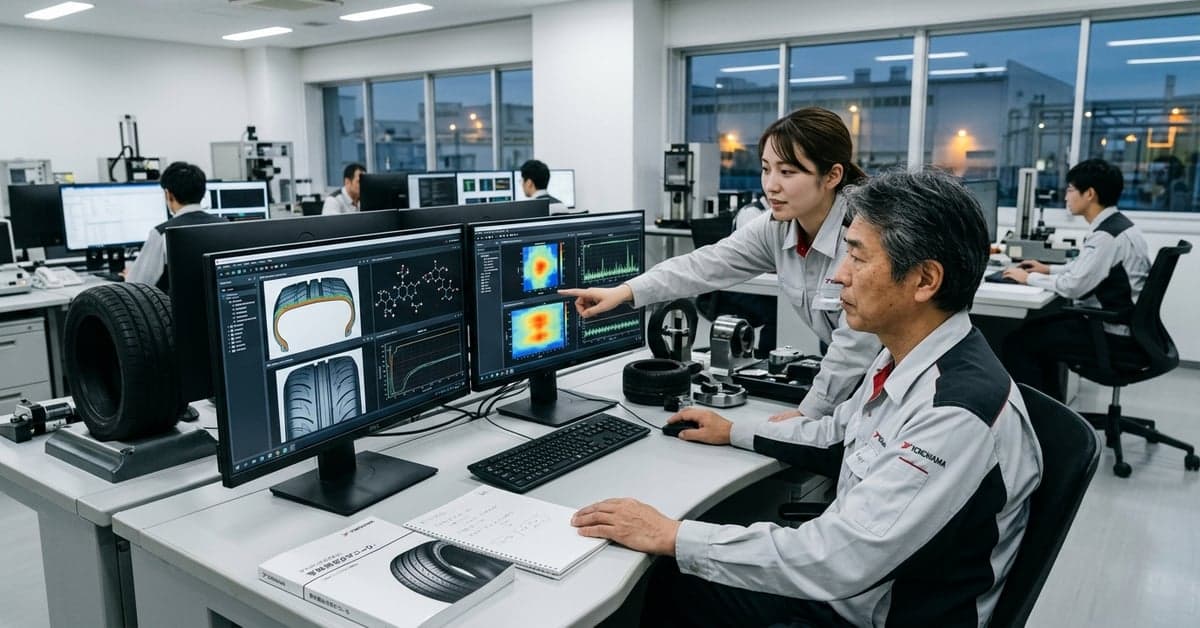
On August 28, 2026, The Yokohama Rubber Co., Ltd. said it had begun full-scale operation of a proprietary generative AI that searches internal technical documents to support tire development, according to MarkLines. The system uses retrieval over the company’s knowledge base to answer engineers’ questions in natural language, a classic RAG-style deployment that moves AI out of pilots and into daily product work.
That shift is welcome for speed and knowledge reuse. It also places ethics and governance squarely inside the design room. When a model shapes choices about compounds, patterns, or testing priorities, leaders inherit fresh duties: prove where an answer came from, catch failure modes before they hit the lab, and record who approved what. This is where the story gets bigger than one factory.
Inside Yokohama generative AI for tire R&D
Per the MarkLines report, Yokohama’s system scans internal technical documents and produces responses based on their contents. That’s the promise of retrieval-augmented generation: shrink the gap between what an engineer needs and what the company already knows. In a tire maker’s world, that means surfacing past test reports, material specs, and design rationales in seconds rather than hours.
RAG helps on two fronts. It cuts time lost to document hunting, and it reduces the chance an answer comes from general web training instead of verified internal sources. But RAG is not a silver bullet. If the index holds outdated guidance, or retrieval favors popular terms over the right ones, a confident answer can be wrong in ways that matter to safety and cost.
Yokohama’s move signals maturity: a proprietary build, grounded in company IP, and now at full scale. The ethics question is less “should they use AI?” and more “how will they run it responsibly when the answers steer design?”
Ethics questions RAG raises in industrial design
Three risks dominate when RAG meets engineering.
First, provenance. If a generated recommendation leans on five documents with different dates and approvals, who signs off on the blend? The answer needs traceable citations, version control, and a paper trail that an auditor can follow. The NIST AI Risk Management Framework frames this as documentation and traceability, not a nice-to-have but a control that underpins accountability.
Second, retrieval manipulation and contamination. Models can be tricked to pull and use the wrong context when a prompt or an embedded document carries hidden instructions. The OWASP Top 10 for LLM Applications calls this retrieval and prompt injection. In a factory, a single poisoned spec or cleverly formatted note can steer an answer toward a flawed process. Guardrails must live at ingestion (clean and sign content), at retrieval (filter and score context), and at generation (force grounded citations).
Third, stale or skewed knowledge. RAG mirrors the library it reads. If the index underrepresents certain test conditions or failure reports, the model will echo those gaps. That is an equity problem inside data, not society at large, and it still has safety stakes. Balanced coverage and periodic reindexing are ethics by design in this setting.
What Yokohama Rubber’s AI rollout signals for governance
This is where regulation intersects with practice. Even if an internal tool like Yokohama generative AI is not itself sold as a product, its outputs can influence components subject to strict conformity regimes. In Europe, the EU AI Act phases in obligations through 2026–2027 for high-risk systems, along with documentation, testing, and transparency expectations. Engineering groups that adopt AI to aid design will be asked—by customers, regulators, and insurers—to show how they control data quality, measure model performance, and review decisions before they affect safety or compliance.
Voluntary standards are catching up fast, and they are useful now. ISO/IEC 42001 defines an AI management system akin to ISO 9001 for quality. It sets a backbone for policy, roles, risk controls, and audits. Many manufacturers already run certified management systems; extending them to AI is a practical path. See the ISO/IEC 42001 overview for scope and requirements.
The operational takeaway: treat RAG-powered tools as part of your controlled process, not as casual assistants. That means change control on indices, documented evaluation thresholds, and clear sign-off points when model outputs nudge a design choice. If a customer asks, “Show me why you picked this compound,” you should be able to click through citations, versions, and approvals.
What R&D leaders should do next
Yokohama’s launch offers a template and a warning. You can move fast with internal knowledge—if you lay down the rails. Five practices make that concrete:
- Data lineage by default: tag every indexed document with owner, version, approval status, and expiry; block retrieval of expired or draft content.
- Grounding checks: require generated answers to cite sources; fail closed when citations are missing or low-confidence.
- Evaluation you can explain: track domain metrics (e.g., spec compliance accuracy), not just BLEU or generic scores; publish thresholds to engineering leadership.
- Defense in depth for RAG: sanitize inputs, strip hidden formatting, and score retrieved chunks for relevancy; monitor for retrieval injection attempts.
- Audit-ready logs: preserve prompts, retrieved context, model versions, and human approvals for any answer that influenced a design or test plan.
These steps align with NIST’s framing and map cleanly onto ISO/IEC 42001 controls. They also scale. Whether it’s one plant or ten, the same playbook applies.
There’s a broader point here. The business case for RAG in manufacturing is strong because industrial firms sit on deep, structured knowledge that is hard to find at speed. The ethics case is just as strong. When a model shortens the path from question to decision, the organization owes its engineers a way to trust, contest, and improve those answers. Without that, productivity wins can turn into quality escapes or recall risk.
The Yokohama generative AI rollout shows that heavy industry is past the slideware stage. The next differentiator is governance that proves your AI helped you do the right thing, not just the fast thing. Tire makers, automakers, and every lab-driven business should read this moment as a green light with guardrails.
One last reason to care: procurement. Large buyers will start asking for AI governance signals in supplier questionnaires—policy links, evaluation summaries, maybe even ISO/IEC 42001 certificates. Firms that can answer cleanly will move faster through audits and win trust. Firms that can’t will find their clever bots stuck at the plant gate. Yokohama generative AI may be early here, but the direction is clear. For more on this, see nytimes.com.