
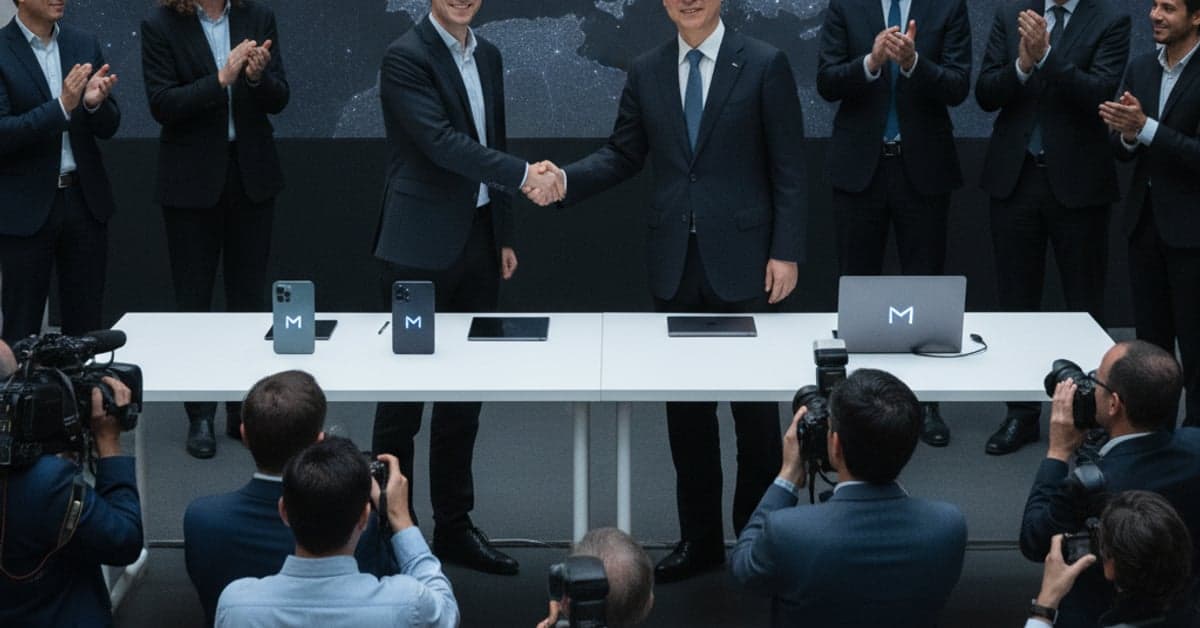
On September 14, 2026, Mistral said it raised €3 billion at a €21 billion valuation in a Series D led by Samsung Electronics. The Mistral Samsung funding is billed by the company as the largest equity raise ever by a European tech firm, three years after its launch, and it comes with a claim: make sovereign, open‑weight AI the frontier of the industry (Mistral).
What the Mistral Samsung funding signals
The deal’s scale matters. A European AI startup just secured capital on par with top U.S. peers while positioning itself against vendor lock‑in and data exposure. That pitch lands as market leaders call for a slower pace of AI development. Live coverage from the Guardian on September 14, 2026, captured investor jitters around those slowdown calls, while the BBC’s AI topic page logged similar warnings on September 13, 2026. Against that backdrop, Mistral’s capital raise reads as a different answer to risk: build systems that let customers keep control of infrastructure, data, and deployment choices.
The cross‑border lineup—Samsung as lead, alongside EQT’s Scaleup Europe Fund and PSG Equity, according to the company—also points to a Europe‑Asia funding bridge. That may help with scale: training frontier models demands compute, memory, and distribution partners. While the company did not disclose supply arrangements, the investor mix signals confidence that Europe’s AI stack can grow without defaulting to a single U.S. hyperscaler’s roadmap.
Sovereign, open‑weight playbook: control without lock‑in
Mistral’s message is direct: open‑weight models, infrastructure and compute capacity, and the products to run them in production—one stack, multiple deployment choices (Mistral). In practical terms, sovereign open-weight AI is about access to weights for integration and auditing, often under custom licenses, paired with options to host on‑premises or in a private cloud. That differs from fully open‑source software, though both are attempts to increase transparency. For readers comparing models and licenses, the Open Source Initiative has outlined the debate over what “open” should mean for AI systems, which helps frame these claims (OSI).
For buyers, the promise is tactical: reduce vendor lock-in risk, keep sensitive data off a third party’s training loop, and align deployments with sector rules. According to the company, Mistral now operates in 20 countries and supports more than 125 enterprises, including Airbus, ASML, and HSBC. That roster spans regulated industries—aviation, semiconductors, banking—where auditability and data residency weigh heavily on procurement. The Mistral Samsung funding gives the company resources to harden those enterprise pathways.
Full‑stack ambition: from compute to customers
Mistral says the raise will expand frontier research and scale compute for more powerful models, while accelerating international growth (Mistral). That road map puts pressure on two bottlenecks: training capacity and distribution. Training needs access to high‑end accelerators, and distribution requires production‑grade tooling that works across clouds and on‑prem hardware. The company’s claim to be the only AI firm building the full stack—from open‑weight models to infrastructure and products—sets a high bar; customers will judge it by how easily they can move workloads between environments without rewriting pipelines or surrendering telemetry.
There’s also a policy tailwind to watch. The European Commission has framed digital sovereignty as a core objective in data, cloud, and AI, arguing Europe should reduce structural dependencies and keep high‑value capabilities within reach of its firms and public sector. That context matters if governments weigh local deployment for sensitive systems (European Commission). The Mistral Samsung funding adds private capital weight to that public narrative, suggesting the market sees commercial upside in sovereignty, not just compliance checklists.
How the funding collides with calls to slow AI
Calls to slow frontier AI development have grown louder—captured in the BBC’s September 13, 2026 coverage of a leading CEO urging a pause, and mirrored in the Guardian’s market reporting a day later. Those headlines speak to risk concentration: few companies, massive models, opaque processes. Mistral’s response is to spread control instead of the pace. Sovereign deployments place infrastructure and model oversight closer to the customer. If that approach scales, it may ease some policy concerns by cutting single‑vendor dependency and improving audit trails. The trade‑off is complexity: more parties managing more systems can also widen the attack surface and raise integration costs.
For CIOs, the decision tree is changing. The question is less “who has the single strongest model” and more “which stack lets us move fast without losing control.” Here, open‑weight access, clear licensing, and repeatable deployment patterns will decide whether sovereignty is a promise or a procurement headache. The Mistral Samsung funding gives the company time and compute to prove those claims in production.
What to watch next
Three markers will show whether this strategy works:
- Model cadence and disclosures: weights availability, licensing clarity, evals that reflect real tasks, and reproducible inference performance across environments.
- Deployment optionality: first‑class support for on‑prem and private VPC, migration guides between clouds, and pricing that doesn’t punish portability.
- Enterprise outcomes: case studies that quantify gains—lower latency, lower unit costs, better compliance posture—without hidden dependencies.
Investors just bet that sovereignty and choice can win in the enterprise AI race. If the company translates capital into compute, products, and credible governance, Europe gets a scaled contender that aligns with its policy aims. If not, incumbents will keep the advantage. Either way, the Mistral Samsung funding has forced the issue: control over where AI runs—and who owns the loop—has become part of the frontier itself. For more on this, see reuters.com and bloomberg.com and nytimes.com.
Related reading: AI Update • Automation • Generative AI