
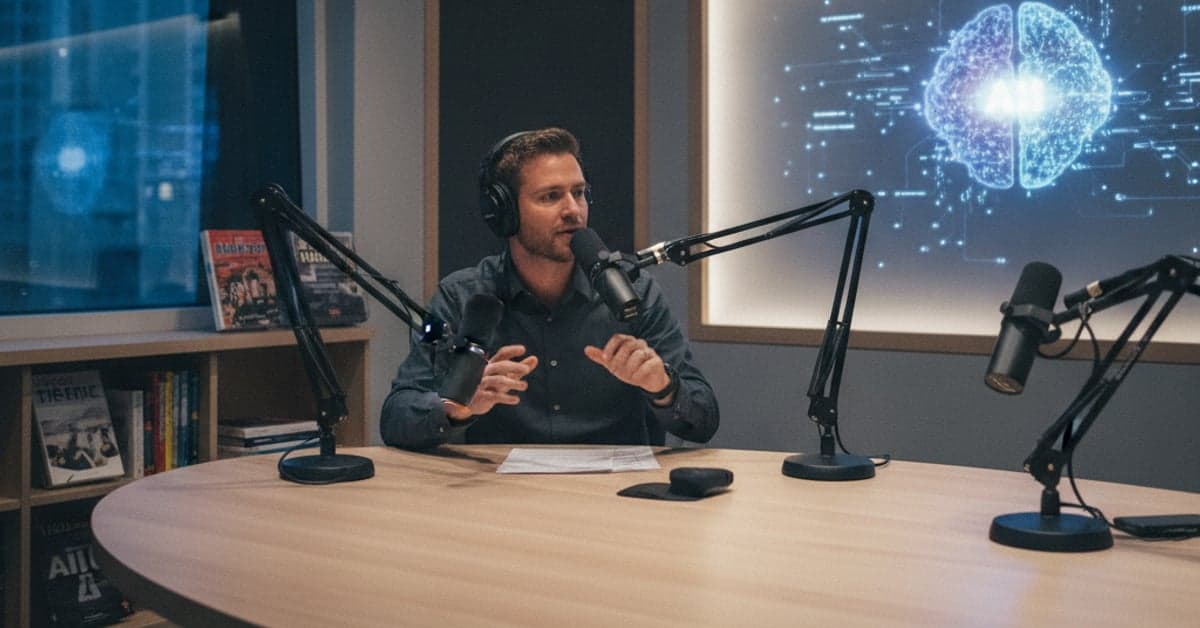
The AI Daily Brief podcast has a 4.7 rating from 850 reviews on Apple Podcasts and publishes multiple times a week. It’s hosted by Nathaniel Whittemore, known as NLW, and it’s built for listeners who want fast context on artificial intelligence without spending all day online.
Why the AI Daily Brief podcast is catching on
According to the show’s Apple Podcasts listing, NLW ranges from creative tools like Midjourney and ChatGPT to workplace disruption and the thorny questions around AGI and alignment. That scope matters because mainstream coverage often skews to single-note headlines. The BBC’s artificial intelligence topic page, for example, has cycled through stories about scams at food festivals, data centre booms, and warnings about a “silicon species” from Microsoft. Those are valid threads; they’re also fragments of a larger picture. A daily AI news podcast knits them together into a narrative you can act on.
The show’s latest episode title signals where the conversation has moved: “Why Everyone Is Getting Excited About Personal AI Agents.” The Apple listing also tees up that day’s headlines: interest rates that could strain the AI boom, OpenAI expanding safety disclosures, and Apple exploring AI servers. That mix—consumer agents plus macro and infra—illustrates the program’s pitch: a tight brief that doesn’t live in only one corner of the field.
Personal agents are the turn in the story
“Personal AI agents” aren’t just a new label for chatbots. They’re systems designed to take goals, figure out steps, and execute them with some autonomy. The idea traces to the broader concept of intelligent agents in computer science, where software perceives, decides, and acts toward given objectives. For readers wanting a primer, the
intelligent agent entry offers a solid overview.
NLW’s emphasis on agents is timely. The Apple Podcasts page for the AI Daily Brief show highlights Meta’s “Muse” as an example driving excitement, and frames the bigger question: why consumers seem ready now to delegate everyday tasks. That’s the inflection point to watch. If users shift from asking models for answers to assigning models work, product expectations and safety questions change with them.
Look at the contrast set by general news. On the BBC’s AI topic page, the theme line over the past few days has leaned on risk: deepfakes, shoplifting detection, even existential warnings from public figures. Those are part of the story. The agent turn asks a different, practical one: what happens when non-technical users get tools that can click, book, buy, and recall on their behalf? A daily AI news podcast can follow that question day by day as the answers evolve.
What the AI Daily Brief show adds beyond the headlines
The promise of the AI Daily Brief podcast isn’t scoops; it’s synthesis. According to the Apple listing, NLW uses a mix of topical walkthroughs and bigger-picture framing: how a policy move changes startup runway, why an enterprise shift matters for developers, where ethics meets deployment. That framing is the missing layer between raw headlines and a team’s Monday meeting.
Consider the episode notes that mention OpenAI expanding safety disclosures. A single headline tells you it happened. A brief can ask who in your org should care first: trust and safety, legal, or incident response; what a disclosure practice implies for vendor diligence; and whether you should mirror that standard internally. That’s the sort of turn a busy operator needs to hear while commuting.
Format also counts. Episodes drop several times a week with an optional ad-free subscriber feed at $2.99 per month or $29.99 per year, per Apple Podcasts. That price point suggests the team wants low-friction support from regulars rather than a gated, premium club. It matches the show’s identity as an everyday tool.
How NLW packages fast news into usable context
The Apple Podcasts page makes clear the editorial range: creativity booms, workplace shifts, alignment debates, and x-risk. The consistent move is to pair a news hook with a why-it-matters takeaway. When the latest episode cites interest rates as a threat to the AI boom, for instance, the follow-on questions write themselves: who’s overexposed to capital costs, which workloads delay, and how do marginal returns on compute shape product decisions. That thought process is the value, not just the headline list.
On agents, the show’s angle meets a moment when consumer expectations are redrawing product roadmaps. If an agent can handle a chain of subtasks, “features” start looking like “delegations.” That shift cascades: UX changes from prompts to approvals, security shifts from content filters to action guardrails, and business models tilt toward outcome pricing. A recurring, well-edited AI news analysis can surface those knock-ons faster than a monthly report.
The format also relieves a common pain point. The BBC feed shows how AI splinters into politics, policy, scams, science, and infrastructure. The AI Daily Brief podcast pulls those threads together and tells you which one deserves attention that day. It’s curation with an argument, not just a link dump.
Who benefits most, and what to watch next
Three groups gain the most from the AI Daily Brief podcast. Product managers get a read on shifts that will hit backlog next quarter. Security and legal teams get early signals on disclosure norms and platform policies. Executives get a handle on macro forces—from rate moves to data centre constraints—that shape hiring and spend.
Expect agents to stay a core beat for the show over the next few months. If more consumers try AI that acts, the frictions will move from “Is it accurate?” to “What can it safely do on my behalf?” That pulls in identity, permissions, and liability. It also puts pressure on the dull but vital work of logs, safe action sets, and user controls. A daily AI news podcast can track those details without losing sight of the larger arc.
For listeners weighing a new show, the best test is simple: does it help you make one better decision this week? The AI Daily Brief podcast sets itself up to do exactly that—by keeping the focus on what headlines mean in practice, and by returning often enough to catch a moving target.
Useful links:
- The AI Daily Brief on Apple Podcasts
- BBC News: Artificial intelligence topic page
- Intelligent agent overview (Wikipedia)
Related reading: AI Update • Automation • Generative AI