
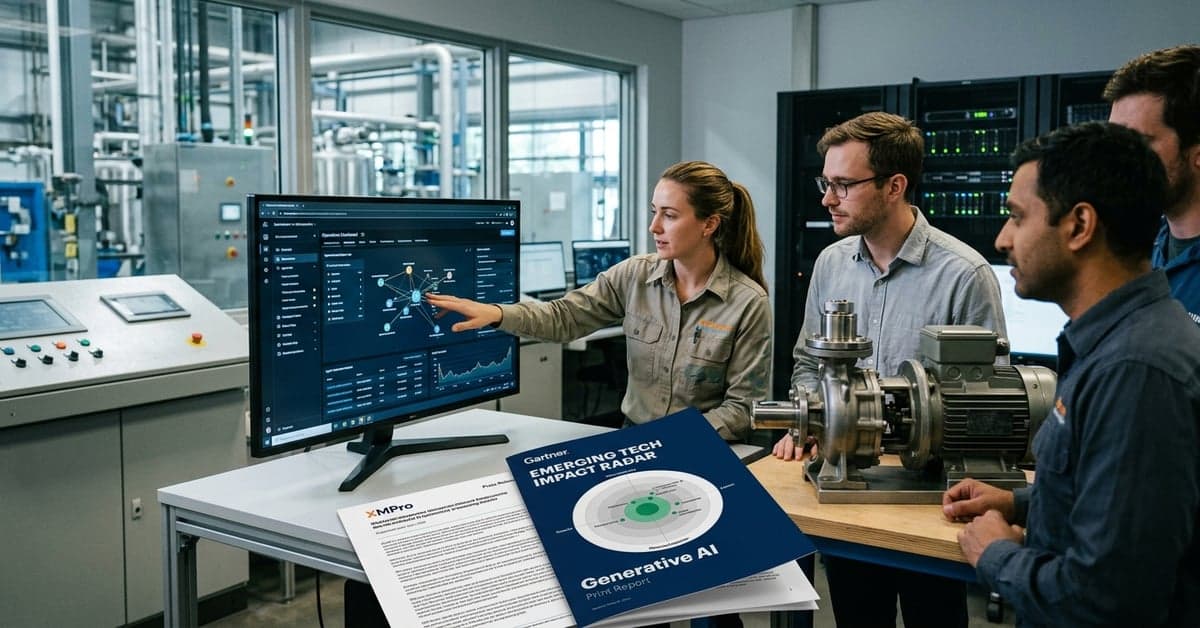
On August 26, 2026, XMPro said it was named a Sample Vendor for Multiagent Generative Systems (MAGS) in Gartner’s Emerging Tech Impact Radar: Generative AI, published August 7, 2026. For asset‑intensive sectors weighing agent-based automation, the XMPro Sample Vendor nod adds enterprise validation to a field still sorting standards, safety, and scale.
What happened and who else is in the club
XMPro described itself as an “agentic operations platform” serving asset‑heavy and mission‑critical environments, and said its listing appears alongside Amazon, Anthropic, Google, IBM, Microsoft, and Salesforce. The company framed the grouping as evidence that multiagent architectures are being evaluated at enterprise scale. XMPro’s CEO Pieter van Schalkwyk said the inclusion reflects years spent on an industrial multiagent framework.
According to Gartner, as quoted by XMPro, MAGS apply “a network of distributed, specialized agents” to manage complex workflows under shared governance. The report signals a shift away from single, monolithic agents toward collaborative swarms optimized for specific tasks. XMPro also cited Gartner’s view that the “mass is very high” because collaborative systems will drive the future of agentic AI as enterprises push to automate end‑to‑end processes.
Gartner’s Impact Radar is designed to gauge the potential and timing of emerging technologies for enterprises. For readers unfamiliar with the framework, Gartner outlines the method and how “mass,” “velocity,” and “reach” shape the view of a tech’s business impact in its public explainer on the Impact Radar (overview).
Why Multiagent Generative Systems matter in operations
Single agents hit a wall in real factories and plants. Production lines, field maintenance, and supply coordination each follow different rules, require different data, and trigger different handoffs. Gartner’s MAGS framing, as relayed by XMPro, matches how many operations teams design work: specialists with clear roles, governed by shared safety and compliance gates. That is the core promise: specialized AI agents that coordinate, document decisions, and hand off safely.
The technical direction is also visible in the open ecosystem. Microsoft’s AutoGen project, for instance, shows how multiple large‑language‑model agents can plan and verify one another’s steps in code and task execution (project page). Academic surveys have tracked similar patterns across retrieval, tool use, and simulation—arguing that multi‑agent setups improve reliability over solo agents by catching errors and distributing work (survey).
That maps cleanly to industrial use cases. Think of inspection scheduling across dozens of sites, or a refinery turnaround plan. One agent can retrieve the latest work orders and risk registers. Another models asset downtime. A third drafts permits and checklists. A fourth reconciles supplier lead times. A fifth documents the chain of decisions. The draw is less “smarts” in any one bot and more the orchestration of many small, auditable steps.
How XMPro Sample Vendor status could influence buying
The presence of hyperscalers in the same category gives large buyers an immediate benchmark. When an industrial CIO brings an XMPro Sample Vendor listing to a steering committee, the conversation shifts from “is this fringe?” to “how do we pilot it safely?” That doesn’t guarantee selection. It often does speed up shortlisting and unlock time for a proof of value.
For operations leaders, the bigger change is architectural. A multiagent model encourages a “many small bets” approach: start with two or three narrow agents tied to known KPIs—mean time to repair, energy variance, or work order backlog. Add governance early. The NIST AI Risk Management Framework offers a plain checklist for mapping risks, testing failure modes, and documenting controls across the lifecycle (NIST AI RMF).
Procurement teams should ask two blunt questions in RFPs. First: can the vendor prove safe handoffs across agents with traceable prompts, data lineage, and role‑based controls? Second: can the platform survive brownfield reality—limited connectivity, messy tags, and a patchwork of historians and CMMS? XMPro positions its “agentic operations platform” at this intersection; Gartner’s MAGS call‑out gives the company a cleaner path to make that case in regulated plants and utilities.
Cost also changes under MAGS. Training one giant agent to do everything is expensive and brittle. Smaller, specialized agents can be faster to validate and cheaper to run, especially if they mix on‑device models with cloud calls. Buyers should push for clear unit economics: per‑agent execution costs, tool‑use limits, and what happens when upstream APIs change. A Sample Vendor badge won’t answer those questions; it will help you get the meetings to ask them.
Gartner recognition, XMPro’s pitch, and the technical bar
XMPro’s platform story—industrial connectors, event streams, and agents that act within governance—aligns with how many OT teams already work. The test is depth. Can the system capture every agent decision, replay it, and tie it to the underlying data change? Can it fence unsafe actions when a sensor drifts or an LLM hallucinates? Multiagent setups reduce single‑point failure risk, but they multiply coordination risk. That’s where observability, simulation, and clear rollback paths matter more than any single model’s benchmark score.
In practice, the most credible pilots keep a human in the loop at key gates and log every step. This is where multiagent shines: one agent drafts the task list; another checks it against operating procedures; a third flags anything that crosses a safety threshold; the supervisor signs off. If a vendor can’t show those gates working under load, look elsewhere. If they can, the XMPro Sample Vendor listing will make it easier to bring them into plants and production lines that resist change by design.
What to watch next in MAGS for heavy industry
Expect governance patterns to harden first. Enterprises will standardize prompts, tools, and role scopes as reusable policies. Expect platform vendors to publish more reference architectures, including agent handoff patterns and failure taxonomies for audits. And expect regulators to ask how agent collectives behave under stress, which will push vendors to invest in simulation and chaos testing for agents much like they did for microservices a decade ago.
On timing, XMPro pointed to Gartner’s assessment that enterprise demand for GenAI‑driven workflow automation is a primary driver of MAGS interest. If that interest holds, the near term will be about narrow, auditable wins in maintenance, safety, and planning—not full autonomy. That path rewards vendors who can plug into messy operational data, document every action, and survive safety reviews.
XMPro now has a stronger door‑opener. The company still needs to prove outcomes. If it can show clear improvements on a plant’s core KPIs with documented controls, the XMPro Sample Vendor recognition will carry weight well beyond a press release. If not, buyers have plenty of choice among larger platforms and open frameworks showing real progress in multi‑agent orchestration.
For leaders planning 2027 budgets, the signal is practical: treat multiagent work as a systems problem, not a model contest. Start with one or two high‑value workflows, wire in governance from day one, and make vendors prove they can coordinate agents under constraints. That’s where this XMPro Sample Vendor moment—framed by Gartner’s MAGS profile—can help an industrial program move from slideware to measurable impact.
XMPro’s announcement is available on its site (press release), and readers can explore broader multi‑agent design patterns in the open community and research linked above. The center of gravity is shifting toward teams of small, accountable agents. Buyers who plan for that shift now will be ready when the pilots scale.