
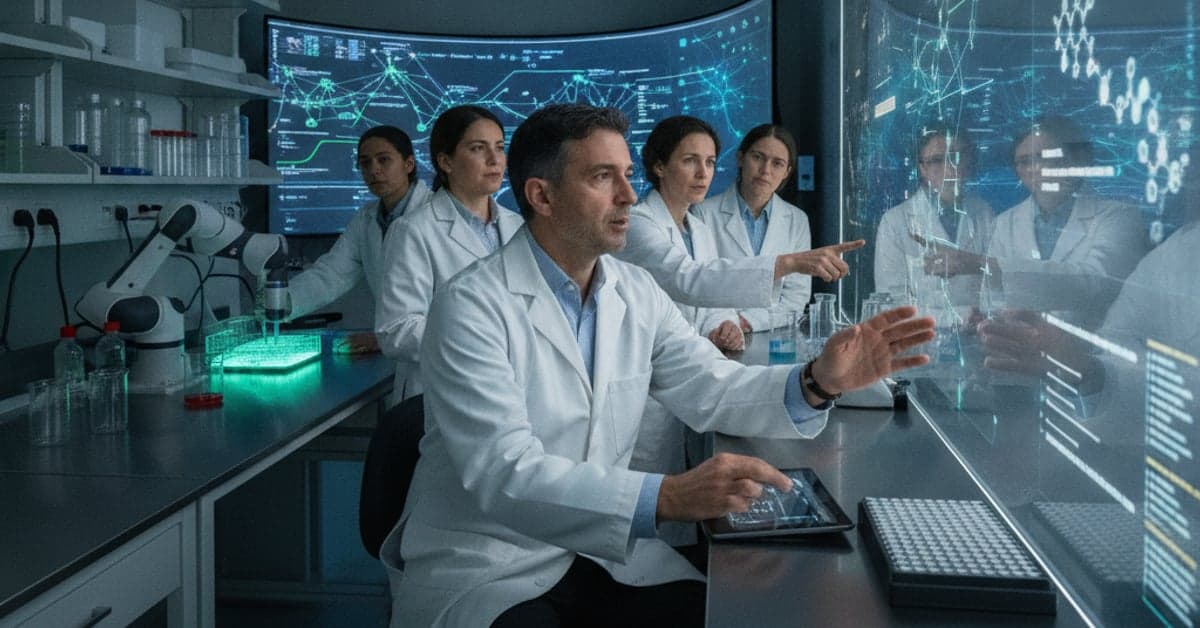
On June 30, 2026, Nature ran a News & Views by Olivier Elemento describing AI agents that generate biomedical hypotheses and design ways to test them, edging toward a lab cycle with AI at every step. The piece signals a shift from pattern-spotting tools to systems that propose, plan, and critique science itself. That is the real turn: AI hypothesis generation is moving from curiosity to workflow.
What Nature reports about AI hypothesis generation
According to Nature’s News & Views (Volume 655, pages 313–314, June 30, 2026), coordinated AI agents can suggest hypotheses, evaluate data, and chart experiments inside a single loop, rather than handing off to humans between steps. The framing matters more than any one benchmark. It posits that discovery can become continuous, with agents proposing ideas as new data arrives, then refining plans after each result. Nature presents this not as a distant vision but as an imminent lab pattern, built on the current wave of agent-based systems.
The same subject page shows Nature’s coverage pushing on two fronts that make the loop plausible. On June 24, 2026, a News & Views described a deep learning model that found a hidden predictor of sudden cardiac death in electrocardiogram traces, identifying an at-risk group that clinicians had missed. On June 17, 2026, another News & Views highlighted an optical metasurface that bakes core computer-vision operations into hardware for real-time, low-energy perception. Taken together, those reports suggest stronger sensors and more predictive models, which feed the kind of closed-loop planning the June 30 commentary describes. Nature’s throughline is clear: better signals, better models, tighter loops.
Closing the discovery loop with autonomous science
The key change is pace. In a classic pipeline, a team drafts a hypothesis, books instruments, runs assays, and waits. Agents collapse that waiting. They can simulate dozens of protocol variants overnight and rerank what to test in the morning. When the first batch lands, they update the model and rewrite the next step. The value is less about a single breakthrough and more about throughput, error catching, and repeatability under the same assumptions.
Nature’s framing also raises a governance question: who checks the loop? In drug or diagnostic contexts, even a small experimental choice can skew an outcome. A system that proposes both the question and the test must log every decision. Without that, replication breaks. The U.S. National Institutes of Health has pressed for stronger reporting on rigor and reproducibility for years; its guidance on experimental design and transparency lays out the baseline records that labs should keep. That baseline must extend to agent actions as these systems step into protocol planning. See NIH’s rigor and reproducibility resources for the current expectations in federally funded work: NIH.
There is also a risk calculus. The same feedback that speeds discovery can amplify bias in measurements or datasets. If agents overfit to a lab’s history, the loop may get confidently wrong. The NIST AI Risk Management Framework offers a map for identifying and monitoring such failure modes across data, design, and deployment. Bringing that mindset into benches and bioreactors is not optional once experiments are chosen by code.
From AI hypothesis generation to compliant lab records
Autonomous planning only helps if its breadcrumbs are auditable. Many labs rely on electronic lab notebooks and LIMS that were not built for agent-driven edits, versioning at protocol granularity, or cryptographically strong timestamps. If AI writes a step, orders a reagent, or changes a temperature ramp, that must be captured in a way regulators accept. The U.S. Food and Drug Administration’s rules on electronic records and signatures (21 CFR Part 11) already set expectations for audit trails and access control in regulated research. Labs aiming to adopt closed-loop experimentation need software that can meet those requirements. For context on accepted controls, see the FDA’s overview: FDA guidance.
Nature’s June coverage hints that hardware may be the surprise enabler. The optical computing prototype for on-device vision reduces latency and power in perception tasks. That kind of edge upgrade can push more decisions into instruments themselves, cutting data transfer delays and shrinking the loop time. Faster loops mean more cycles per day, but also more chances for silent drift. Version control for both models and firmware becomes a scientific necessity, not an IT chore.
Credit, authorship, and responsibility when agents propose the work
As agentic systems suggest hypotheses and shape protocols, the old question of authorship returns with new stakes. The ICMJE authorship criteria tie credit to substantial contributions, drafting or revising the work, approval, and accountability. If a model contributes a core idea, does that count? Journals have said no to listing AI as an author, but they increasingly ask for disclosure of AI use. Expect more granular contribution statements that specify which steps—hypothesis drafting, protocol design, data analysis—were agent-assisted, and who verified them.
Responsibility does not shift to software. The human team remains accountable for the choice to accept a proposed experiment and for the interpretation of results. That is a bright line across scientific guidance, and one that the Nature commentary implicitly relies on when it frames agents as collaborators rather than principals.
What changes now for labs and tools
Three pragmatic moves follow from Nature’s signal. First, inventory the decisions your instruments and scripts already make, then decide which ones should become agent-suggested but human-approved. Second, upgrade record-keeping to capture machine reasoning, not just results. Third, plan a bias and safety review cadence that matches the loop speed. If your system can plan daily, your checks cannot be quarterly.
The broader point is cultural. AI hypothesis generation is not simply another plugin for analysis. It shifts where ideas come from and how quickly they get tested. That will favor labs with clean data, well-instrumented gear, and software teams who can wire agents into existing workflows without breaking audit trails. It will also favor journals and funders that reward detailed provenance, not just glossy figures.
Nature’s machine learning page reads like a map of that future. A deep learning model flags a hidden cardiac risk group (June 24, 2026). An optical metasurface bakes perception into hardware for real-time decisions (June 17, 2026). And on June 30, 2026, the commentary ties it together: AI agents can propose, test, and refine. The pieces fit. The work ahead is stitching them into trustworthy lab practice.
Expect fast followers. Large centers will pilot closed-loop assays tied to electronic records that meet FDA standards, with risk reviews based on frameworks like NIST’s. Smaller labs will copy the playbook with open tools and tighter scopes. Journals will sharpen disclosure policies. Training will shift toward experimental design with agents in the room. As that happens, the phrase AI hypothesis generation will stop sounding like futurism and start reading like lab policy.
Nature has set a marker on June 30, 2026. The next question is who can turn that marker into a repeatable, documented, and fair scientific loop—at speed, and at scale. For more on this, see bloomberg.com.