
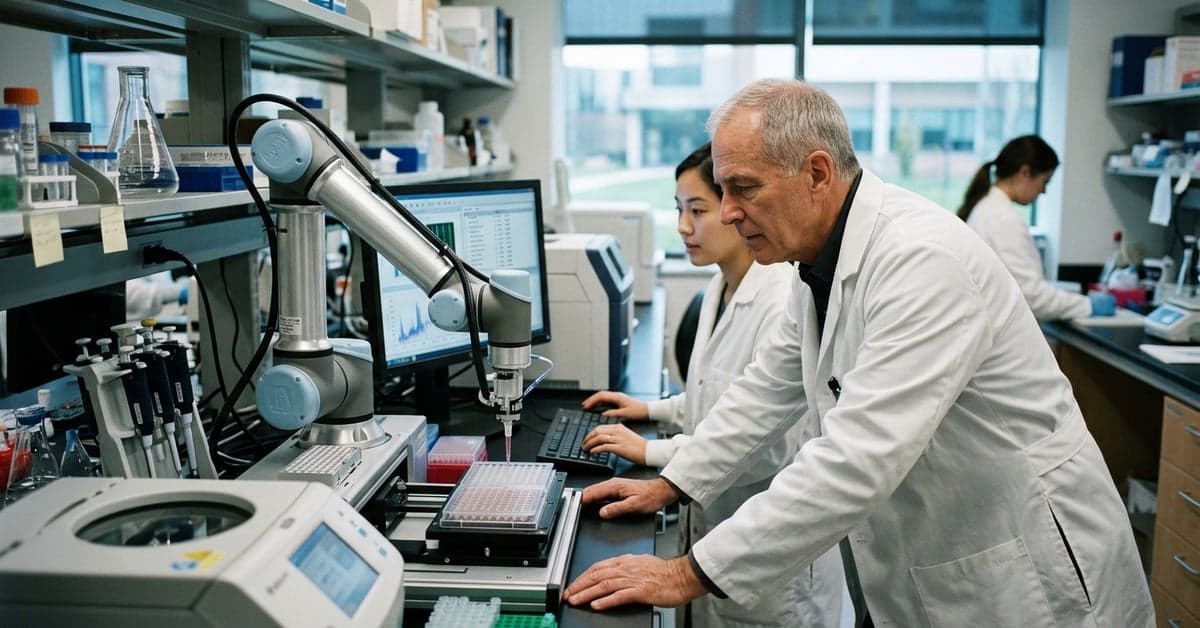
On June 30, 2026, Nature ran a News & Views by Olivier Elemento describing AI agents that propose biomedical questions and plan how to test them. The piece frames a move toward a discovery loop with AI involved at every step, from hypothesis to analysis. That’s the tell: AI hypothesis generation is no longer a thought experiment. It’s edging into lab workflow.
What Nature says happened on June 30
According to Nature’s machine–learning subject hub, the News & Views reports that “AI agents collaborate to generate biomedical hypotheses and analyse data,” pointing toward a laboratory cycle with AI embedded throughout (Nature subject page). The author of that analysis is Olivier Elemento, a genomics and systems biology researcher, which signals the piece is anchored in real bioinformatics practice rather than blue-sky speculation. Nature’s framing matters here because News & Views columns typically contextualize peer-reviewed advances for a broad scientific audience.
Why highlight this now? Because moving from AI-assisted data crunching to AI-directed inquiry changes the center of gravity in research. We’ve had models that classify images and rank drug candidates. We’ve had systems that write code and summarize papers. What this Nature write-up suggests is a hand on the wheel: multi-agent systems that don’t just analyze outputs but choose what to ask next, and why.
Why AI hypothesis generation is a different shift
Past breakthroughs such as protein structure prediction made AI indispensable for specific tasks. But they still slotted into human-defined pipelines. With AI hypothesis generation, the software starts to define the pipeline itself. That shift, highlighted by Nature’s June 30 coverage, moves AI from tool to partner. It puts the question-asking step—long treated as the most human part of science—on the table for automation.
That change brings two immediate consequences. First, speed. Systems can draft many candidate questions, rank them by expected information gain, then schedule experiments or analyses in minutes. Second, accountability. When an AI agent chooses a question, proposes a dataset, and interprets outputs, we need a chain of custody for every decision. Without it, reproducibility and credit assignment get fuzzy.
The reproducibility community has warned for years that opaque workflows undermine trust. The National Academies called for better provenance and standards to make results verifiable across teams and time (National Academies). AI-directed research raises the bar again. It’s not enough to log parameters. Labs will need auditable records of hypothesis selection, ranking criteria, and the alternatives rejected along the way.
From data helper to decision-maker: why it matters
Nature’s column points to a future where coordinated software agents propose, justify, and test ideas across biomedical data. That’s more than a productivity boost. It reorders who, or what, gets to frame a problem. In biomedicine, where datasets are messy and incentives are strong, this matters.
Consider bias. If an agent learns from historical clinical data, it inherits gaps and skews. Put that system in charge of which questions to pursue and which cohorts to analyze, and you risk amplifying those skews. A careful lab might counter this with pre-registered study plans, fairness checks, and independent replication. The AI era likely needs stronger versions of all three.
Then there’s data governance. Multi-agent stacks will touch protected health information and proprietary assays. Every step must be permissioned and logged. The FAIR data movement already emphasizes findability and traceability; its principles are a natural fit for agent-led workflows (FAIR Principles). But FAIR alone won’t resolve the new questions about how to audit the reasoning chain behind a machine-proposed trial or analysis.
Finally, safety. Even if early systems operate purely in silico, the path from suggestion to bench is short in many labs. That calls for established laboratory standards to be applied to AI-mediated work, from method validation through archival storage and quality systems (OECD Good Laboratory Practice).
What changes now for labs and journals
Nature’s spotlight nudges the scientific community toward process updates, not just model benchmarks. The most conservative labs can still prepare without deploying agents tomorrow. Five concrete shifts stand out.
- Provenance-first design. Treat the agent’s reasoning as experimental data. Log hypothesis formation, data selection, and prompt histories with the same care as raw measurements.
- Human-in-the-loop checkpoints. Define when a scientist must approve or edit an AI-proposed plan. Make those interventions visible for review and publication.
- Bias and coverage reporting. When agents triage questions, require reports on excluded data, demographic coverage, and known model limitations.
- Replicability kits. Share agent configs, seeds, and versioned toolchains, not just datasets and code. That improves cross-lab reproducibility when decisions are automated.
- Credit and authorship policy. Clarify how to credit contributions when hypothesis automation shapes the study. Journals and funders should align guidance before disputes arise.
Journals have already issued guidance on acceptable AI use in manuscripts, and the rise of agent-led inquiry will force another pass on those policies. Nature’s own ecosystem, including Nature Machine Intelligence, has covered the technical progress relentlessly. The governance track needs equal attention to keep pace with what the June 30 News & Views implies about end-to-end autonomy in the lab.
What to watch as automated hypothesis making matures
Three signals will show whether the approach is sticking. First, preregistration trends. If more studies list agent-generated rationales and ranked alternatives, that’s a sign of maturing practice. Second, lab information systems. Vendors that can capture agent decision trails cleanly will win buyers. Third, peer review. Look for referee requests that probe how the system filtered questions and why a specific path was chosen over others.
Nature’s coverage arrives alongside a broader shift: scientists are moving from one-off model demos to workflows that close the loop between problem framing and evaluation. If those loops are transparent and auditable, they can compress time to insight without eroding trust. If they stay opaque, the speed gains won’t matter. Reviewers will balk, and regulators will step in.
That makes the June 30 signal from Nature more than a curiosity. It’s a quiet line in the sand about where AI belongs in science. The next phase won’t be judged only by benchmarks but by how responsibly labs operationalize AI hypothesis generation—day by day, decision by decision. For more on this, see bloomberg.com and nytimes.com.