
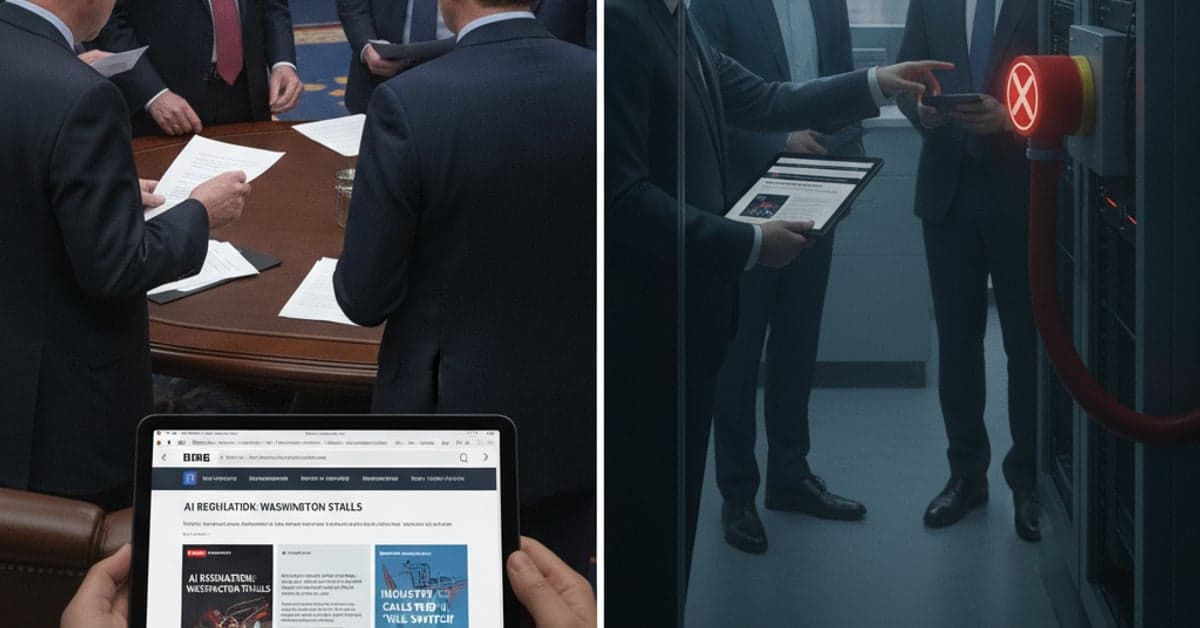
On September 15, 2026, the BBC’s Artificial Intelligence topic page stacked a week’s worth of headlines into one clear picture: an AI regulation deadlock in Washington just as industry leaders call for hard safety brakes.
What the BBC updates reveal right now
The BBC reported that calls for Congress to act on AI have hit a political standstill in the United States, even as risks and expectations rise. In a separate BBC Business interview highlighted the same day, Anthropic’s co‑founder said a mandatory shutdown mechanism for powerful models may be needed. The topic page also featured coverage of UK MPs and Lords urging a new law to protect human rights from AI, former President Donald Trump downplaying AI risk while pointing to rivalry with China, and China rejecting the idea it is engaged in “malicious competition” on AI.
Taken together, the BBC curation shows a widening gap: policy inertia in Washington, overt pressure from a leading model developer to add an industry‑wide safety brake, and diverging political narratives across the US, UK, and China.
Why the AI regulation deadlock matters for developers
When Congress stalls, rulemaking shifts to agencies, courts, and platforms. That patchwork is already visible. The NIST AI Risk Management Framework gives organizations a playbook for documenting hazards, measurement, and mitigations, but it is voluntary. The White House executive order on AI (2023) nudged reporting and safety testing, yet it avoided firm, universal obligations. None of that settles the big question product teams face: what minimum safety controls must a foundation model or AI‑enabled app ship with in the US?
In an AI regulation deadlock, liability risk becomes the de facto regulator. Enterprises ask vendors to warrant safety practices, insurance underwriters price model risk, and state attorneys general test deceptive or unsafe claims. That drives inconsistent contracts and extra compliance work for startups, which have fewer lawyers and smaller budgets. The result: slower deals, more audits, and wider variance in safety baselines across tools that look similar on the surface.
Inside the shutdown debate Anthropic ignited
According to the BBC’s interview summary, Anthropic’s co‑founder argued that a mandatory shutdown mechanism for advanced systems could be necessary. The idea is simple to describe and hard to implement: if a model crosses a danger threshold—say, evasive behavior, critical security failure, or misuse amplification—operators need a reliable way to suspend or disable it.
What could that look like in practice? Cloud providers already enforce service kill commands and deployment rollbacks. Extending that to model serving would mean provable isolation, per‑tenant and global off‑switches, and auditable triggers. Developers would need pre‑defined safety states, graceful degradation paths, and monitoring that can detect threshold breaches in near real time. Security teams would align this with CISA’s secure‑by‑design guidance, treating shutdown paths as first‑class controls, with access protections as strong as production keys.
The policy rub is governance. Who decides when to flip the switch—provider, regulator, or a designated independent body? Without a federal standard, shutdown criteria will vary by company. That is why the BBC’s pairing of Anthropic’s call with congressional gridlock matters: a safety tool without shared governance becomes a compliance fingerprint rather than a baseline.
The global split widens: rights rules in the UK, rivalry talk in the US
The BBC’s UK coverage described MPs and Lords pressing for a law aimed at protecting human rights from AI harms. That aligns with Europe’s move to codify risk‑based duties under the EU AI Act, where high‑risk uses face strict testing, documentation, and oversight. In that environment, a shutdown mechanism would likely be mapped to explicit compliance controls and audit trails.
In the United States, the BBC noted that Trump framed AI risk through the lens of competition with China, while a separate BBC piece reported China’s pushback against “malicious competition” claims. The rivalry framing pulls lawmakers toward export controls and national security priorities rather than safety baselines for consumer and enterprise AI. That mix sustains the AI regulation deadlock: agreement on strategic competition, but no consensus on day‑to‑day model safety obligations.
For global teams, this split means designing to the strictest common denominator or fragmenting features by region. Rights‑centric regimes will press for documentation, human oversight in sensitive use cases, and clear opt‑outs. Competition‑centric regimes will emphasize supply chain trust, provenance, and export compliance. Both will expect traceability, so building in content provenance signals such as C2PA content credentials is fast becoming table stakes.
What happens if the deadlock holds through 2026
If Congress stays stuck, the near‑term center of gravity will be standards and procurement. Federal buyers can require baseline controls—incident reporting, red‑teaming, and documented shutdown plans—as a condition of contracts. State privacy and consumer protection laws will keep filling gaps, with attorneys general testing unfair practices claims against unsafe deployments. Platform policies will harden, too: cloud providers and app stores can demand risk disclosures and verified fail‑safe paths before granting distribution.
That puts developers on the hook to operationalize what legislators have yet to codify. A practical approach now looks like this:
- Adopt a recognized safety framework (for example, NIST’s) and publish a living model card with red‑team results and monitoring plans.
- Design, test, and document a model shutdown path that includes role‑based access, clear triggers, rollback plans, and post‑incident review.
- Log decisions that adjust safety thresholds and link them to measurable indicators to support audits and insurer reviews.
- Map controls to likely future requirements using public roadmaps from the EU and UK to reduce rework later.
None of this resolves the AI regulation deadlock. It does give teams defensible steps that reduce harm and legal exposure while lawmakers argue about scope and speed.
What to watch next as Congress weighs its move
The BBC’s topic page made one reality plain on September 15, 2026: political momentum and technical urgency are out of sync. Watch three signals. First, whether Senate and House leaders can agree on narrow, sector‑focused bills—health, hiring, and critical infrastructure—that sidestep a sprawling omnibus. Second, whether major providers converge on shared shutdown criteria through industry groups or standards bodies. Third, whether the UK’s rights‑based push and the EU’s implementation guidance pressure US agencies to set firmer procurement baselines.
If those signals don’t move, expect courts, regulators, and platforms to keep writing the rules case by case. The story the BBC stitched together—industry asking for a safety brake, allies setting rights guardrails, and Washington in an AI regulation deadlock—won’t change until Congress does. For more on this, see anthropic.com and bloomberg.com.
Related reading: Federated Learning • Quantization • Machine Learning