
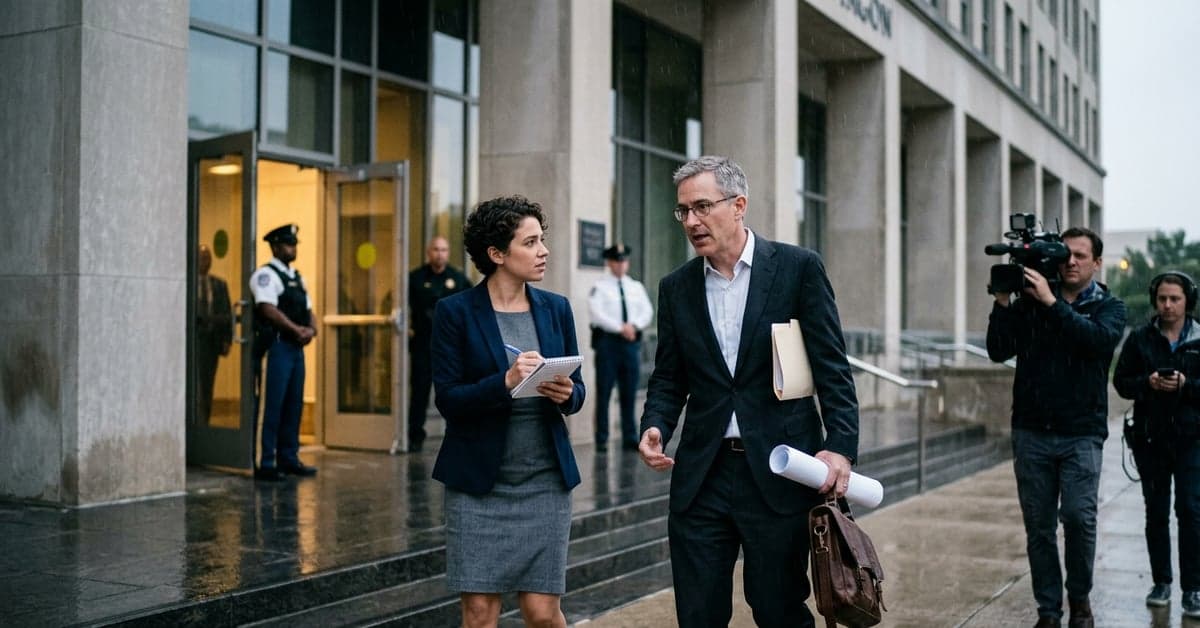
On August 28, 2026, The Guardian reported that a US judge ruled the Pentagon’s blacklisting of Anthropic unlawful, a decision with consequences far beyond one company’s prospects (The Guardian). The Anthropic blacklist ruling isn’t just a courtroom skirmish. It’s a signal that informal, opaque exclusions of AI vendors won’t survive scrutiny in federal procurement.
What The Guardian reported, and why it matters for AI buyers
The Guardian’s account describes a court finding that the Department of Defense stepped outside accepted procurement norms when it excluded Anthropic from consideration. Anthropic, known for its Claude AI systems, has chased public‑sector work as agencies test large models for analysis, planning, and cyber support. If a judge determined the Pentagon’s action was unlawful, agencies will now face fresh limits on ad hoc “do‑not‑buy” decisions dressed up as risk management.
This matters because federal buyers are under pressure to move faster on AI pilots while showing they can manage safety, security, and privacy risks. Procurement law already provides tools for this balance. The Federal Acquisition Regulation’s debarment and suspension rules require documented cause and a defined process, not a quiet watchlist. Those standards are spelled out in FAR Subpart 9.4.
What the Anthropic blacklist ruling actually changes
The immediate change is procedural discipline. If an agency wants to exclude an AI vendor for safety or integrity concerns, it will need to use formal channels that safeguard due process and provide a record for review. Informal blacklists invite legal challenges, bid protests, and delays that slow fielding of useful tools.
Expect more scrutiny from company counsel and investors on how agencies justify AI risk calls. If the Pentagon or any civilian agency relies on untested claims, or cites model speculation without evidence, a protest could follow. The Government Accountability Office’s bid protest venue has long offered vendors a path to challenge agency decisions; its process and timelines are public (GAO). Vendors can also seek relief in federal court, which is where this dispute appears to have landed.
In practice, the Anthropic blacklist ruling will push program offices to document risks with specifics: model evaluation data, red‑team reports, content safety controls, and incident histories that actually map to contract performance. That’s good for fairness and speed, because it narrows room for arbitrary calls that later get overturned.
Vendor watchlists, due process, and the AI risk playbook
Agency teams do need a way to separate credible partners from risky bets. The method matters. The NIST AI Risk Management Framework lays out a defensible approach: define context, measure harm pathways, and select controls before you make a go/no‑go call. Its guidance is free, and widely referenced across government and industry (NIST AI RMF).
That playbook can coexist with formal debarment rules. Use the NIST framework to structure the analysis. If the result is that a vendor cannot meet safety or security needs, write down the evidence and engage in the processes that FAR requires. That creates a clear administrative record and lowers the chance a court finds the outcome arbitrary.
Rulings like this one also sharpen the line between national‑security export controls and procurement exclusions. Policymakers can still block certain technologies from adversaries under export law. Buying decisions inside the US, though, must respect competition and due process. The Anthropic blacklist ruling underscores that split.
How the Pentagon case reframes AI vendor blacklists
There’s a broader signal here for every AI lab and integrator. Agencies can assess risk, but they must show their work. Watchlists with vague labels will carry litigation risk, as will whisper‑campaigns that tar one model as unsafe while greenlighting a competitor without side‑by‑side evidence.
This decision will likely accelerate an audit‑ready culture around AI model use. Expect more solicitations to ask for safety case documentation, model lineage, content moderation controls, incident logging, and third‑party testing summaries. Agencies that move in that direction will reduce protest risk and keep timelines intact. For disputes that do arise, the U.S. Court of Federal Claims and GAO will look for the paper trail.
For defense programs, this could also level the field for smaller AI vendors. If large incumbents previously benefited from soft blacklists aimed at upstarts, that advantage narrows when every exclusion must stand on documented facts and formal review.
What startups and agencies should do before the next challenge
Startups should align their assurance story to the government’s own frameworks. Map safety and security controls to the NIST AI RMF functions. Build an internal debarment dossier: model cards, evaluation metrics, jailbreak resistance testing, incident postmortems, and change‑management logs. If an agency questions your suitability, you’ll have evidence ready on day one.
Program offices should standardize AI risk criteria inside market research and source selection. Tie concerns to contract requirements, document why controls are or aren’t sufficient, and seek legal review before excluding a bidder. When possible, use pilot contracts to collect performance data rather than reaching for exclusion first.
The Guardian’s reporting on the unlawful exclusion gives both sides a reason to reset. It doesn’t remove the government’s duty to screen risky tools. It does raise the bar on how those calls are made, and how they’re defended when challenged.
If the last year was about racing pilots into the field, the next will be about maturing the process that decides who gets a seat at the table. The Anthropic blacklist ruling will be cited in that shift, because it tells every agency and vendor the same thing: show your evidence, or expect to be overruled. For more on this, see bloomberg.com.
Related reading: Federated Learning • Quantization • Machine Learning