
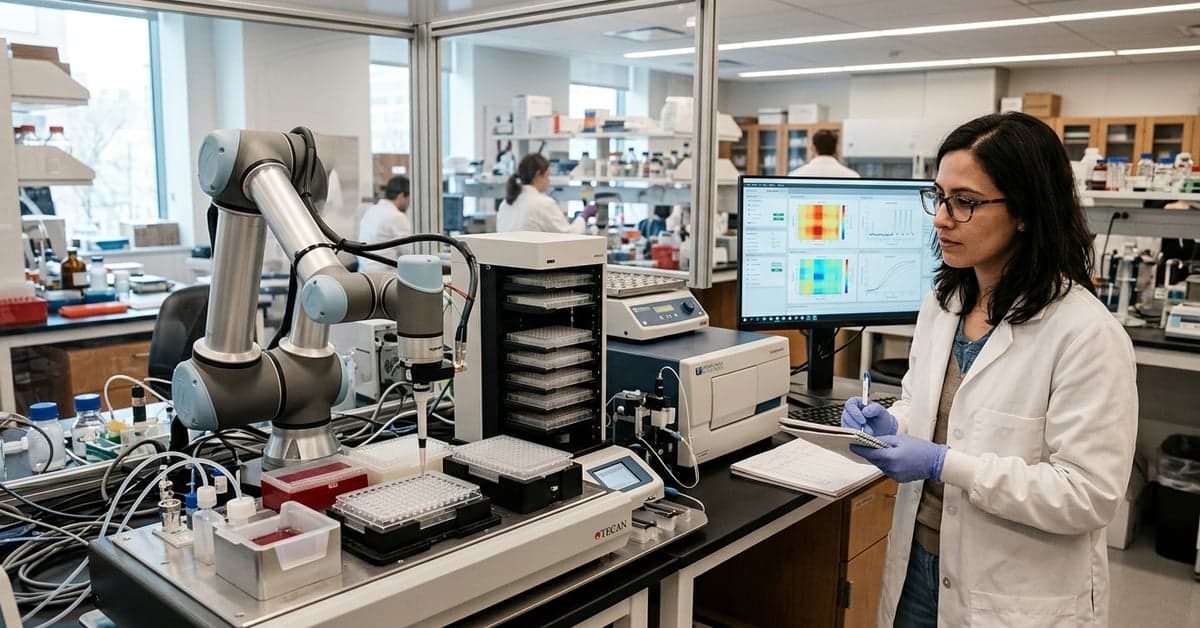
On June 30, 2026, Nature published a News & Views by Olivier Elemento describing AI agents that propose biomedical hypotheses and outline tests for them, with AI involved in every step of a lab discovery cycle (Nature subject page). That vision pushes beyond analysis into design, execution, and iteration. In short: automated science agents are coming into focus.
How automated science agents would run the loop
Elemento’s summary points to a chain that starts with literature mining and past data, moves to candidate hypotheses, and then to concrete experimental plans. The same system parses results, updates beliefs, and decides the next step. According to Nature, the promise is a discovery loop with AI at each handoff, not just a model that reads papers or predicts outcomes.
That differs from older lab automation, which executed fixed protocols well but rarely chose what to try next. The self-driving lab idea—pairing planning with robots and instruments—has been building for years (overview). The Nature piece suggests the planning layer is maturing: agents don’t only write protocols; they argue over competing hypotheses, prioritize experiments, and learn from misses.
To get there, the plumbing matters as much as the intelligence. Instruments need reliable interfaces, error states must be machine-readable, and data has to arrive with timestamps and calibration context. Without that, even sharp models will stumble on real benches.
From prompt to pipette: closing the discovery loop
The hard part isn’t drafting hypotheses. It’s closing the loop with measurements that are safe, interpretable, and reproducible. Biomedical labs have biosafety rules, reagent constraints, and ethics reviews. Any system that proposes or schedules experiments has to respect those boundaries by design, not by hope.
Data hygiene will decide whether these loops inform or mislead. Labs will need complete metadata for instruments and samples, standardized file formats, and durable stores. Policies like the NIH Data Management and Sharing Policy already nudge groups in that direction; they can become the backbone for AI-driven work (NIH guidance).
There’s also the matter of preregistration for key tests. If agents can rapidly try many variants, they can also overfit the bench. Precommitting the primary endpoint, sample size, and stop conditions makes p-hacking harder whether a human or an AI is in charge (Open Science preregistration).
Why automated science agents need guardrails
Agents follow incentives. If the reward is a high accuracy score on held-out data, they may optimize analysis quirks, not biology. If the reward is a publication-ready plot, they may discard messy but vital negatives. Guardrails should target these failure modes directly.
Three steps can help. First, build provenance into every object the system touches—samples, protocols, results, and decisions. A common provenance model makes this auditable across tools and teams (W3C PROV). Second, require agents to propose “surgical” falsification tests, not only confirmatory ones, and budget time for them. Third, separate exploration from evaluation. Keep a locked box of assays, operators, and instruments the agent never sees during design, then measure generalization on that box at the end.
Safety reviews should run in parallel. In biomedicine, many go/no-go gates exist already. Encode them as formal checks that block scheduling, and log every override with names and timestamps. When a run hits an edge case—contamination, drift, a stuck pipette—the system should fail safe and write down why.
What to watch next for lab teams
Nature’s signal is about trajectory, not a single tool launch. So what would count as real progress over the next year? Two things. First, time-bound cycles that a lab can reproduce: for example, a seven-day loop from hypothesis to validated follow-up, repeated three times, with traceable changes at each step. Second, head-to-heads against current practice on a fixed budget: fewer false starts, higher hit rates, or clearer stop decisions, with all negatives reported.
Instrumentation will be the unglamorous blocker. Teams that agree on a minimal API for plate readers, incubators, microscopes, and liquid handlers will move faster than those polishing planners while the lab stays manual. Expect “gray box” integration, where humans still move plates and check plates, but agents choose batches and timing.
Transparency should rise with ambition. As agents suggest riskier moves, public protocols, data releases, and machine-readable lab logs become a trust compact between developers, PIs, and readers. That’s where the Nature coverage points: confidence will come from loops that outsiders can inspect, replay, and critique.
Elemento’s News & Views framed the opportunity: AI agents that don’t stop at analysis but steer experiments as well (Nature). If lab groups can line up provenance, preregistration, and clean instrument lanes, automated science agents will start earning bench time. If they can’t, the demos will stay on slides. For more on this, see bloomberg.com and nytimes.com.