
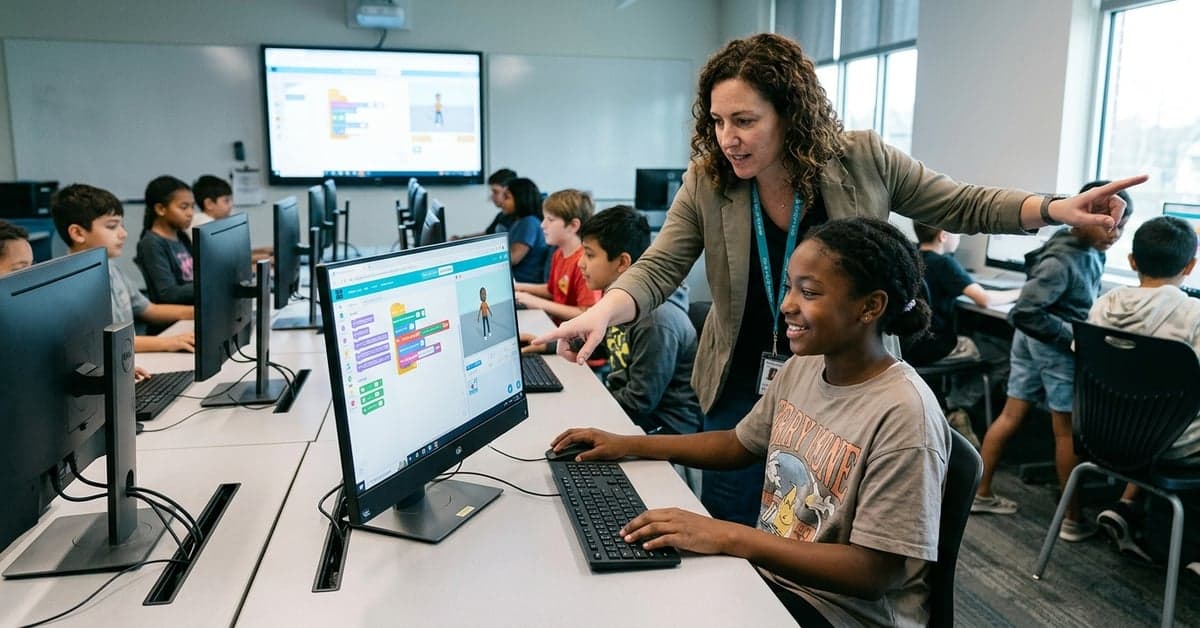
Code.org has turned its flagship Hour of Code into the Code.org Hour of AI, and it launched a new student activity called Mix & Move with AI that blends music, choreography, and coding in one place. The update reframes the one-hour entry point to computer science around AI literacy and creative problem-solving, rather than only syntax and loops, according to Code.org’s Hour of AI page.
What changed in the Code.org Hour of AI
Code.org now curates an activity catalog that pairs core CS ideas with age-appropriate AI concepts. The catalog spans grades 2-12 and highlights music, science, design, and web-building pathways. Code.org lists Mix & Move with AI for creative choreography, Music Lab: Jam Session for remixing tracks while learning sequencing and functions, and AI for Oceans to train a simple model that distinguishes sea life from ocean trash. Minecraft tutorials remain in the mix for block-based exploration, while a Dance Party: AI Edition adds artist-driven energy to concept practice. These offerings are laid out on the official Hour of AI page.
The shift goes beyond content. Code.org invites organizers to register events so the nonprofit can track global impact and provide support, reinforcing the program’s role as a shared ritual for first contact with computing. That matters for teachers who need materials that are free, short, and safe to run with mixed-age groups.
Inside Mix & Move with AI: creativity meets coding
Mix & Move with AI asks students to design a dancer, mix music, and choreograph steps, then use AI to jump-start or refine their code. Code.org positions the activity as a creative on-ramp, where the AI can propose patterns and students edit or extend them. That framing emphasizes AI as a partner rather than a replacement. It also makes abstract concepts—like pattern generation—feel visible through beats and motion.
Creative-first design is a smart bet for classrooms and clubs. Research groups and standards bodies have urged schools to introduce AI through familiar contexts and to foreground human agency. UNESCO’s guidance on AI in education stresses age-appropriate exposure and teacher control, recommendations educators can scan in the organization’s public materials (UNESCO: AI in education). Code.org’s music-and-dance focus fits that brief.
An AI Tutor in Web Lab: from helper to collaborator
For older students, an Intro to Web Lab lesson brings an AI Tutor into the flow of building a webpage. Code.org describes the Tutor as an assistant and collaborative partner during a self-paced lesson. That design choice places the student in the driver’s seat while the assistant suggests snippets, offers feedback, or explains a concept on demand. The dynamic mirrors how many professionals now work with coding assistants, but in a simpler, safer space for teens.
This model of “AI alongside students” aligns with guidance from the U.S. Department of Education, which urges schools to treat AI as a tool that augments teaching, with clear expectations and oversight. Educators can review the agency’s 2023 policy brief to see how classroom use is framed (U.S. Office of Educational Technology: AI).
Why the shift to an Hour of AI matters
AI has moved from research labs into everyday tools, yet most K‑12 classrooms lack time, training, or vetted materials to address it. By recasting a familiar tradition as the Hour of AI, Code.org turns a low-friction, one-hour event into a practical start on AI literacy. That can lower the barrier for schools that want AI exposure but can’t commit a full unit or semester.
The Code.org Hour of AI catalog also makes a point of meeting students where they are: remixing pop tracks, crafting dance routines, and recognizing sea creatures. Activities like AI for Oceans introduce core ideas such as classification and training data without drowning students in jargon, per Code.org’s descriptions. Creative framing helps students see how AI is pattern-based, statistical, and fallible, which is the right foundation for later, more technical study.
Beyond pedagogy, reframing the Hour of Code signals where entry-level CS is headed. Instead of learning to code first and meeting AI later, students encounter both together, with clear guardrails. That mirrors how modern work combines scripting, model prompts, and critical review. The approach also echoes the AI4K12 “Five Big Ideas”—perception, representation, learning, natural interaction, and societal impact—which educators can explore through the AI4K12 initiative.
How to run a safe, smart Hour of AI event
Organizers can pick one activity and keep it genuinely one hour. Code.org suggests registering the event so support resources and impact tracking kick in, as outlined on the Hour of AI page. For mixed-age groups, consider starting with Dance Party: AI Edition or Music Lab: Jam Session, which use songs to teach sequencing and functions while sprinkling in AI-generated beats. For grades 8-12, the Web Lab lesson with the AI Tutor introduces the “human in the loop” pattern that modern teams expect.
Safety and clarity matter. Share norms before students begin: the AI can suggest, but students decide; verify suggestions; and cite help when appropriate. The U.S. Department of Education’s guidance, linked above, includes discussion prompts and cautions that map well to short sessions. If your school uses a digital citizenship framework, connect the activity to existing lessons on privacy and fair use.
Where Code.org could go next
The Hour of AI is a start, not a finish line. The next step many schools will want is a bridge from one-hour taste tests to weeklong mini-units and assessment-ready projects. Code.org already points to longer curricula from each activity’s page, which can help departments align AI learning with standards and report progress without reinventing rubrics.
If the organization expands the Code.org Hour of AI with more cross-curricular tie-ins—science data labs, media literacy checks, or writing support that foregrounds citations—teachers will have even more ways to connect AI to core subjects. External frameworks, such as UNESCO’s competencies and AI4K12’s big ideas, give a map for that journey.
For now, the message is clear. The Code.org Hour of AI treats AI as a creative partner, not a black box. It gives teachers a quick, credible way to start the conversation and lets students build something they can share—music, motion, and code—inside a single hour. For more on this, see reuters.com and nytimes.com.