
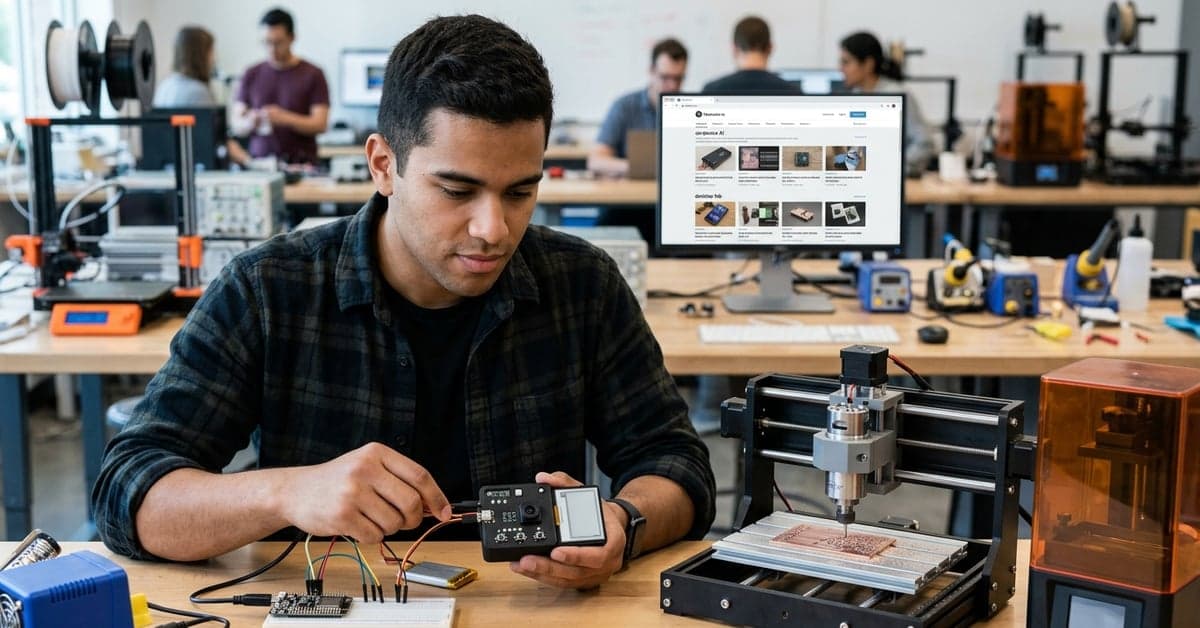
August 12, 2026 — A quick scan of Hackster.io’s news feed shows a clear shift: privacy-first devices, desktop-grade fabrication tools, and tiny on-device AI demos now crowd the top slots. That cluster is more than a coincidence. Read together, these Hackster.io maker trends point to a movement toward self-reliant builds that work without clouds, subscriptions, or outsourced factories.
What Hackster.io maker trends say about 2026
Several headlines tell the story at a glance. “Muse Glimmer Keeps Your Data Out of the Cloud” centers on a device that favors local processing, as highlighted by Hackster.io. “Rapid PCB Prototyping Has Arrived on Your Desktop” spotlights new benchtop fabrication. “Smartwatches Can Now Read Your Hand Gestures” shows sensors and ML moving closer to the wrist. A “Tabletop Arcade Built to Show Off” and a Star Trek–inspired LCARS interface for Pi‑hole add the maker spirit: playful, tactile, and proudly DIY.
The common thread is control. Makers want ownership over data and hardware pipelines. Local-first gadgets cut exposure to third-party servers and recurring fees. Desktop PCB tools collapse lead times from weeks to hours. Gesture interfaces and physical keyboards promise less screen time and more intent. Privacy advocates have long argued for this design posture; the Electronic Frontier Foundation’s primer on privacy by design explains why default-local processing matters. Now that stance is showing up in mainstream hobby builds.
For readers who don’t live on Hackster, this is a bigger change than a set of neat one-offs. These posts read like early commits to a new toolchain: software that runs offline, hardware that makers can fabricate or fix, and interfaces that respect attention rather than chase it.
On-device AI turns up on an $8 board
One headline stands out: “Running a 28.9M Parameter LLM on an $8 Microcontroller.” According to Hackster.io’s coverage, a developer squeezed a sizable language model into an ESP32-class board by borrowing a memory-saving technique referenced in Google’s Gemma work. The exact method matters less than the direction: viable natural-language features are creeping into parts that cost under $10.
That does not mean chatbots will flow from a coin cell. It does mean the line between “AI-capable” and “always-online” is blurring. With aggressive quantization and clever attention variants, small models can now parse short commands, route tasks, or format sensor summaries on-device. For constrained boards like the ESP32, developers can target narrow, reliable behaviors: wake-word detection plus intent tags, context-aware control of a pump or light, or natural-language labels for logs.
The practical win is privacy, latency, and cost. No server bill. No network round trip. No backend to secure beyond the gadget in hand. These gains mirror the local-first push in other Hackster posts. Makers get features people actually ask for—voice control that doesn’t leak conversations and assistants that work in a cabin with no bars.
Desktop PCB prototyping changes the build loop
Hackster.io’s “Rapid PCB Prototyping Has Arrived on Your Desktop” is the other inflection point. In-house PCB tools shrink the distance between idea and iteration. They also reshape budgets. Instead of paying a rush fab and waiting days, a shop can route, print, or mill a simple two-layer board in an afternoon, try it, then spin again before dinner.
The shift is not free. Desktop equipment brings new chores: ventilation for resins, consumables to stock, and alignment quirks to learn. But the strategic payoff is speed and confidence. Teams can harden designs before sending them to a factory, cutting re-spins and shipping waste. Open hardware communities also benefit; contributors can test fixes locally instead of waiting on a mailer from across the ocean.
In a year when supply-chain stability still swings, the ability to keep more of the build loop on the bench is a hedge. It also complements the on-device AI push. If your firmware can do more locally, you need faster ways to cycle through sensor and power layouts that support it.
Interfaces go tactile: keyboards, gestures, and retro UIs
Several other Hackster posts reinforce the same direction. “The Minimal Phone 2 Brings Back the Physical Keyboard — To Minimize Modern Distractions” backs a quiet trend: tools that help people disengage from endless feeds. A keyboard is not nostalgia for its own sake; it is a promise of deliberate input. Pair that with “Smartwatches Can Now Read Your Hand Gestures,” and you get the other pole of interaction: subtle movement instead of taps and swipes.
Then there are the love letters to computing’s past. A “Tabletop Arcade Built to Show Off” and an LCARS-style interface for Pi‑hole lean into fun and familiarity. They also make a point. Good interfaces are learnable and legible. They don’t require a week of onboarding or a cloud account. Makers are voting with their soldering irons for that view.
Read together, these choices align with the privacy-first bias. Devices that demand less attention also tend to collect less data. Gesture models can run locally. Keyboard-first phones can live without background telemetry. The build pattern is consistent across these Hackster.io maker trends.
Why these Hackster signals matter for vendors and educators
Vendors chasing the maker market should take the hint. Boards with small NPUs or DSP blocks will land better than raw GHz. Clear, maintained toolchains for quantization, audio features, and low-memory inference will win mindshare over flashy demos. Documentation that shows an LED matrix labeling sensor events offline will beat another cloud login screen.
Benchtop fabrication deserves equal focus. Ship fixtures, jigs, and alignment aids right in the box. Publish profiles for common resins and copper weights. Offer community-maintained libraries for footprints matched to at-home processes. If hobbyists can route and print a breakout on Saturday, they will build around your parts by Sunday.
Educators and hackerspaces can ride the same arc. Courses that teach privacy by default, model compression basics, and safe, repeatable PCB workflows will feel timely. Students should practice making a device that never touches the internet yet still understands a dozen voice commands. Tie that to a one-day board spin on a desktop tool, and you’ve built a complete loop that mirrors what readers see on Hackster.io.
The maker world has always prized autonomy. What’s different now is the toolkit. Tiny models, better sensors, and benchtop fab gear make autonomy practical, not just aspirational. If the current Hackster.io maker trends hold, expect more devices that keep data local, ship faster from the workbench, and favor inputs you can feel. That is a future worth building toward. For more on this, see bloomberg.com and nytimes.com.