
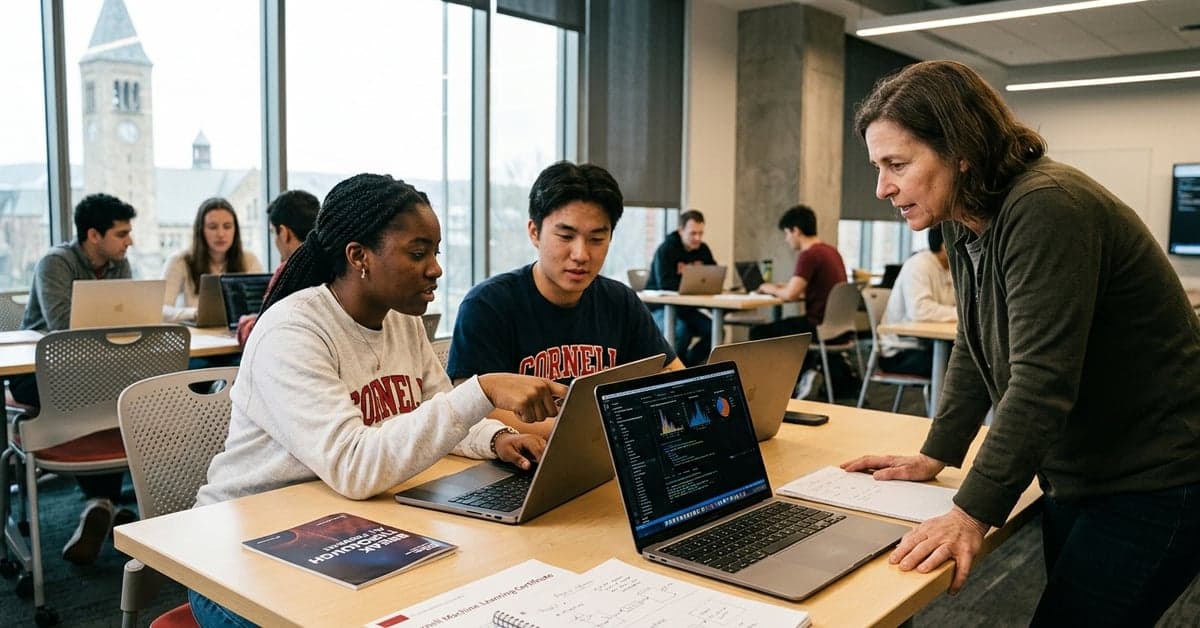
A one-year virtual program promises something undergraduates often struggle to get: real projects, a respected credential, and a mentor who shows up each week. The Break Through Tech AI Program pairs a Cornell University machine learning certificate with studio-based projects and small-group coaching, all designed to turn classwork into a portfolio employers can scan in minutes, according to Break Through Tech.
What the Break Through Tech AI Program actually includes
Break Through Tech describes the offering as a virtual, one-year extracurricular built for the fastest-growing areas of tech: data science, artificial intelligence, and machine learning. At its core is a summer curriculum, AI Studio in the fall and spring, and ongoing mentorship. The structure matters because it compresses credential-building and applied work into a single academic cycle.
First, the Machine Learning Foundations curriculum has students work with industry-relevant tools over the summer. Participants analyze real datasets, identify patterns, and build end-to-end projects. Successful completion earns a machine learning certificate from Cornell University, a name that can help a resume get a second look. This portion is meant to create a baseline of skills and a clear credential, per Break Through Tech.
Then comes AI Studio across the academic year. In the fall and spring, fellows tackle ML challenge projects with guidance from academic and industry advisors. The goal is to add polished, narrative-ready artifacts to a portfolio—work that shows problem framing, feature choices, evaluation, and iteration. The studio format keeps the cadence steady and the feedback timely.
Mentorship and career coaching run throughout. The program pairs each small group of fellows with an industry mentor for case studies, simulations, and targeted feedback. That setup gives students regular practice at communicating results and receiving critique—both habits that speed up early career growth, as the organization explains on its program page.
Taken together, the Break Through Tech AI Program gives undergraduates three assets by year-end: a recognized ML credential, two waves of applied projects, and weekly exposure to how practitioners think. Many degree programs try to deliver this mix over several years. Here it’s stacked into one.
Who benefits—and how the AI fellowship fits an early resume
The design is well suited to first- and second-year students who haven’t broken into traditional internships yet. The summer coursework fills a common gap: proof that the student can work with tools and data beyond a single class assignment. The fall and spring studios then add project depth and repetition, which matters when a hiring manager asks, “Show me something you built and how you improved it.”
Because the mentorship is group-based and continuous, students learn to present work in a professional setting and to iterate based on feedback. That rhythm mirrors real teams. It also reduces the time between learning a concept and using it under light pressure. For students switching into data or AI from another major, that pace can be the difference between a thin resume and one that shows momentum.
Another advantage is sequencing. The certificate signals baseline readiness. The first studio cycle delivers a portfolio piece you can share. The second cycle lets you revise, extend, or try a different domain. By the end, there’s a story arc in place—what problem you took on, what changed after feedback, and what you’d try next. That narrative isn’t just for interviews. It also helps when you apply to research labs, hackathons, or partner programs that want clear evidence of progress.
Where Sprinternship fits next to the program
Break Through Tech also runs a Sprinternship, a short, full-time micro-internship during academic breaks. Fellows work in cohorts on a focused technical project inside a host company, with on-site, hybrid, or remote options. The organization lists several outcomes: project experience you can add to a resume, an expanded industry network, confidence from working in a real environment, and a peer and alumni community. Those claims and formats are described on the same programs page.
For students in the Break Through Tech AI Program, a Sprinternship can serve as the “field test” for skills learned in the summer and studio cycles. It puts a deadline on scoping, shipping, and communicating under company constraints. Even a short engagement can surface the practical questions students need to answer in later projects: What does “done” mean for this stakeholder? How does this model change a workflow? Where will the data come from next quarter?
The pairing also broadens a portfolio. Studio work often highlights technical depth and iteration. A Sprinternship shows delivery inside a team with business context. When both appear on the same resume, reviewers can see both sides at a glance.
Why this skills path matters beyond tech roles
Demand for applied AI is no longer limited to software companies. Scientific fields are racing to adopt machine learning for discovery and tooling. Google.org’s Impact Challenge: AI for Science—a $30 million open call that closes on May 1, 2026—explicitly backs projects that use AI to advance health and climate research. The fund offers selected organizations accelerator support, Google Cloud credits, and pro bono technical help. That kind of backing signals where entry-level talent will find new problems to work on over the next few years.
The implication for students is simple. If your portfolio shows you can move from an initial dataset to a defensible result, then explain trade-offs to a mentor or stakeholder, you’re relevant in more places. The Break Through Tech AI Program’s mix of a Cornell credential, studio projects, and mentor-run case studies maps cleanly onto that need. It’s a template for building evidence that travels across industries—not just into software engineering teams, but also into labs, non-profits, and startups tackling scientific challenges.
What to watch if you’re considering the program
Look for three signals as you evaluate fit. First, do the summer tools and datasets line up with the kinds of roles you want next year? Second, will the fall and spring studio challenges let you go deeper on one domain or push you to try two distinct ones? Third, does the mentor cadence give you chances to present work, hear critique, and revise quickly? Each answer shapes what your portfolio will look like when you start applying.
Break Through Tech’s site lists a “Submit Interest” path for the AI track and an inquiry route for Sprinternships. Read the fine print and timelines, then work backward from when you want your next application to land. The students who get the most from the program will treat each phase—the summer certificate, the first studio sprint, the second studio sprint, and any micro-internship—as a step toward a single, cohesive story about their skills.
The throughline is clear. Students who assemble credential, practice, and context inside one year enter the market with sharper proof. That’s the bet behind the Break Through Tech AI Program, and it’s one more way undergraduates can turn curiosity into work that ships. For more on this, see bloomberg.com and nytimes.com.