
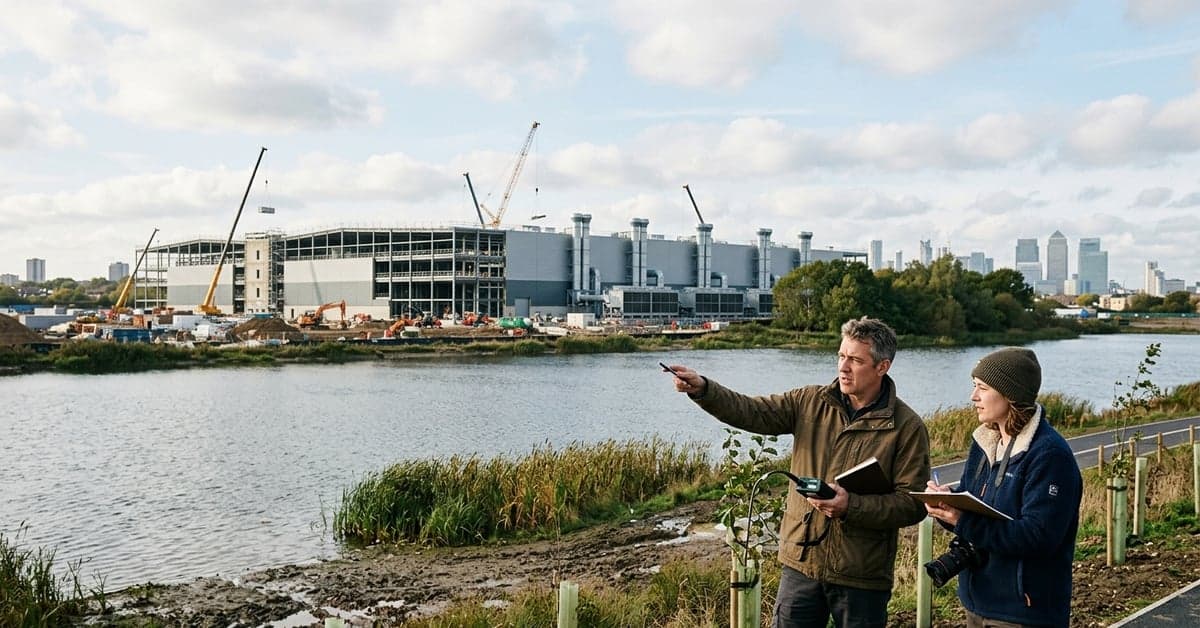
On August 21, 2026, The Guardian reported that a proposed London datacentre was judged “incompatible” with net zero, with an expected 1 million‑tonne carbon footprint. That headline number is stark on its own. Taken in context, it exposes the gap between the city’s climate targets and how digital infrastructure is planned, powered, and cooled — the heart of the London datacentre emissions debate (The Guardian).
What 1m tonnes says about London datacentre emissions
One million tonnes of CO2 is hard to picture. Using the US Environmental Protection Agency’s equivalency factors, that’s roughly the annual emissions of about 217,000 passenger cars, based on an average of 4.6 tonnes per vehicle per year (EPA). For a single project, that scale would weigh on any urban carbon budget.
London’s administration has set a 2030 net zero ambition for the city, ahead of the UK’s statutory 2050 target. Every large, long‑lived asset that locks in energy use through the 2030s will be judged against that clock. The question isn’t whether London needs more compute capacity; it does. The test is whether the project’s power source, cooling approach, and heat recovery can align with those goals (City Hall).
The electricity draw behind a modern facility also ripples beyond the site fence. Global data centre electricity use reached several hundred terawatt‑hours in 2022 and is set to surge as AI workloads scale, according to the International Energy Agency. AI inference and training push higher compute densities, which amplifies both energy and cooling needs unless efficiency gains outrun demand (IEA).
Why the plan collides with the UK’s net zero pathway
The reported 1 million‑tonne figure points to the project’s total lifecycle or operational emissions under a grid mix that still contains fossil generation. That math will improve as the grid decarbonises, but planning approvals land now, not in an ideal 2035 scenario. Without firmed renewables or credible offsets of waste heat, the facility’s data centre carbon footprint would push in the wrong direction in the near term. That is the crux of the planning objection The Guardian highlighted.
AI acceleration compounds the challenge. Training windows can be scheduled to align with abundant wind output at night, yet inference for consumer and enterprise apps tends to be on‑demand. Unless backed by contracted clean power — and storage to ride through lulls — those loads can still trigger fossil peakers. The net result: the emissions intensity of delivered compute stays higher than a glossy PUE number suggests.
Grid constraints and siting: lessons from West London
London has already seen what happens when power planning trails digital build‑out. In 2022, developers were warned that parts of West London faced severe grid connection constraints, tied in part to a cluster of data centres along the M4 corridor near Slough. That pinch delayed housing and other projects, a reminder that grid upgrades and major compute hubs must move in lockstep (coverage at the time was widely reported, including by the Financial Times).
Three siting realities follow. First, proximity to users is valuable for latency, but moving certain AI training workloads to cleaner or less constrained regions can cut both cost and emissions. Second, any London site competing for scarce capacity needs a clear public benefit beyond jobs: think recoverable heat or local skills pipelines. Third, transparency on connection timelines and curtailment risk matters to investors and residents alike.
What would make a London data centre pass climate scrutiny
Projects can still clear the bar — if they bake in concrete measures, up front, that survive beyond the marketing deck.
- Firm clean power: Long‑term power purchase agreements matched hourly to local or regional generation, plus storage to cover multi‑hour gaps. Annual book‑and‑claim accounting is no longer convincing for London datacentre emissions when local impacts are the issue.
- Heat reuse at scale: Capture low‑grade waste heat for nearby homes, hospitals, or campuses via district networks. The UK’s Green Heat Network Fund is already backing such schemes; tapping server heat can displace gas boilers when designed into the urban fabric (UK Government: GHNF).
- Water‑wise cooling: Shift to hybrid or dry cooling where feasible, and publish peak water demand. London may avoid the worst drought stress seen elsewhere, but unreported withdrawals undermine trust.
- Public reporting: Annual, third‑party‑verified disclosure of energy, water, and emissions, broken out by workload class. Include the marginal emissions rate of consumed electricity, not just averages.
None of these are novel on their own. What’s changed is the tolerance for promises without binding milestones. Planning committees will ask when the PPA closes, how many megawatts of heat are signed by a district operator, and what happens during wind droughts. Answers must be specific.
What The Guardian story signals for developers and councils
The Guardian’s reporting plants a flag: climate compatibility will be judged in the application, not deferred to an industry roadmap. For developers, that means submitting grid impact studies and heat‑network MoUs alongside architecture drawings. For councils, it means setting conditions that bite — sunset clauses on diesel backup, penalties for missing heat‑offtake targets, and triggers to review permits if the grid mix stalls.
There is also a market signal here. Projects that can prove clean, firm power and tangible community benefit will move faster through planning and appeal. Those that can’t may find that the cost of delay overwhelms any savings from cutting corners on sustainability.
If London wants AI jobs and low‑latency services without blowing its carbon budget, the bar is clear. Build the compute, but pair it with real clean power, real heat recovery, and real transparency. Otherwise, as The Guardian’s August 21 report suggests, London datacentre emissions will keep running into the city’s own climate maths — and lose. For more on this, see bloomberg.com and nytimes.com.
Related reading: Federated Learning • Reinforcement Learning • Machine Learning