
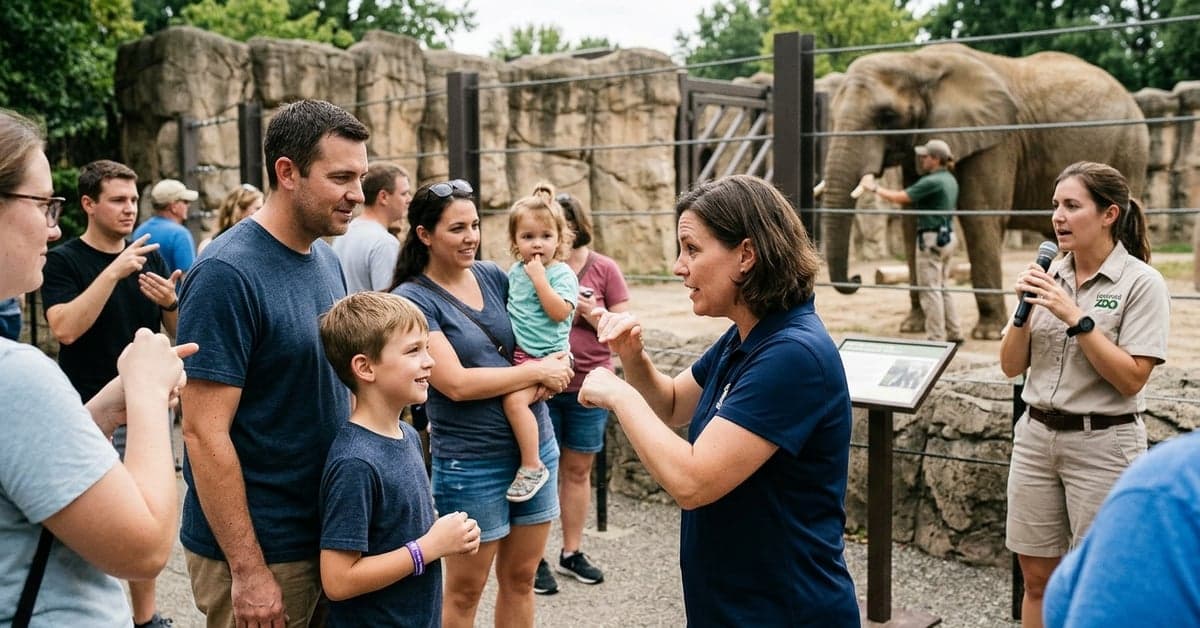
On August 29, 2026, the Louisville Zoo will hold its eighth annual Deaf and Hard of Hearing Awareness Day from 10 a.m. to 2 p.m., and the facility will close early that afternoon, with gates closing at 2:30 p.m. and exit by 3:30 p.m., according to the Zoo’s calendar (Louisville Zoo). The event is presented with Kentucky Hands & Voices and includes American Sign Language (ASL) interpreter support across select experiences. For families planning a visit, Louisville Zoo Deaf Awareness isn’t just a date on the calendar. It’s a day designed around communication access.
What Louisville Zoo Deaf Awareness offers on August 29
The Zoo says ASL interpreters will be stationed at several habitats, keeper talks, and animal training demonstrations, and at the front entrance for wayfinding support that morning and early afternoon (source: Louisville Zoo). That setup matters. Interpreters at the point of experience—inside a habitat area or during a live demo—turn passive viewing into a two-way learning moment for visitors who are Deaf or hard of hearing.
Partnering with Kentucky Hands & Voices signals the event is built with families in mind. Hands & Voices chapters focus on language access and unbiased support, so programming shaped with that input tends to account for the flow of a real zoo day: moving between exhibits, catching a keeper talk on time, finding bathrooms and quiet spots, and asking spontaneous questions—through an interpreter—when an animal does something surprising.
For regular members and first-time visitors alike, Louisville Zoo Deaf Awareness is a clear invitation: you can plan a full, communicated experience without piecing together ad hoc support.
Deaf and Hard of Hearing Awareness Day details, translated into a plan
There’s enough here to build a smooth visit. Start with the clock. The event itself is 10 a.m. to 2 p.m., and the Zoo will close early that day, with gates closing at 2:30 p.m. and all guests expected to exit by 3:30 p.m. (per the calendar listing on Louisville Zoo). That means a morning arrival is more than convenient—it’s essential.
Expect interpreter-supported programming to be clustered in that 10 a.m.–2 p.m. window. If you’re traveling with children, front-load the day with the live keeper talks and demos, then move to self-guided exhibits after lunch. The Zoo’s note that interpreters will be “available at several habitats” implies multiple locations; look at posted schedules on arrival, ask at the gate where interpreter rotations are, and keep a few must-see stops in mind so you’re not sprinting across the grounds between sessions.
Wayfinding and Q&A support at the entrance can set the tone for the visit. Use that moment to ask about any sensory-friendly spaces, quiet areas for breaks, and where strollers or mobility devices fit best on the day’s route. The Americans with Disabilities Act requires effective communication in public accommodations, which can include sign language interpreters when needed (ADA.gov). Events like this one go further by putting interpreters where learning actually happens, not just at a desk.
Early close: how to time your visit and avoid missing key moments
Shortened hours change visitor behavior. People arrive earlier, and more guests tend to cluster around the first round of keeper talks. To make the most of Louisville Zoo Deaf Awareness, aim for the gate shortly before 10 a.m., head straight to the first interpreter-supported talk on your list, then build in a mid-morning break. If you need extra time at a favorite habitat, hold it for the end of the program window, when live programming tapers and paths can thin out.
Remember the last call. The Zoo’s early close on August 29 means ticketing and re-entry policies wind down sooner; gates close at 2:30 p.m., with exit by 3:30 p.m. Plan meals and bathroom stops with that in mind so you’re not cutting a keeper talk short.
If you’re coordinating a group, split roles: one adult tracks the interpreter schedule while another handles snacks and transitions. That small move keeps you from missing the start of an interpreted demo by a minute or two—the window when the key safety or animal-welfare context is often explained.
Why a dedicated accessibility day matters—beyond one Saturday
The eighth annual tag isn’t just an anniversary. It shows sustained commitment to access, and that consistency helps families build traditions—and confidence—that a day at the Zoo will work for them year after year. Across accredited zoos, accessible programming has expanded in scope, from sensory-friendly mornings to interpreted talks and tactile learning where safe to do so. The trend reflects broader expectations under the ADA and from Deaf-led groups that effective communication be the default, not an exception (National Association of the Deaf).
Dedicated days also do something routine accommodations can’t: they concentrate resources. With interpreters at multiple habitats and live demos in a single block, visitors can move from one interpreted experience to the next without long gaps. That density of access, especially for kids, turns a few hours into a full slate of science learning. It also gives staff practice running interpreted programs, which can improve everyday interactions the rest of the year.
There’s a feedback loop here. When families show up for inclusive programming, zoos can justify more of it. When interpreters are embedded in live education, staff field better questions and spot where signage or talks need clearer language for all audiences.
What to watch for next—and how to help the day run smoothly
Before you go, refresh the event details on the Louisville Zoo site in case the interpreter schedule or habitats list is posted. If you use assistive tech, bring what works best for you and your child; interpreters add communication access, but familiar tools can help with pacing and comfort. If you need an accommodation beyond what’s part of the program, ask early; public venues are expected to communicate effectively with visitors with disabilities, and advance notice makes it easier for teams to arrange support (ADA.gov).
Families connected with Kentucky Hands & Voices can look for any day-of meetups or tips being shared among parents. If you’re attending with hearing visitors, talk through interpreter etiquette with kids: face the person who’s speaking, save questions for a pause, and leave extra room by the interpreter so everyone can see.
Most of all, expect a day built for conversation. When an animal training demo is interpreted well, the focus shifts to the animal itself—its behavior, care, and conservation story—because everyone in the group has the same information at the same time. That’s the point of Louisville Zoo Deaf Awareness, and why this annual event keeps drawing families back.
Louisville Zoo Deaf Awareness is a small change on the calendar that makes a big difference in how people experience a science-driven day out. Show up early, catch the interpreted talks, and let the questions flow. For more on this, see bloomberg.com and nytimes.com.