
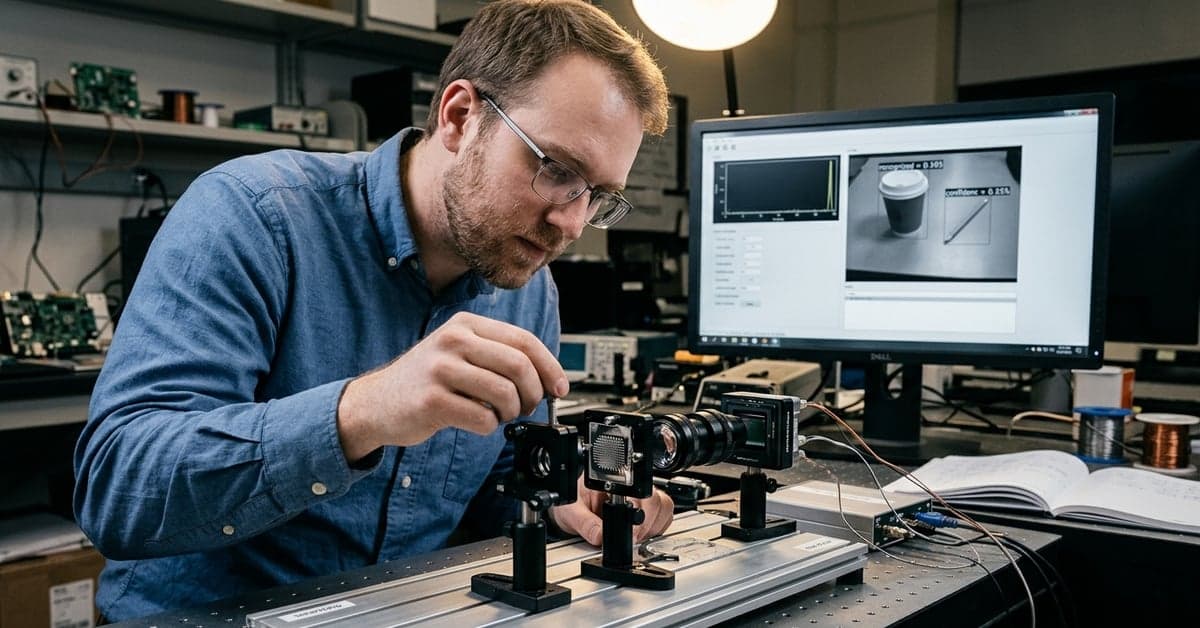
On June 17, 2026, Nature spotlighted a prototype that makes light do part of the computing. The team embedded core computer‑vision steps in an optical metasurface, then paired it with a sensor to deliver real‑time perception. According to Nature, the result is accurate performance across diverse tasks with far lower energy, pointing to a new path for on‑device vision. For readers tracking machine learning news, this is the rare hardware advance that could shift how cameras think.
An optical metasurface turns light into compute
A metasurface is a thin, engineered layer that bends and filters light in precise ways. Instead of digitally crunching every pixel, the surface itself performs parts of the workload as photons pass through it. In the work highlighted by Nature, the surface is designed to carry out the building blocks of computer vision—operations such as filtering, edge extraction, or feature mixing—before the signal ever hits the main processor. You can think of it as a preprocessor etched into matter. For background on the physics, see the primer on metasurfaces.
The Nature summary describes a “general‑purpose” artificial‑intelligence vision system built this way. That detail matters. Optical accelerators often target one task. Here, the prototype handles varied perception jobs while keeping accuracy and speed. If the approach holds under wider benchmarks, it could bring a new class of low‑power, in‑sensor AI to phones, glasses, drones, and industrial cameras.
Why this machine learning news matters for edge devices
Edge devices live under tight budgets: power, heat, and bandwidth. Moving fewer raw pixels into a digital pipeline helps with all three. When a metasurface executes early vision steps, the downstream silicon has less to do. That cuts battery drain and latency, which in turn makes real‑time perception more practical in thin, battery‑limited products. Edge AI research has been chasing those wins with quantization and clever model design; doing some of the work in optics attacks the same problem from the other side.
There’s a privacy upside too. If a sensor can parse features on the spot, a device can avoid shipping full frames to a cloud or even to its own main processor. Only the distilled signal moves forward. In sectors like home security and wearables, that’s not a minor perk. It’s a design choice that reduces exposure by default. This machine learning news is less about a hotter benchmark and more about shifting where intelligence happens—closer to the photons.
What the prototype shows — and what it doesn’t
Nature’s report says the prototype achieves accurate, real‑time perception across a range of tasks. That’s the headline. It also labels the device “general‑purpose,” which sets it apart from single‑use optical tricks. The implied gains are speed and energy: photons glide through a carefully crafted surface while core operations occur for free, in physical time.
Open questions remain. How programmable is the metasurface once fabricated? Can its behavior be tuned, or must an upgrade wait for a new mask? What’s the integration story with standard image sensors and ISP pipelines? The answers decide whether this becomes a lab curiosity or a path to shipping parts. Optical computing, as summarized in references like optical computing overviews, trades flexibility for speed and efficiency; the trick here is claiming “general‑purpose” without surrendering those optical advantages.
Manufacturing is another gate. Metasurfaces must be produced with high precision across large areas to serve mass‑market cameras. Yield, cost, and alignment with existing CMOS image sensor lines will drive real‑world feasibility. If the system demands tight tolerances that don’t scale, the idea stalls. If it rides existing optics assembly flows, it moves.
Who benefits first if it scales
Early wins likely show up where power and latency dominate. Small drones that need obstacle avoidance without a heavy compute board. AR glasses hungry for scene understanding that won’t burn cheeks—or batteries. Smart cameras that must run person or object detection for months on a modest cell. In all three, shaving milliwatts and milliseconds is a direct product feature.
Phones are a tougher but bigger prize. Modern cameras already rely on dedicated silicon and clever ISPs. A metasurface that preconditions light for the ISP could free up headroom for better video stabilization, HDR, or on‑device generative effects. If each shot arrives with edges and features already teased out, the pipeline can skip steps. The bet is simple: do less with electrons because photons did more upfront.
Supply chains would need to adjust. Lens vendors, sensor fabs, and ISP designers would coordinate around a new split of duties. That’s a multi‑year journey. But the incentive is clear for any platform that wants lower heat and longer life without ceding quality. As Nature frames it, the promise is rapid, low‑energy, on‑device vision intelligence—with the “intelligence” starting in the glass.
What to watch next in machine learning news
Three checkpoints will tell us if this is a turning point or a clever demo. First, independent benchmarks across more tasks and lighting conditions, not just lab scenes. Second, evidence of programmatic control—some means to reconfigure or co‑design the surface with evolving models. Third, credible manufacturing pathways that fit within camera module costs.
For now, the signal is strong: Nature has put a spotlight on a practical form of compute‑in‑matter for vision. The piece lands amid machine learning news cycles that often center on ever larger models and cloud compute. This story points in the opposite direction—toward smaller, faster, cooler, and closer to the sensor. If the work matures, expect “optical metasurface vision” to show up in spec sheets right alongside sensor size and pixel pitch. For more on this, see nytimes.com.