
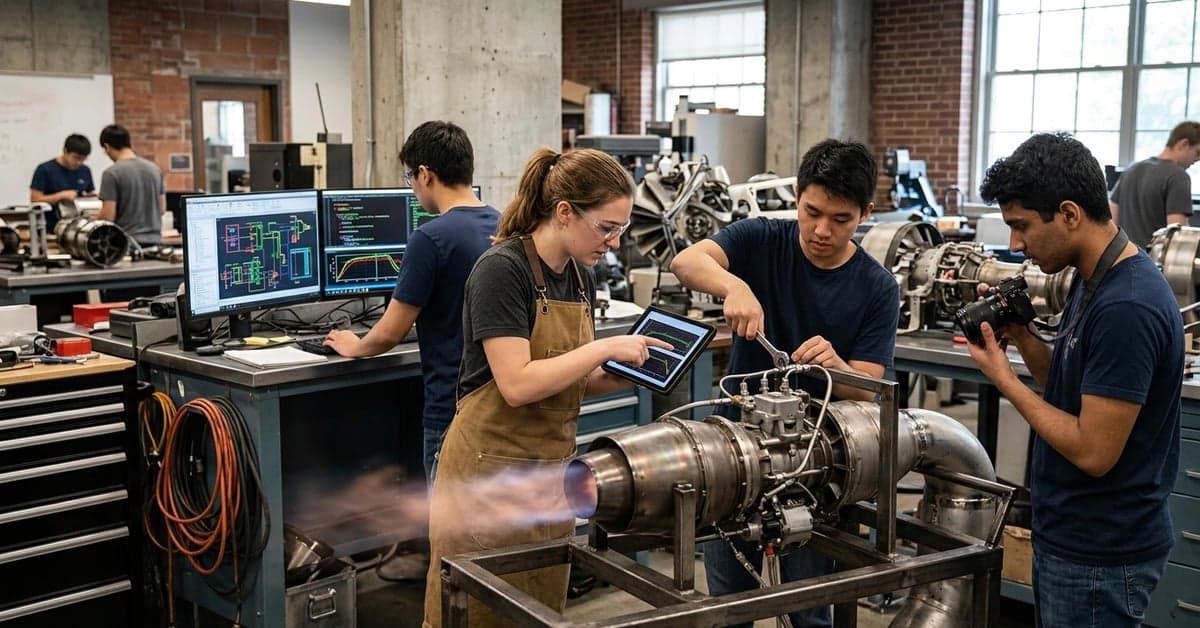
On July 14, 2026, MIT News reported that students designed, built, and tested a jet engine with AI copilots as part of the MIT JARVIS Challenge — a rare, end-to-end trial of machine learning inside tough‑tech engineering workflows (MIT News machine learning topic page). The project didn’t just make a flashy demo. It evaluated where AI helps in real hardware, and where it does not.
What the MIT JARVIS Challenge actually built
According to MIT News, the challenge asked student teams to integrate AI copilots into the development of a high‑performance aerospace system, then carry the work through to a physical test on a jet engine. That framing matters. Many AI claims stop at code generation or simulation; this one pushed into manufacturing and validation. The MIT JARVIS Challenge set out to measure usefulness, not hype.
What counts as “usefulness” in this setting? In aerospace, design cycles hinge on trade studies, constraints, and tight safety margins. AI copilots could plausibly draft documentation, propose geometric variants for components, or help route design changes across shared models. They might also misread limits, miss edge cases, or suggest ideas that pass in silico but fail on a test stand. The point of the exercise, as described by MIT News, was to find those boundaries with a real engine on the line.
That end‑to‑end setup is the signal here. It shifts the question from “Can an LLM write code?” to “Did the assembled system hit targets without creating new risks?” In other words, it treats AI as one contributor inside a complex engineering program, where schedule, budget, and safety all bind.
Where AI copilots helped — and where they didn’t
Physical engineering exposes gaps that slide by in software‑only tests. Parts must be manufacturable. Tolerances stack. Cooling, vibration, and materials behavior make or break performance. By carrying AI assistance into a real jet engine build, the MIT effort offers a clearer read on when copilots speed work and when humans need to slow down.
The broader AI community is wrestling with similar measurement issues. On July 28, 2026, Nature ran a News & Views arguing that medical AI still lacks solid ways to evaluate assistants embedded in clinical workflows. Engineering has the same problem in a different uniform. If a copilot drafts a CAD macro that saves a day but introduces a subtle error path, how should teams score that? What if the error is caught by a later gate? A usable metric must include time saved, defect escape rates, and rework — not just a neat demo output.
Risk guidance already exists for high‑stakes systems. The U.S. National Institute of Standards and Technology publishes an AI Risk Management Framework to surface potential harms and set controls. NASA’s Systems Engineering Handbook lays out disciplined requirements flow‑down, verification, and validation across hardware programs (NASA SEH). The value of the MIT jet engine project is that it turns those abstractions into a testbed: you can observe whether AI assistants make it easier to satisfy requirements, or simply add churn that later gates must clean up.
How the JARVIS project reframes AI in hardware
Putting AI inside a student‑run jet engine program reframes the debate. It’s no longer about clever prompts or model tricks; it’s about whether system performance improves without slipping on safety. The JARVIS project gives educators and industry a concrete scaffold for answering four practical questions:
- Which engineering tasks consistently benefit from AI copilots, measured by cycle time and first‑pass yield?
- Where do assistants introduce subtle errors or optimistic assumptions that downstream checks must catch?
- How should teams document AI contributions so audits, certifications, and recertifications can trace decisions?
- What training keeps engineers in the loop without turning the copilot into a crutch?
Because the work touched a real engine test, outcomes can be tied to physical evidence — pass/fail on a dyno, temperature margins held or missed, vibrations damped or not. Even if the student engine is small, the pattern generalizes. Turbomachinery, battery modules, medical devices, and industrial automation all need that same bridging of digital suggestions to physical proof.
There’s also a cultural point baked into the MIT JARVIS Challenge. It normalizes asking for evidence before adopting shiny tools in safety‑sensitive domains. If copilots excel at document control, analysis setup, or variant exploration, show it with time stamps, defect logs, and test reports. If they falter on requirements reasoning or hazard analyses, quarantine them from those steps until stronger guardrails exist. That mindset aligns with mainstream systems engineering, not a backlash against AI.
Why this kind of evaluation matters now
Engineering organizations are under pressure to adopt AI while keeping regulators, customers, and insurers on side. Without shared methods to judge AI‑in‑the‑loop design, teams default to anecdote. A challenge that starts with a complex requirement and ends with a hot‑fire test supplies a better yardstick. The fact that MIT’s effort happened on a jet engine, a system where performance margins and safety are tight, raises the bar for what “works” should mean.
It also suggests a template. Select a representative subsystem. Declare the role allowed for copilots in advance. Track time saved and defects escaped at each gate. Validate on hardware. Publish the rubric with failure cases included. That’s how you turn a one‑off headline into a living benchmark the field can compare against — the kind of structure Nature called for in medicine, adapted to engineering.
There’s a final benefit: talent development. Graduates who have seen both the speed and the limits of AI assistance inside a real build will be better at judgement calls. They’ll know when to trust a suggested optimization and when to reach for a torque wrench and a test plan. That’s the kind of literacy companies say they want, and it can’t come from a chatbot window alone.
What to watch next from MIT’s hardware labs
MIT News framed the jet engine program as an assessment of AI’s usefulness in high‑performance aerospace work. If the institute shares more data from the trials — even simple measures like design iteration counts, test reruns, or time‑to‑fix on AI‑introduced errors — it could seed a comparative benchmark other labs can reuse. Paired with established risk tools from NIST and systems engineering checklists from NASA, it would let companies adopt copilots in a controlled way, with fewer surprises.
That’s why this story matters beyond campus. If the MIT JARVIS Challenge becomes a template, AI copilots will face the same requirement every good part faces: prove it on the stand. For more on this, see reuters.com and bloomberg.com and nytimes.com.