
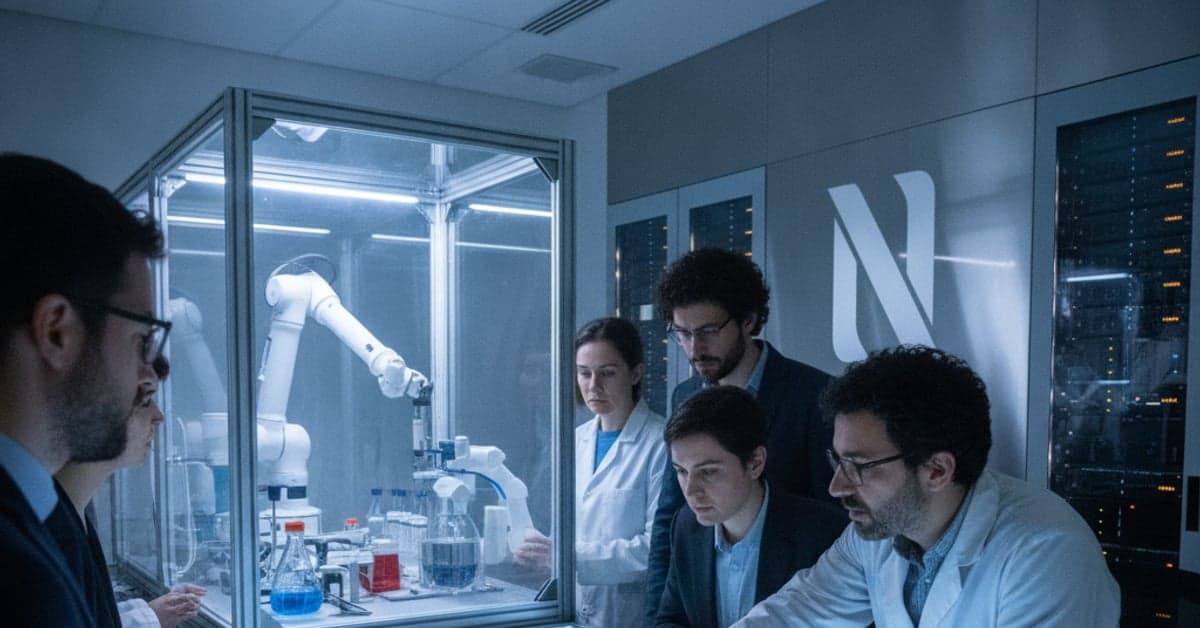
On June 30, 2026, Nature ran a News & Views arguing that software agents can now generate testable biomedical hypotheses and plan how to validate them. The piece, by Olivier Elemento, frames a shift toward a discovery cycle with AI involved at every step. That claim puts AI lab agents on the threshold between code and experiment, which is where impact—and risk—start to compound (Nature).
Nature says AI lab agents are entering the discovery loop
The article describes a multi-agent approach: systems that read papers, propose hypotheses, critique one another, and outline tests on the data they can access. According to Nature, the goal is an end-to-end discovery loop, not just a one-off model run. That matters because the bottleneck in biomedicine is rarely computing power alone; it’s turning ideas into experiments that survive contact with real samples and noisy instruments.
Nature has recently spotlighted model-first wins—such as deep learning surfacing a hidden predictor of sudden cardiac death from ECGs—yet Elemento’s piece marks a different arc. It is less about another accuracy chart and more about closing the loop between inference and intervention. If AI can both suggest a biomedical hypothesis and map the next test, the conversation shifts from performance metrics to decision rights, reproducibility, and cost in the lab setting (Nature).
Agentic AI in science moves from code to wet lab
The idea of automated science isn’t new. A decade and a half ago, the “Robot Scientist Adam” project showed that machines could generate yeast genetics hypotheses and run them on lab hardware under human oversight. That work proved feasibility, but it ran on carefully fenced scopes and bespoke systems (Science, 2009).
What’s different now is the substrate. Today’s agents can parse literature at scale, retrieve domain knowledge, weigh alternatives through debate-like workflows, and then emit concrete protocol steps or in silico tests. Linking those plans to robotic liquid handlers, imaging rigs, or sequencing pipelines is still a heavy lift, but the software stack is closer to general-purpose than hand-built. That unlocks iteration speed. It also raises the stakes: a fast loop can multiply a bad assumption as quickly as a good one.
Two questions define whether this wave crosses into routine practice. First, can agents produce hypotheses that survive contact with fresh data and independent replication? Second, can they draft experimental steps that a lab can run safely, within budget, and without hidden dependencies? The answers depend as much on plumbing and governance as on model weights.
Why labs, not models, will decide the timeline
Even the sharpest model can’t fix a lab that can’t find its data. For AI-driven discovery to land, research groups need structured, queryable records of samples, reagents, protocols, and outcomes. The FAIR data principles—making data findable, accessible, interoperable, and reusable—aren’t paperwork; they’re preconditions for agents to reason across projects without hallucinating context (Nature: FAIR Guiding Principles).
Governance must keep pace. Labs will need provenance tracking for every input, versioned prompts and plans, and audit trails linking agent decisions to instrument runs. The U.S. National Institute of Standards and Technology offers a useful north star in its AI Risk Management Framework: document context, map risks, measure, and manage. Translating that to benchtop work means clarifying who approves an experiment, how errors are caught, and when an agent’s proposal is simply out of bounds (NIST AI RMF).
Metrics should also change. Model accuracy is necessary, but labs buy time, reliability, and safety. A practical scorecard might include: mean hours from hypothesis to first test, consumables cost per validated hypothesis, error rate in protocol steps suggested by agents, and replication rates across sites. Those numbers force attention on real constraints and help compare AI options without hype.
These are the reasons the timing is on laboratories, not algorithms. The institutions that already run electronic lab notebooks and LIMS, enforce data dictionaries, and budget for automation engineers will extract value first. Others will wait even if they can run the same code.
What to watch as AI lab agents take on real workflows
First, expect a split between read-only deployments and action-enabled ones. Many groups will start with agents that mine literature, reconcile results, and flag testable gaps. That’s low risk and often high yield. Moving from suggestion to execution—issuing protocol steps to robots or scheduling instrument time—demands tighter security, role-based approvals, and sandboxed test runs.
Second, watch for bias feedback loops. Agents trained on published literature can inherit publication bias and overemphasize positive results. Pre-registrations and registered reports can blunt that effect by creating a traceable plan before data arrive. The NIH’s push on rigor and reproducibility offers practical checklists that map well to AI-augmented studies, from blinding to sample size estimation to transparent reporting (NIH: Rigor and Reproducibility).
Third, insist on fail-safes. A safe system should make it hard for an agent to quietly escalate from a spreadsheet check to a wet-lab action. Simple guardrails—like requiring a human to co-sign any material transfer, dose change, or new cell line—solve many problems. Stronger ones log every suggestion and its status, so postmortems don’t rely on memory.
Finally, budget for the dull work. Ontology mapping, unit harmonization, and instrument metadata feel tedious. They’re also the difference between an impressive demo and a reproducible pipeline that scales across projects and sites. Once those basics are in, the payoff compounds: the same plumbing that enables agents today will support better search, compliance, and collaboration tomorrow.
Nature’s signal is clear: the conversation is moving from model performance to full-cycle practice. The labs that prepare their data, controls, and workflows will see AI become a daily collaborator rather than another dashboard. If that happens, AI lab agents won’t just propose ideas—they will help turn them into evidence, faster and with tighter feedback than human-only loops can manage. For more on this, see bloomberg.com and nytimes.com.