
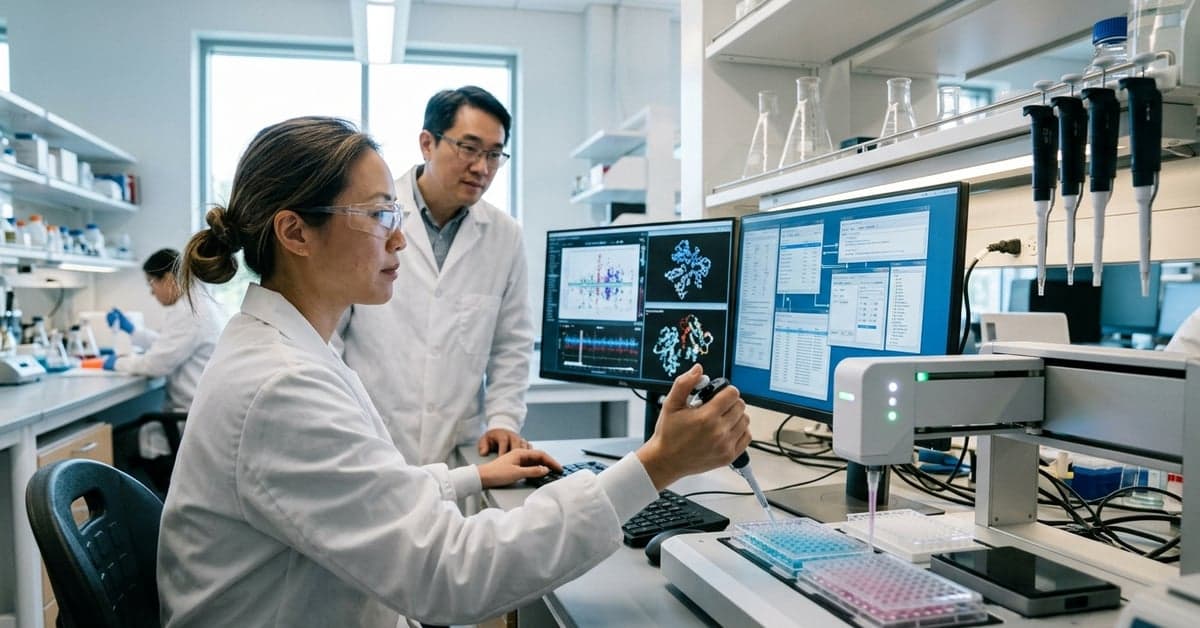
On June 30, 2026, Nature published a News & Views describing AI agents that generate and test AI biomedical hypotheses across a full discovery loop. The piece, by Olivier Elemento, argues that software is inching toward an end-to-end role in biomedical research, from idea to analysis.
What Nature reported on AI biomedical hypotheses
Nature’s summary says these agents collaborate to propose biomedical questions, select assays, and analyze outcomes, with AI present at every step of the discovery process. As the journal puts it, they enable a “laboratory discovery cycle with AI involved in every step,” which raises the ceiling on what a small team can attempt in a single project. The coverage appears on Nature’s machine learning page, where the News & Views situates this approach within mainstream computational biology.
The idea is simple in outline and hard in practice: turn research into a loop. Agents propose a testable claim, select an experiment, collect data, and update the claim. If a result looks promising, the loop tightens. If it fails, the system pivots fast. The promise is speed and discipline; the risk is automating a mistake.
The News & Views highlights momentum, not a solved problem. It signals that hypothesis generation is no longer the limit. The hard parts now include choosing safe, informative experiments and stitching results into a reliable record researchers can trust.
How hypothesis agents change the scientific workflow
Most lab software has supported people at fixed points: a model here, a plotter there. Hypothesis agents turn that into an integrated plan. They choose what to measure next, budget time on instruments, and flag when a result demands replication. That ties AI to physical constraints, not just to text or images.
Two ingredients matter for this to work at scale. First, the hardware side: laboratory automation that can run small, fast, and reliable protocols on demand. Second, the decision side: principled selection of the next experiment, which draws on methods such as Bayesian optimization and active learning. Put together, they form a feedback loop that narrows uncertainty with each batch.
When an agent selects the next study, it also inherits responsibility for record‑keeping. That is where audit trails and structured logs matter. Integrations with electronic lab notebooks can make each decision legible: why a particular dose, why that cell line, why that endpoint. Clarity is the difference between a reproducible path and a black box that no one will trust.
There is a cultural shift here as well. Teams will judge models not by leaderboard scores, but by how many informative cycles they complete without wasting samples or triggering avoidable errors. That is a stricter bar, and it is better aligned with real science.
Why autonomous science is shifting the bottleneck
Nature’s framing points to a new choke point: the bench. As hypothesis agents improve, the slowest piece becomes sample handling, assay setup, and turnaround times. Money and time concentrate there.
Data quality rises in importance too. Models can only iterate as fast as the inputs allow. Labs that adopt FAIR data practices—findable, accessible, interoperable, reusable—start with an edge. The principles, explained in FAIR data guidance, reduce friction between instruments, notebooks, and analysis code.
- Procurement shifts toward flexible, small‑batch automation that shortens the loop time between ideas and results.
- Governance expands to include agent decisions: pre‑registered criteria for when to repeat, abandon, or escalate an experiment.
- Validation budgets move earlier, with frequent low‑cost replications used to keep error from compounding across cycles.
This is also where safety lives. An agent that designs a clever plan but overlooks a contamination risk is a liability. Checklists and hard gates—what can never be authed without a human sign‑off—should be defined before the first cycle runs. When loops get fast, guardrails must get clear.
What to watch next in the AI discovery cycle
The News & Views sets expectations without hype: early success will be narrow, measurable, and local to a particular lab stack. That is fine. The more important questions are about transportability and trust. Can a loop that worked in one facility, with one set of instruments, work in another without relearning everything?
Expect stronger reporting standards. Teams will need to share not just code and data, but the decision policy that drove each step. Reproducibility, discussed in depth in reproducibility guidance, depends on that visibility. Journals can help by asking for machine‑readable logs alongside standard methods sections.
The market signal is clear. Groups that connect their instruments, clean their data, and adopt interpretable agent policies will run more cycles per quarter. Those cycles will produce better priors, fewer dead ends, and faster handoffs to clinical or industrial partners. The story Nature highlighted is less about new math than about closing the loop. That is why AI biomedical hypotheses matter now: they turn research into an executable plan.
The next wave of results will show whether these loops pay off outside of demos. Labs that build for the bench first—latency, logging, and safety—will move faster than labs chasing another model milestone. If that holds, the winners in this phase will be the teams that treat AI biomedical hypotheses as the start of a disciplined cycle, not just a clever prompt. For more on this, see reuters.com and bloomberg.com and nytimes.com.