
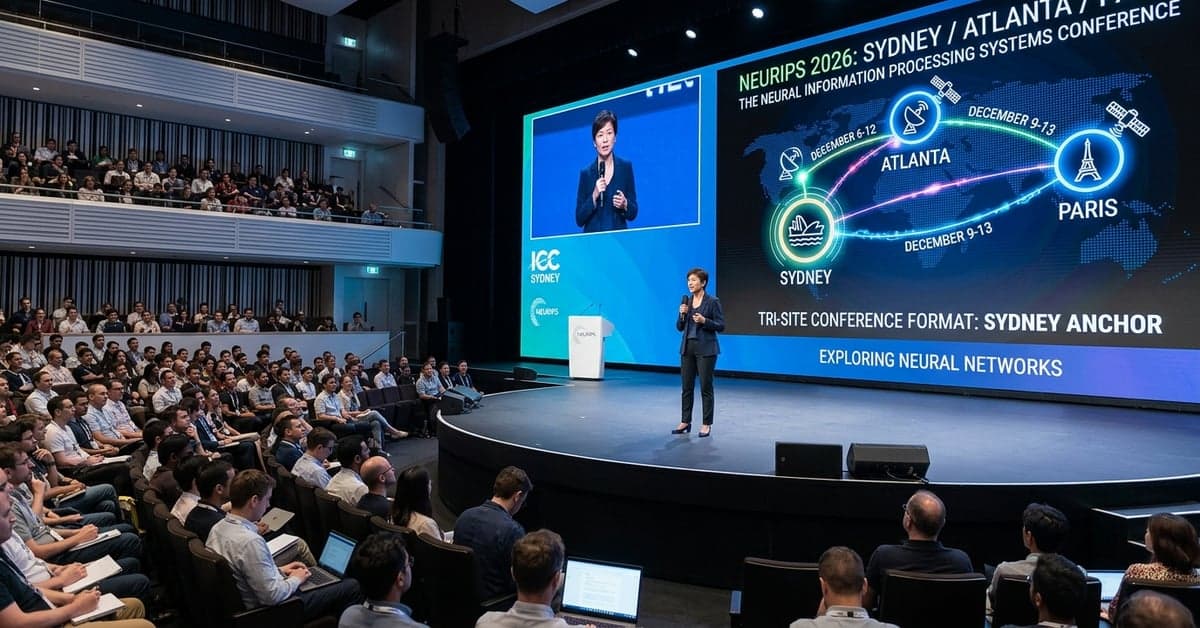
December 6-12, 2026 in Sydney. That’s the main stage for the Fortieth Annual Conference on Neural Information Processing Systems, with satellite gatherings in Atlanta, Georgia, and Paris, France from December 9-13, 2026, according to NeurIPS. The setup is clear: one anchor city, two regional hubs, one shared program.
How NeurIPS 2026 Sydney anchors a tri-site plan
With NeurIPS 2026 Sydney as the anchor, the conference is leaning into a three-location design. The official site lists Sydney as “Main” and labels Atlanta and Paris as “Satellites,” all tied to the same week (NeurIPS). That structure answers a long-running tension: global access versus in-person energy. The main site concentrates the densest hallway track. The hubs lower flight times and simplify visas for many, while still syncing with the core program.
Organizers aren’t just booking rooms and leaving it there. The 2026 page groups a wide set of calls under one roof: papers, evaluations and datasets (with their own FAQs and reviewing guidance), position papers, reproducibility, tutorials, competitions, workshops, affinity events, educational resources, and a “Creative AI” stream (NeurIPS). It also highlights an “AI Reviewing Experiment” alongside the main reviewing guidelines. That slate signals where the conversation is headed: not only models, but also measurement, reliability, and process.
What the three locations mean for attendees
Pick your base, then plan around time zones. Sydney runs December 6-12, 2026; the Atlanta and Paris hubs run December 9-13. If you aim for the anchor, expect the thickest concentration of authors and sponsors. If you choose a satellite, expect fewer 20-hour flights and a local crowd that still tracks the same agenda.
This format also touches travel logistics. Visa requirements vary by nationality, which can make a regional option more practical for many researchers and engineers. The Australian government’s own pages explain the visa categories and steps for visitors (Department of Home Affairs). For teams, the tri-site plan spreads risk: if only part of a group can travel far, others can still attend closer to home and keep meetings on the calendar.
Exhibitors get choices, too. The site lists a “2026 Exhibitors” entry and a portal, hinting that sponsors can plan where to invest and how to split presence (NeurIPS). Expect high-end hardware demos in Sydney, with targeted booths or meetups at hubs where hiring pipelines run strongest. That’s a budget conversation as much as a branding one.
Tracks, calls, and where the energy may flow
The 2026 menu of tracks is wider than a single Call for Papers. According to the official listings, NeurIPS is inviting:
- Paper submissions for the main track, with a public handbook and reviewing guidelines
- Evaluations and datasets, supported by a dedicated FAQ and review process
- Position papers and reproducibility reports
- Tutorials, competitions, and workshops with separate review guidance
- Affinity events and educational resources
- Creative AI contributions
That breadth matters because it redistributes attention. Evaluations and datasets shape what gets measured next year. Reproducibility sets a tone for claims that need to stand up on different hardware and code paths. Competitions pull in students and startups that don’t yet have a dozen accepted papers but do have a sharp idea and the code to back it up. In a tri-site year, those communities can meet where it’s feasible and still plug into the shared program.
The site also links to a “Sanctions” communication meant to address community concerns (NeurIPS). That tells you conference policy is part of the agenda alongside papers, and that organizers expect questions well before badges are printed.
Planning around NeurIPS 2026 locations and ICLR
Calendar context helps. The other top-tier deep learning meeting, ICLR, is booked for Rio de Janeiro from April 23-27, 2026, per ICLR. Two global fixtures, both in the Southern Hemisphere in the same year, will push travel teams to stagger budgets and prioritize which results land where. The April slot gives ICLR the early read on the year’s methods. December puts NeurIPS 2026 Sydney in position to collect late-breaking results and industry demos that hardened across the summer and fall cycles.
If you aim to present iterative work across both venues, the spacing between April and December is workable. If you prefer to cluster launches and recruiting, the three NeurIPS locations open a different play: keep senior staff in Sydney for dense meetings, and send hiring managers or product managers to the satellite where their target schools and partners already sit.
What to watch next before December
Deadlines and detailed schedules aren’t the headline yet; the site’s focus is on calls, organizers, and exhibitor planning (NeurIPS). Watch the announcements feed for session formats, hub-specific programming, and how Q&A flows between rooms. Those choices determine whether the satellites feel like mirrored theaters or like genuine local gatherings plugged into a shared backbone.
For attendees, the practical move now is to decide your base city and block calendars and budgets accordingly. For presenters, expect early guidance on recording, streaming, and poster logistics to clarify what must happen in the main venue and what can be done at a hub. For sponsors, get in early on the exhibitor portal and lock booth plans before flight prices climb.
The tri-site bet raises the stakes. If it works, the meeting keeps its scale without pricing out teams that can’t cross oceans every year. If it stumbles, the hallway track thins. Either way, the dates are set and the anchor is clear: NeurIPS 2026 Sydney will carry the week, with Atlanta and Paris bringing more of the community into the room. For more on this, see reuters.com and bloomberg.com and nytimes.com.