
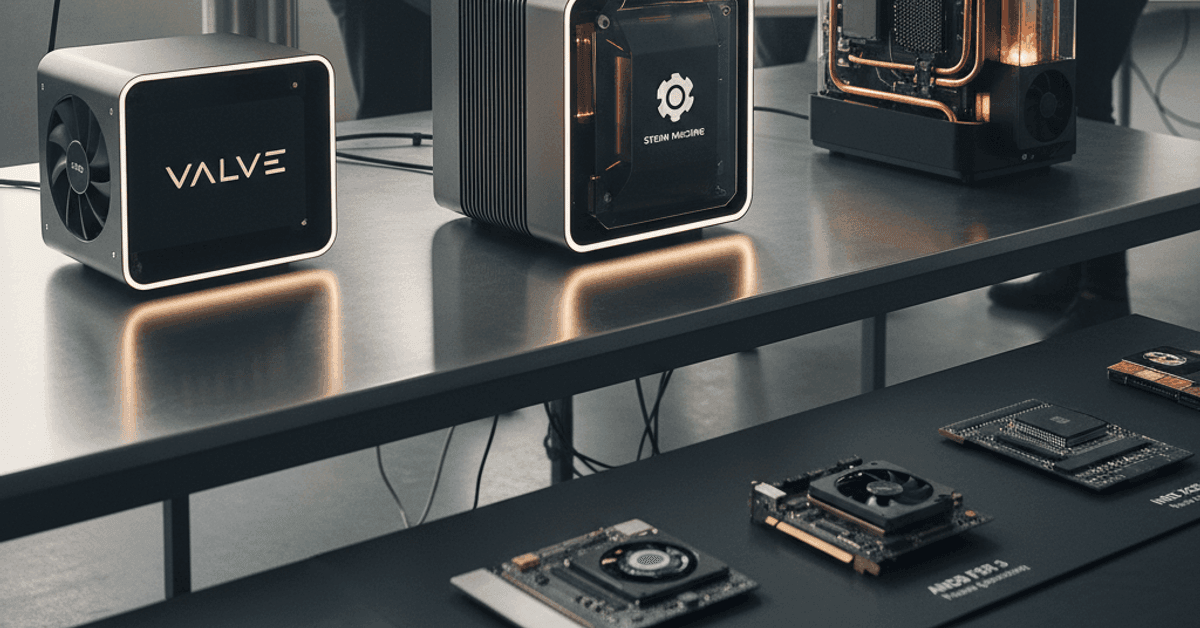
Valve signaled that its upcoming Steam Machine will be priced in line with the current PC market, and that shapes expectations for Steam Machine AI features central to modern gaming performance. The pricing guidance matters because machine learning upscalers, frame generation, and AI-assisted rendering now define how far mid-range hardware can stretch.
Steam Machine AI outlook
In an interview, Valve’s Pierre-Loup Griffais said the new device would not be subsidized and should sit near comparable DIY PC builds. He emphasized value at a given performance tier, rather than a loss-leading console strategy. Consequently, developers and buyers can plan around PC-like capabilities, including AI-enhanced rendering that has become standard across GPUs.
Griffais described pricing as fluid due to shifting component costs, while reiterating that the aim is a solid deal at a specific performance level. He also noted interest in a potential Pro variant, though the immediate focus remains a mid-range device. That stance aligns with Valve’s framing of the hardware as a PC first, even if it looks console-like under a TV. Therefore, expectations around ML-driven features should track the broader PC ecosystem rather than a fixed console spec sheet.
Valve’s approach follows its message that Steam Machine is not a console in brand, but it targets the living room like one. That hybrid identity places extra weight on AI rendering, because it can maintain high visual quality on 4K TVs without demanding ultra-high-end silicon. In other words, ML can bridge the gap between target resolution and practical performance.
Griffais captured the pricing stance simply:
“Our goal is for it to be a good deal at that level of performance.”
With that guidance, attention turns to the ML stack buyers should expect from a mid-tier, PC-aligned box.
DLSS 3.5 ray reconstruction explained
NVIDIA’s DLSS 3.5 uses trained models to reconstruct detail and denoise ray-traced scenes, which meaningfully boosts frame rates. Furthermore, ray reconstruction reduces the reliance on traditional denoisers, often improving clarity in reflections and global illumination. When paired with Frame Generation on supported GPUs, the effective smoothness can climb even when native rendering cost remains high. DLSS can turn 4K, path-traced showpieces into living-room-friendly experiences on mid-range hardware, depending on the final GPU tier chosen.
Because Steam Machine iterates within the PC stack, DLSS support would follow the GPU vendor choice, not a proprietary console pipeline. That flexibility benefits players who want scalable settings and familiar tools. Additionally, it helps developers, who can target a mature, well-documented SDK already used across the Steam catalog.
For technical readers, NVIDIA documents how DLSS leverages motion vectors, depth, and historical frames to feed a neural network that predicts a higher-resolution image. As a result, performance uplifts scale with motion, lighting complexity, and display resolution, especially on ray-traced workloads.
NVIDIA DLSS overview Steam Machine AI transforms operations.
AMD FSR 3 frame gen options
AMD’s FSR 3 focuses on broad compatibility and includes Frame Generation that interpolates frames using motion data. While FSR upscaling itself is not model-based like DLSS, the pipeline still targets the same goal: deliver higher perceived frame rates and stable image quality across a wide range of GPUs. FSR 3’s openness can help a mid-range configuration reach smoother output without vendor lock-in.
For living room play, FSR’s combination of temporal upscaling and generated frames can reduce the trade-off between fidelity and responsiveness. Consequently, developers can expose presets that meet both cinematic and competitive preferences on a single device class. Importantly, that flexibility matters if Valve ships multiple configurations over time.
AMD FidelityFX Super Resolution
Intel XeSS upscaling basics
Intel’s XeSS employs a trained model that runs on Intel XMX hardware, with a DP4a path for other vendors’ GPUs. XeSS can deliver model-driven upscaling beyond Intel’s own chips, reinforcing the cross-vendor nature of the modern PC stack. DP4a support helps broaden adoption across mid-range graphics cards, which fits Valve’s positioning around PC-aligned builds.
Image quality comparisons vary by title and driver maturity, but XeSS aims to compete closely with DLSS quality modes at similar performance levels. As developers continue to ship multi-upscaler support, players benefit from choice and tuning headroom. Consequently, an ML-aware Steam Machine would inherit that choice by design.
Intel XeSS overview
Pricing signals, performance tiers, and ML impact
Valve’s “in line with the current PC market” guidance suggests component-driven price bands instead of a single console price. Because ML upscalers can elevate perceived performance, the actual GPU class may not need to chase flagship tiers to satisfy 4K TVs. Moreover, the mid-range target aligns with DLSS, XeSS, and FSR delivering efficiency in both rasterized and ray-traced scenes.
From a developer perspective, fixed profiles and QA matrices get simpler when a device behaves like a known PC tier. Additionally, studios can ship identical upscaler integrations used on existing Steam builds. That reduces engineering risk while maintaining visual parity with desktop PCs.
Thermals and acoustics still matter in a living room chassis. However, ML-driven rendering can lower thermal load for a given quality target, because the GPU works on fewer native pixels. As a result, cooling solutions may stay quieter under cinematic presets, even while outputting crisp 4K images.
Not a console, but built for the couch
Valve frames Steam Machine as a PC, and that positioning keeps AI features at the center of the experience rather than an afterthought. The living room environment pushes 4K displays and HDR, where ML-assisted reconstruction shines. PC-like openness ensures that DLSS, FSR, and XeSS can coexist, giving players choice per title.
Analysts will watch for GPU pairings and memory bandwidth, which influence the gains ML upscalers can realize. Therefore, the final bill of materials will decide which AI path offers the best quality and latency in practice. Meanwhile, the potential of a future Pro model hints at a tiered roadmap that could scale AI features with higher-end silicon.
Engadget interview summary and Wired’s analysis both reinforce the PC-first narrative, which naturally folds in today’s ML rendering stack.
DLSS 3.5 ray reconstruction in practice
Ray reconstruction can sharpen path-traced reflections and lighting while reducing ghosting and noise. Additionally, it helps maintain detail in motion, which is critical on big screens. Consequently, when a Steam Machine targets 60 fps or higher, DLSS can stabilize results across heavy scenes without pushing thermals into noisy territory.
Developers often tune DLSS presets per title, balancing quality, performance, and latency. Therefore, players should expect similar toggles on a living room PC, including frame generation where supported. Importantly, competitive modes may disable frame generation to minimize input latency, while cinematic modes leverage it for smoother motion.
Conclusion: What to watch next
Valve’s pricing signal anchors expectations around a mid-range, PC-aligned box that thrives on AI-enhanced rendering. Because ML upscaling now underpins modern game performance, Steam Machine AI will likely define how well the device handles 4K TVs and ray-traced showcases. Moreover, the PC-first strategy ensures broad developer support and rapid feature updates as DLSS, FSR, and XeSS evolve.
Specs, thermals, and GPU vendor choice will determine the exact AI toolchain and its impact. Nevertheless, the message is clear: with PC pricing and PC DNA, the next Steam Machine is poised to lean on ML to deliver living-room performance without chasing ultra-premium hardware.