
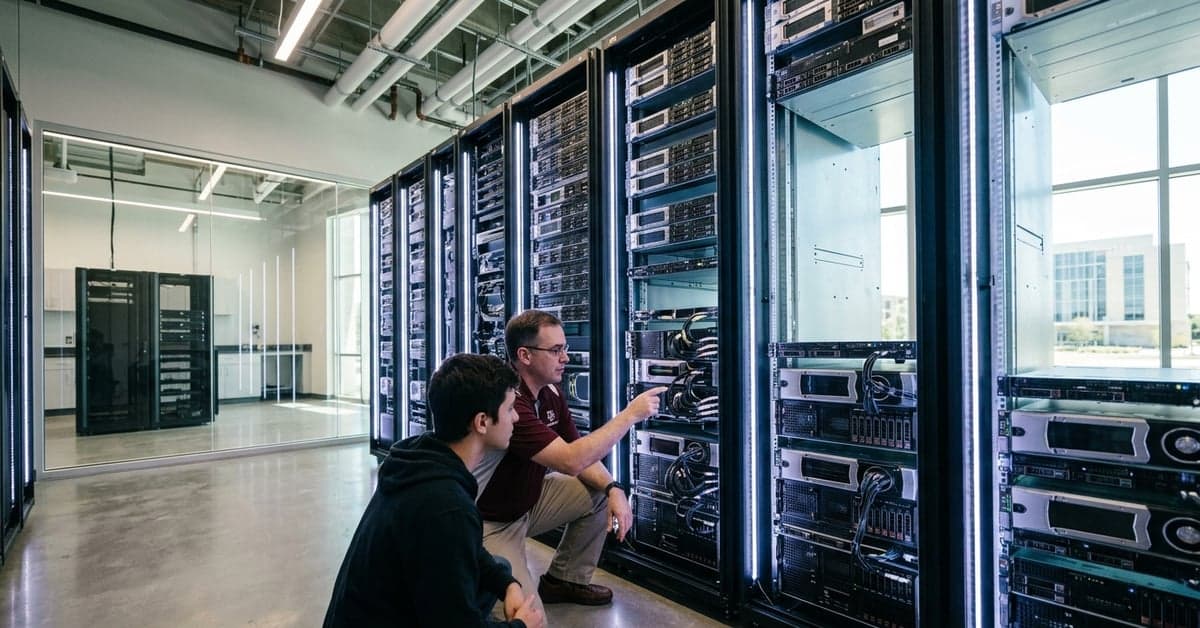
Texas A&M’s Electrical and Computer Engineering program now spotlights two big numbers on its homepage: a $45 million Texas A&M GPU cluster for AI/ML and a $250 million Semiconductor Institute. According to the department site, those pillars sit alongside active faculty hiring and a top-15 public ranking for its graduate program (Texas A&M Electrical & Computer Engineering). Read together, they look less like isolated upgrades and more like a full-stack plan to connect chip research with large-scale model development on campus.
A $45 million Texas A&M GPU cluster, in context
GPU clusters are the workhorses of modern AI training and inference. They pool accelerators so labs can fine-tune large models or run data-heavy simulations locally, rather than buying time in the cloud. The engineering school’s callout of a $45 million system signals scale; it implies multi-lab access and enough headroom to support projects beyond one marquee group. For readers outside HPC, this is the kind of on-prem setup used across national labs and major research universities to push parallel workloads at speed (U.S. Department of Energy on HPC; a primer on GPU acceleration from NVIDIA).
The value for an ECE department is leverage across subfields. Signal processing, embedded systems, robotics perception, and power systems all benefit from access to shared accelerators. Texas A&M’s site also promotes faculty work in machine learning and artificial intelligence, framing the cluster as common infrastructure for dozens of labs rather than a single flagship center (Texas A&M Electrical & Computer Engineering). That matters for grant strategy. When compute sits on campus, PIs can prototype faster, cut latency between ideas and experiments, and reserve cloud credits for spikes rather than every baseline run.
There’s a talent signal here too. Graduate students tend to notice whether they’ll train models on a waitlisted queue or on ample nodes. The Texas A&M GPU cluster suggests shorter backlogs and richer hands-on experience with distributed training, which hiring managers now treat as table stakes for applied AI roles.
How the AI cluster meets a $250M bet on chips
The second number on the department homepage sits on the other end of the stack: a $250 million Semiconductor Institute. The site frames it as a campus-wide investment. In the middle of a national push to expand domestic chip R&D and workforce capacity, those dollars align with a broader industrial trend led by the CHIPS and Science Act (NIST: CHIPS for America), even if Texas A&M’s page doesn’t tie the institute to a specific federal award.
Why pair the two? Because hardware-software co-design is where competitive advantage shows up now. If you teach students to design devices and also give them a sandbox to deploy and tune the models that run on those devices, you compress the loop between theory, fabrication-aware design, and AI performance. The Texas A&M GPU cluster provides the training ground for model developers; the semiconductor effort grounds that work in materials, packaging, and circuit constraints. For ECE, that’s a cohesive identity: chips to code, end to end.
This kind of coupling also suits sponsored research. Companies hungry for AI acceleration, power efficiency, or domain adaptation want two things at once: better hardware and models that exploit it. A program that can assemble a joint student team across both pieces lowers friction for industry partnerships and shortens time to results.
Why it matters for students, faculty, and partners
The department is scaling people as well as infrastructure. The homepage highlights faculty hiring and points readers to open positions, a signal that new labs and course coverage are coming online. Headcount today is sizable: Texas A&M lists 1,712 undergraduates and 771 graduate students in ECE, and it cites a #13 rank among public graduate programs (Texas A&M Electrical & Computer Engineering). Those numbers suggest there’s critical mass to keep the Texas A&M GPU cluster busy from day one—and to populate the semiconductor initiative with project teams.
For students, the bet changes two near-term realities. First, access. Large-model practice gets harder to fake in coursework; hands-on time on properly networked accelerators counts. Second, optionality. A&M’s emphasis across devices and data supports career paths into chip design, verification, embedded AI, systems engineering, and applied ML. That breadth shows up in recruiting, where labs that share compute and datasets often place grads into roles that bridge hardware and software.
For faculty, shared compute reduces proposal risk. Reviewers now look for credible plans to train and test models at scale. Being able to point to the Texas A&M GPU cluster—and to department-backed support staff—can help de-risk timelines. The same applies to multi-institution collaborations; a campus system can serve as anchor compute when partners don’t have equivalent on site.
Industry partners care about runway. Access to accelerators and a pipeline of students means faster prototyping, clearer KPIs, and a path to pilots. The semiconductor institute should widen the aperture further by connecting applied AI projects with packaging, reliability, and new materials research. That cross-talk tends to generate publishable results and transferable IP at the same time.
How to judge whether the strategy works
Big numbers draw attention. Proof will live in throughput and impact. Watch for signals that the Texas A&M GPU cluster is being used as a campus utility, not just a showpiece: shared scheduling across labs, published benchmarks, and project acknowledgments in papers. On the semiconductor side, look for joint seminars, co-advised theses, and cross-listed courses that blend device physics with ML systems.
External markers matter as well. An uptick in multi-year industry-sponsored projects suggests partners see the end-to-end value. So do competitive federal grants that cite both the compute stack and the chip institute. Over time, the best evidence will be student outcomes: placements into roles that demand fluency in both hardware constraints and model performance.
There will be trade-offs. Managing fair access to the Texas A&M GPU cluster while keeping queues short takes budgets, staffing, and hard choices. Balancing open science with sponsor needs around the semiconductor investment needs careful governance. Those are good problems to have, and they’re solveable with clear policy and transparency.
What to watch next in College Station
Texas A&M is positioning ECE to operate across the full stack at scale. The site already pitches AI/ML research, faculty hiring, and the two marquee investments in compute and chips. The next step is execution many readers will feel day to day: course projects that reserve accelerators when they need them, internships tied to the semiconductor institute, and capstone teams that ship results rather than just reports.
If that happens, the Texas A&M GPU cluster becomes more than a procurement line—it becomes a campus habit that changes what students build and what partners expect. The $250 million institute then turns into the upstream that feeds those builds with constraints and possibilities. That’s how an ECE program turns two big purchases into a durable advantage.
For a sense of how public investments are reshaping the environment these students will enter, the U.S. government’s CHIPS initiative outlines the workforce and R&D drivers in play (NIST). And for readers curious about the compute side, federal HPC resources explain why cluster architecture matters in practice (DOE on HPC), while GPU-acceleration explainers offer a quick mental model for why accelerators dominate training workloads (NVIDIA).